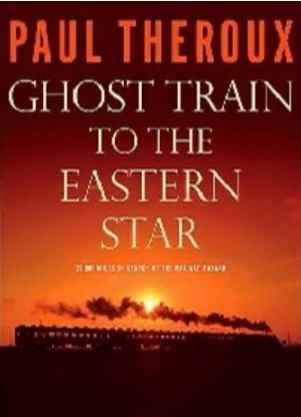
Ghost Train to the Eastern Star: On the Tracks of the Great Railway Bazaar is the most recent Paul Theroux book.
He retraces his rail journey from Europe through Asia of 30-years earlier.
Theroux has mellowed with age. Now in his mid-60s, he’s less disagreeable than ever before in this, another travel classic.
I’ve read all his travel books. He’s one of my favourite authors. Always entertaining and informative. This one is as good as any of the others. Read it.
Still, critics call Theroux: arrogant, dishonest, a narcissist, a misanthropist.
Certainly he’s envious of greater writers than himself, especially Nobel Prize in Literature winner V. S. Naipaul. Theroux thinks much about the great authors, obviously because he thinks himself just as skilled a wordsmith, unrecognized. Unawarded.
Theroux’s the son of a French-Canadian father and an Italian mother, I learned.
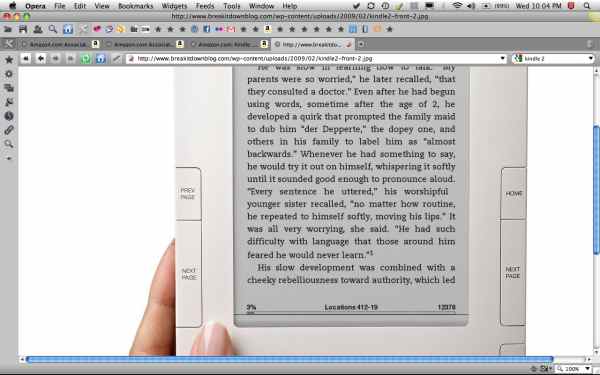
But those who still like to use their eyes to read … are quite charmed by the Kindle.
click image for details on Amazon
A respected review:
The good:
Slimmer and sleeker looking than the original Kindle; large library of tens of thousands of e-books, newspapers, magazines, and blogs via Amazon’s familiar online store; built-in free wireless “Whispernet” data network–no PC needed; built-in keyboard for notes and navigation; a faster processor speeds up the device; with 2GB of internal memory, it’s capable of storing 1,500 electronic books; font size is adjustable; improved battery life; displays image files and plays MP3 and AAC audio; compatible with Windows and Mac machines; new Text-to-Speech feature allows you to have text read aloud.
The bad:
No expansion slot for adding more memory or accessing files; files such as PDFs and Word documents aren’t natively supported, and need to be converted at 10 cents a pop by Amazon; no protective carrying case included; battery is sealed into the device and isn’t removable; hardware and content is still too expensive.
The bottom line:
While it’s still short of perfection–and has a price tag that’s too high–the Amazon Kindle 2 offers a range of improvements that makes it the best overall e-book reader we’ve seen to date.
What a shame that Obama arrived at this precise moment.
He’s committed to the bail-outs. Those will sink the ship, I expect. And not work.
How long before the majority of Americans come to realize the bailouts were a mistake? And Obama’s popularity drops through the floor?
Why should all Americans subsidize those who “who bought a house that cost more than they could afford, hoping for a spike in value so they could sell at a profit or take out a new loan based on an increased value.”
I follow 26 people now. And find it fairly useless.
I would need as many friends as I have on Facebook to make it interesting.
As a search engine, however, it’s interesting. For example, I could have searched for Academy Awards during the broadcast and seen in real time what random people were saying about the event.
As my default browser, I’m just about to switch from Opera to the beta version of Safari 4 on Mac.
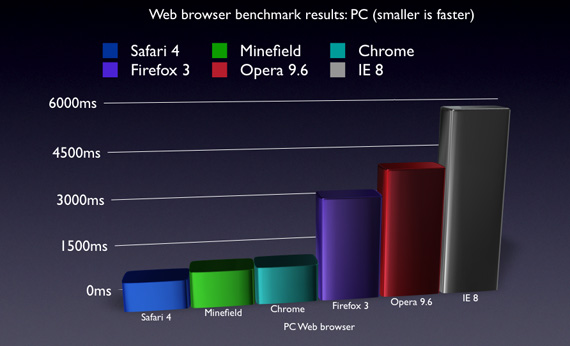
It’s fast. (smaller is faster)
The main thing this graph shows is that Internet Explorer is for idiots. It’s horribly slow.
Opera is good. But has some annoying features that cannot be modified.
In future, I will keep Firefox and Safari open at the same time, switching back and forth. Safari now offers full screen zoom like Firefox. That’s the main feature I need, aside from speed.
… It’s the best thing I’ve seen on how social media in general, and YouTube in particular, are profoundly changing the world. It’s almost an hour long but totally captivating. Anyone interested in Web 2.0 must watch this. …
It is terrific.
Michael Wesch will understand if you start watching it, then quit whenever you wish. Very few YouTube videos are watched from start to finish.
The best part is the first 20min IMHO.
Presentation at the Library of Congress, June 23rd 2008. This was tons of fun to present. I decided to forgo the PowerPoint and instead worked with students to prepare over 40 minutes of video for the 55 minute presentation.
An Anthropological Introduction to YouTube
by Michael Wesch
and the Digital Ethnography Working Group
Friendfeed is better and different than Facebook. But it’s not nearly so engaging.
Twitter seems a useless waste of time to almost everyone who tries it. Yet many experts feel that Twitter is the future. That it could supersede Facebook one day.
Why? Why? Why?
Twitter is cryptic and random. I cannot even respond to a message sent me on Twitter. Frustrating!
Here’s why:
What if you could peer into the thoughts of millions of people as they were thinking those thoughts or shortly thereafter? And what if all of these thoughts were immediately available in a database that could be mined easily to tell you what people both individually and in aggregate are thinking right nowabout any imaginable subject or event? Well, then you’d have a different kind of search engine altogether. A real-time search engine. A what’s-happening-right-now search engine.
In fact, the crude beginnings of this “now” search engine already exists. It is called Twitter, and it is a big reason why new investors poured another $35 million into the two-year-old startup on Friday. Twitter is not the only company trying to solve this problem. Facebook, FriendFeed, and even Google are trying to crack it, but Twitter has a decided advantage in that it is capturing the vast majority of the real-time thought stream on the Web (because more people enter their thoughts directly into Twitter’s database than any other, and are doing so at an increasing rate).
What makes Google and other search engines so valuable is that they capture people’s intent—what they are looking for, what they desire, what they want to learn about. But they don’t do a great job at capturing what people are doing or what they are thinking about. For thoughts and events that are happening right now, searching Twitter increasingly brings up better results than searching Google. …
… After testing out the NiMH rechargeable batteries on an LED flashlight, Gizmodo found that the Duracell batteries lasted far longer – ranging from about 5 to 6.5 hours in life compared to the 3.5 hours of Energizer. …
… The Duracell family of rechargeable batteries also come precharged out of the package, so that’s very convenient. They’ve also got USB ports for charging USB gadgets. …

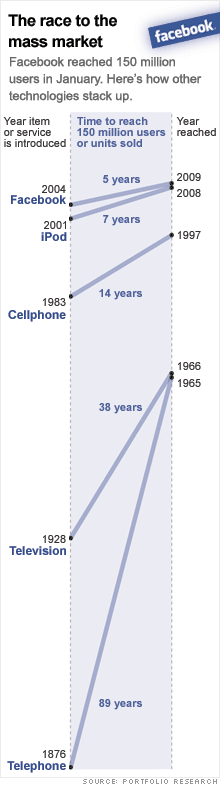 Facebook is confusing. And is pretty crappy, to be honest. But my friends number amongst the 175 million regular users. They like it.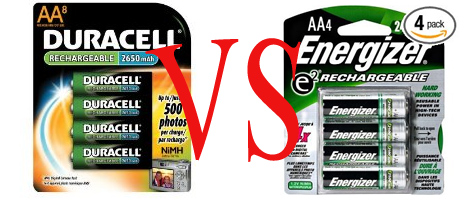

 Rick McCharles