
I arrived in the City of Joy. A wonderful day. Nothing was open. No vehicle moved. The beautiful new cable bridge, normally choked, deserted.
Nothing was doing — except cricket. Boys and men played everywhere, the space glorious.
They are mad for cricket here. You from Canada coming? You are seeing the CLASH India-Pakistan?
It is too dangerous for nuclear super-rivals to play on the subcontinent, so they play in Toronto. (Matches are planned soon in India. A disaster looms.)
You can quote me as a physical educator. If there is a more useless physical activity than baseball, it is cricket. I blame the British who inflicted this disease on all their colonies, except snowy Canada.
I strolled empty Calcutta for hours, clueless. Finally I saw the poster:
24 Hour National Strike against Globalization, Privitization, Unemployment, Indiscriminate Computerization, and Murderous Price Rise, etc.
In the Calcutta Telegraph the next day: Bengal Basks in Strike Glory. With blood on its hands, West Bengal stood … boastful of bringing life to a complete halt.
Bengal is a poor region with Marxist local governments. The Strike, protesting national government economic policies, was successful here while mostly ignored in the rest of the country. Everyone seemed pleased that 2 strike-breakers died in roadblock confrontations, and relieved that even more weren’t killed.
Next day Calcutta was back to normal; loud, polluted, ugly. One of the most densely populated cities on Earth.
The City of Joy is no joke. The poor migrate here when life in the floodplains becomes a death sentence.
There are few Westerners, mainly those in transit and a core of NGO volunteers. A vocal few defend the city, It has a soul. It’s the centre of the Arts.
 Sudder Street
I stayed at the Salvation Army in the backpacker ghetto of Sudder Street. Two blocks away is New Market, the biggest in the city. In the mountains of garbage behind was a scene from Hell; dogs, humans, black pigs, and crows, all scavenging. In Calcutta the pigs and crows are thriving, the dogs and humans might be close to death.
I was reminded of a dusty bus stop in Nepal where I watched huge vultures, wings spread for balance, battle dogs and pigs for a buffalo carcass.
 I’ve seen too many pitiful dogs; open-sored, limping 3-legged, squinting hopeful, but suspicious. Even one paraplegic, dragging useless hindquarters across the village meat market. I involuntarily compared these desperately poor Bengalis with pariah dogs. Pups and children appear quite healthy, then quickly deteriorate, a cumulative effect of disease, malnutrition, and bad water.
I’m painting the worst possible picture.
I visited the border of rural Bangladesh; green paddies, lush mango groves, fertile fields. There were no walking skeletons. Most often I’m impressed how happy are the poor, their simple lives. Some of the garbage dump architecture (Alex Frater) appears homely, and breezy. In Sri Lanka the beach shacks of the poor Tamils appealed more than the modern Sinhalese homes.
I didn’t visit the goonda-controlled slums, the bustees of Calcutta or Bombay. I’m reluctant to go with no greater purpose than picturesque poverty. (James Cameron)
I should make clear that the Indian peoples are bodily fastidious. While the streets are rank, teeth and gums are brushed, the body ritually scrubbed. Westerners are always struck by how much clothing is washed. The dhobi-wallahs, washers, are seen by every body of water, all day, every day, enthusiastically slapping the laundry clean on boulders.
Naipaul pointed out that the impoverished wash the most because they have so few clothes. The poorest women are conspicuous — they own just one sari and have no undergarments. Of course they wash and bathe at the same time.
It seems a contradiction that these ritually clean people are so unaware of the filth around them. I’m told that it is caste related. It is unclean even to notice shit underfoot.

Everyday I’m asked, You are liking India?
I always respond, Great! Wonderful people! But it is very dirty, polluted. (I can point in any direction.) Locals always look puzzled at such an unfounded concern.
Most far-travelled backpackers would concur that India is the most rewarding destination.
The Indian peoples are fascinating and fanatic. Friendship assails the stranger. You are besieged with Indian company, all hopeful new pen friends.
I was the lone Westerner in town. A jolly smiling chap introduced himself and his pretty wife. Next morning I had breakfast at their home in the Police Lines — he was the Commissioner. This lovely, traditional Bengali family had come to know a number of Westerners. His last posting was in Nadia, home of ISKCon, the International Society for Krishna Consciousness. Hare Krishna, to you.
I’ve been befriended by English teachers, political activists, free-lance journalists, priests, and a travelling vegetable oil sales rep.
A proud father pushed his 3 year old through a crowded bus so that the Sahib might admire his prodigy’s knowledge of world capitals and political leaders, with just a little prompting. Only in India.
A tiny woman approached me at a bus stand; Roshan, a Parsi (originally from Iran), the first lady lawyer in Karnataka state. Vivacious, articulate, impressive. She had traveled all of India, providing us with a wealth of advice — even the price of tiger prawns on Varkhala beach! I assumed Roshan was that rarity, a single, academic career woman. Actually she had 9 children in 10 years, the youngest 14 and all still in school.
I was reading the autobiography of another Indian barrister, one M.K. Gandhi. Roshan’s life was even more exceptional.
Actually it’s a problem to meet the women of India. Few are forward enough, and speak English well enough, to engage.
I did meet an Islamic dentistry student studying at an Arab-financed university. She was horrified at what I was doing. Roaming India was her worst nightmare.
I travelled first class compartment with a lady journalist, a BBC correspondent from Myanmar. We were both en route to see the Dalai Lama. When I saw her next she had shaved her head and become a nun. (Not on my account, I’m sure.)
Bodhgaya, the most important pilgrimage in Buddhism. This is where Prince Siddhartha meditated beneath a tree until he achieved enlightenment. The moment of all awareness is depicted seated, with the right hand touching the ground, “calling the Earth to witness”.
Bodhgaya is a tiny enclave in the middle of Bihar state, India’s poorest. Dacoits (bandits) still loot pilgrim buses with impunity. These dusty Gangetic plains are where the historic Siddhartha was born, taught, and died (from eating poisonous mushrooms).
Around the ancient Bo tree temple, Buddhists from every sect have built. You can contrast the Thai, Japanese, and Korean monasteries. I stayed in a makeshift dungeon dormitory in the Burmese monastery where I had a fine reunion with backpackers I had met in Tibet.
 The Dalai Lama did not disappoint. Larger than life, energetic, enthusiastic. He charmed the audience. A one-man-show.
He was very humble. In my knowledge and teaching of the Buddha, I might stand slightly taller than the pygmies.
He spoke in Tibetan. We listened to simultaneous translation on FM radio. Of his teachings I have little recollection as most were incomprehensible.
In fact, few of the thousands assembled each day under the huge bamboo supported tents had much idea what he was talking about. Certainly not the simple Tibetans. Perhaps the discourse was intelligible to the book-Buddhists, Westerners who have read every text on the subject.
No one complained. Like me they were happy to be present, listening to his laugh, his mellifluous voice. I read, wrote, and napped. It was tranquil. Even tranquilizing.
One of my few notes: Think of all sentient beings as your Mother.” Christians are only concerned for souls of man while Buddhists revere all living creatures.
His Holiness referred to the friends from the West asdepressed, self-obsessed. He advised we renounce acquisition, heaping-up. No clinging or despising.
Another note: Relinquish self-cherishing and self-grasping. That translation became a bit of run-on-fun.
We spent our evenings at the Bo tree, the most marvellous of all the Buddhist festivals I’ve seen. Thousands circumambulated the temple, smoky and fragrant, lit by tens of thousands of candles. Hundreds practiced the impressive prostration meditation. The murmur of mantras merged with the clamour of candle salesmen, mostly kids reaching through the fence.
The Dalai Lama called for a Prayer Night and a Peace March for the victims of the Iraq bombings. The mischievous ones will somehow escape. Only the powerless will suffer. He was diplomatic in his criticism of the U.S. and England. But he was the only diplomat in town. I felt badly for our American friend Michelle. Perhaps this is why so few Americans backpack.
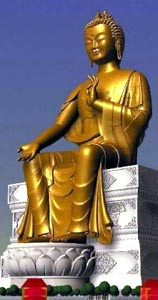 The best story in Bodhgaya is the Maitreya Project, anotherWorld’s Biggest Buddha. This one will be 152 metres high, seated! (The statue of Liberty is 46 metres.) A high-tech Buddha; elevators, assembly halls, telecommunication centre. Earthquake-proof, it must last 1000 years.
Undoubtedly it will be built. There is a lot of money in Buddhism these days. Perhaps Richard Gere, or the high lama Steven Segal, will lead the mega-project fund-raising.
The GREAT IRONY is that the Buddha specifically forbade his followers from making any image. Buddhism is not centred on any Gods but is a a personal philosophy, a code of morality:
1) Right understanding (uninhibited by superstition or delusion)
2) Right thought
3) Right speech
4) Right action
5) Right mode of living (do no harm to living creatures)
6) Right endeavour (self-discipline)
7) Right mindfulness (alert, contemplative)
8) Right concentration
Right.
Your pandit-wanna-be has gone South.
Namaste!
 Rick McCharles