
I couldn’t stop grinning. The terrain strange, wild, beautiful. Giant granite boulders heaped inexplicably among green plantations and meandering rivers.
This is Hampi — lost City of Victory, one of 3 astonishing abandoned cities in India.

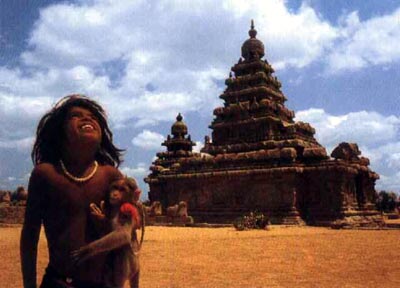
Hampi is land of the Monkey Kingdom in The Ramayana, an epic of greater than Biblical importance to Hindus.
It’s that old plot; boy (Rama) marries girl (Sita), demon kidnaps girl, boy and monkey (Hanuman) rescue girl, boy denounces girl as soiled goods, girl swears to have kept her virtue, boy and girl reunited in Heaven.
In Hampi, Hanuman is the most cherished God. Monkeys are sacred, a Holy Terror, actually. There’smonkey menace.
These sneaks loot kitchens, snatch daypacks from tourists, steal candy from children. In the cool Hill Station of Kodaicanal, monkeys violate the Hostel dorms every morning. They’ve learned how to open backpacks.
One Hampi monkey I saw swiped a hand mirror — he paused every once in a while to admire himself.
Locals despair of monkeys, but I love them. Fighting, playing, mounting. So human. And such pleasing posture.
The Hampi ruins are great. But my best fun was scrambling the boulders. I trooped after the monkeys at dusk when they retire to the highest hill, actually the highest heap of boulders. In many ways we have devolved. The most inept baby monkey is more agile than a skilled gymnast. Even after several attempts I failed to summit that hill.
I guess it wanted a bolder boulderer.

Though I spent New Years in Hampi, it was a bit of a let-down. I wished I was there.
A friend wrote to ask if I was getting anaesthetizedto these sights, something he had experienced on his long trip to Europe. Yes. The euphoria seemed to wear off after about 4 months. I still love to travel. But I’m no longer giddy.
I did enjoy Pongol (Thanksgiving), though. We ate sweet rice pudding. Farmers washed and then tarted-up the Holy Cows in day-Glo polka dots. At the Maharaja’s palace in Mysore, confused cattle were made to jump over sacred fires. Other cities conduct incompetent versions of The Running of the Bulls. I don’t recall how many casualties. Newspapers love to cite the death counts, but I’ve stopped jotting down the figures.
In South India there are no unhappy travellers — at least not during the temperate winter months.
Most colourful are the hordes (men, boys, young daughters) dressed entirely in black, on pilgrimage to a mountain temple in Kerala. There dwells the peevish child God, Lord Ayappan, an incarnation of Vishnu.
Twenty years ago Ayappan was a minor deity visited only by a hardy handful willing to walk 6 miles barefoot up his mountain.
Today millions take a vow to leave home for 41 days, sleep on bare floors, abstain from sex, meat, and eggs. They are devotees of Hanuman too, and make pilgrimage to his special shrines like Hampi.
No one knows why Ayappan suddenly became so popular. Another mystery of Hinduism.
Roshan, a lady lawyer from Karnataka, explained that Ayappan does not suffer women of menstruating age. One pregnant woman (not mensturating) thought to accompany her husband. The boy God was not amused. A resthouse roof collapsed killing her and spouse.
It’s wisdom as old as India that menstruating women are unclean. Children learn the laws of pollution on their mother’s knee. Many temples prohibit women in their monthly flow. This, like untouchability, like apartheid, is institutionalized inequality.
Caste discrimination is slowly disappearing. But Roshan told that affluent Indian homes include a room used exclusively by women at that time of the month. It is yet quite common.)
It would seem the Ayappan pilgrimage is fraught with risk. Newspapers daily report the number of pilgrims killed in road accidents, mainly pilgrim bus crashes.
Let me climb way out on another limb to declare — South Indian drivers are the most reckless in the world.
Skilled as knife throwers (James Cameroun), they race madly to no purpose. Even the never squeamish Lonely Planet guide advises, take the train … or walk!
The biggest and loudest vehicle has right of way. It was only a few years ago that I finally realized that almost no one wears glasses. No vision test is required. Many are driving blind, relying on the protection of dashboard Gods & movie stars.
The government puts up speed breakers (bumps) and erects barricades. But they serve mainly to infuriate. Drivers make up for lost time.
One of my biggest frustrations here are taxis. I envision a special circle of Hell where hacks cruise calling out only to each other, Taxi? Tuk-tuk? Where you go?, in an ever thickening haze of exhaust.
Oh, NO!, Master. 50 DOLLAR, no 50 rupee!
I’ve counselled many, enthusiastically, to seek honest employment.
I travelled with Robert, an Austrian wurstmeister, now living in South Africa. He inspired — kind and patient with hacks, touts, and beggars.
For the tourist, beggars are a disturbing, sometimes heart-rending dilemma. Some travellers follow the lead of locals who can distinguish between professional beggars and the truly impoverished of the neighbourhood.
Others, the majority, myself included, give nothing to anyone who asks on the street. This is the safer, simpler strategy. You don’t risk luring more into the trade.
I can see no upside to beggary.
What should be a short-term, last-ditch contingency — is usually not.
I’ve counselled many, enthusiastically, to seek honest employment.

Begging is sanctified by Hinduism, Buddhism, Islam, and alms for the poor Christianity. Millions sit out in the sun all day in postures of supplication, as pitifully as possible.
Historically, Buddhist monasteries provided food and sanctuary. No more. Today the destitute squat beside the river, cook under the bridge, sleep wrapped like a corpse beside the highway. Children are left to play all day at the Railway station.
Mother Teressa has been questioned, but never her mission. What other organizations care for thepoorest of the poor, no questions asked, no demands made?
In my experience, all children are willing to hound, even if they get something from only 1 in 5000 tourists. School pen? Bon-bon? One rupee?
A beggar boy (Lazarus?) accompanied me patiently for 25 minutes, chanting his mantra in Bengali, until finally driven off by locals threatening to beat him.
Street urchins are the most wrenching. (Kids just won’t listen to reason.) Beggars are rarely threatening, though one time I was swarmed by a group of boys. I moved out into rush hour traffic forsafety. I assumed they were pick-pockets, but a professor who happened by assured me they were just curious cricket lads.
The congenitally malformed are mostly fated to beg. Tim Ward was entreated by an armless boy restrained on a leash by a blind woman beggar. He cut the leash.
I heard the story of a tourist who could not get an air ticket to Dharmsala where the Dalai Lama was to be speaking. Eventually he was offered a seat on a charter. Arriving for the flight he found he was the only non-leper. A colony had booked the plane. It was the start of high season.
Tourist beggars are those who have somehow learned a little English. On Sudder Street in Calcutta there is a Feeding of the Poor every Sunday morning. The beggars, mostly women with babies, who work that pavement the rest of the week, do not appear. Charity is beneath them.
Indian beggars are the most inventive. Normal, skinny, flexible! boys suddenly appear with weirdly twisted or splayed limbs. Little girls learn to roll back their eyes, then put something in to make them green and cloudy.
I don’t blame the beggars. There but for the grace of Shiva, go I. Parasites will appear wherever the misled offer something for nothing. The result? Degraded self-esteem, self-pity, a welfare mentality.
Gandhi said, If your heart goes out to a beggar, offer him work not alms.
As for me, I try to steel myself to look each in the eye, smile, shake my head, no. I’ve heard that beggars, like all salespeople, don’t mind being refused (it’s a numbers game) but they resent being ignored.
Everyone agrees that someone should be feeding, housing, and providing medical attention. Most travellers feel they have not given, nor volunteered enough. There is no shortage of reputable charities.
Yet these alternatives do not seem to be attractive enough to pull beggars off the street. It’s economics. A subsistence salary in Madras is $120 / month though the average is only $60/month. A beggar needs only collect $2 / day to match that. Numbers would indicate that begging is one of the more profitable street jobs.
The most successful beggars I’ve come across are the adorable Chicklet girls in Mexico. They move restaurant-to-restaurant offering a tiny box of 2 Chicklets for whatever the tourist chooses to pay. I was told they earn more than police officers there. Why go to school?
I feel more compassion for the non-begging poor. More respect for the man I saw licking clean the used banana-leaf plates out of the trash than for the cripple I surprised enjoying a smoke and chai with the boys at the tea shop.
Indian peoples are very industrious. Most are too proud to beg. You will never find a Sikh beggar — it’s a tenet of their faith to care for their own.
When the Dalai Lama gave a bag of food to each pilgrim, I offered mine to a severely handicapped woman who sold crafts on the curb. She was one of the few who didn’t cry out to foreigners every time they passed. I was careful to offer it when no one else was looking; she careful to hide it away — so as not to get robbed when I turned the corner.
There is no end of do-good charity gone wrong.
James Cameroun made a documentary on the plight of indentured farmers. Dowry debt impoverishes millions. He chose a typical family enslaved to blood-sucking moneylenders. No chance to ever pay back the principle.
The filming complete, the producers paid off the loan then rewarded the incredulous peasant with 100 Pounds Sterling. He immediately set-up shop — as a moneylender.
I travelled with Carole from Spain. Last year she fulfilled a 30 year old promise to return to India as a volunteer. She chose an orphanage out of the Madras phonebook.
Carole is in construction. She renovated, cleaned, painted the buildings & planned an addition — a medical ward.
At home she raised funds and corresponded to be sure work was progressing as she had directed.
Arriving back this year, all of her donated money had gone missing. The children eating plain rice 3 times / day.
She was heartsick but didn’t blow the whistle for fear of having the orphanage closed, the kids turned-out.
In the meantime she was struggling over what to do about another orphanage; a European manager, reportedly, a child molester.
So many problems.
What’s to be done?
Where to start?
I wish Gandhi were here. In England he said, India has problems that would baffle any statesman. But they do not baffle me.
The best investment, I think, is Basic Education of women. Not Tagore, but simple nutrition, hygiene, family planning.
I read a book twice; “May You Be The Mother Of A Hundred Sons”, by Elizabeth Bumiller.
Women work hard and suffer much. Food, water, animal feed, care of the children. They get no rest.
Heavy manual labour too. Convict work; breaking river boulders to stone, stone to gravel, sifting sand, carrying loads up to the road. This is done by women who are paid half a man’s wage.
Despite all, India is progressing. By some accounts, 200 million are middle class. Some are optimistic about the future.
I dropped-in to SEWA (Self-Employed Women’s Association), a success story since 1972.
This trip I’ve been happier, more patient, by taking an educator’s outlook. (Though teaching India is like enlightening a beach, one grain of sand at a time.)
I aspire to be a good role model.
But this country is distressing. It is said thatwhatever weaknesses you have, India will find them.
Too often I’ve lapsed as did Zen Buddhist Peter Matthieson. In his revered book The Snow Leopardhe recounts how a Tibetan dog chased him up on to a roof. He urinated on the beast.
He lamented, that aching gap between what I know and what I am.
PS
A teacher told me that the government has recently decided to fund free education for girls for 2 years longer than for boys. Reverse discrimination? Certainly. But I took this as excellent news.
PPS – Email from Ray Heiderich
I enjoy your accounts of your trip. Interesting stuff. Could use. Some more. Two word. Sentences, though.
PPPS
Back in Canada I got a letter from Carole in Spain. The European paedophile orphanage manager was ejected from India.
PPPPS
Peter Long wrote to note out that Europe is far, far bigger, geographically, than India.
Oops, I sit corrected.
 Rick McCharles
Pingback: Scottish racist – RickMcCharles.com