
Paul Thereaux said of China, I rarely saw an example of man’s insignificance against the greater forces of nature.
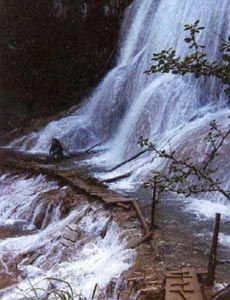 Only in China would you find a huge gorgeous waterfall criss-crossed with rickety wooden walkways, some washed away, others about to go. These walkways do provide access for Buddhist monks practicing waterfall meditation, contemplating in caves or standing in freezing spray. And they do provide me a magic moment. Sitting warming in the morning sun directly above a waterfall is a strange, wonderful experience.
Only in China would you find a huge gorgeous waterfall criss-crossed with rickety wooden walkways, some washed away, others about to go. These walkways do provide access for Buddhist monks practicing waterfall meditation, contemplating in caves or standing in freezing spray. And they do provide me a magic moment. Sitting warming in the morning sun directly above a waterfall is a strange, wonderful experience.I seek out these magic moments, choosing exotic and unique places to visit. When travelling, the pursuit of magic is my full-time job.
Magic can happen at home in the real world, of course. I remember writing a respected friend about Craik, Saskatchewan on a cold, windy October night. I saw a field ablaze with giant bonfires.
Fantastic.
I wandered between the dozens of fires. Beautiful. The fire burned so clean. Canary yellow! I never saw such a fire colour. The heat thrown was unbelievable.
The farmer was lighting misshapen haystacks from a truck with a portable acetylene torch.
Burning’ flax straw. Damned stuff won’t rot, he told me with rural verbal economy.
He was the performance artist; me the astounded city slicker. He was understated; me hyperbolic.
This morning, though, I am wondering if this backpacking thing is a self-indulgent conceit. It’s great, but am I being irresponsible, not focusing on more weighty life matters? Running away?
Yet I thrive on the backpacking trail. I see others distressed, wearing down. But I never seem to tire. The road is bliss though, admittedly, ignorant bliss. All this breathing in. Living in the moment. After all, both Hinduism and Buddhism teach that real life is but an illusion, anyway.
Like everyone else, I loved Songpan. It’s a bustling little town in the foothills of the Tibetan plateau. Yaks, farmers, and Tibetan cattle herders clop down the main street. Peddlers hawk exotic mushrooms and animal pelts, some with the blood still dripping. Officials parade self-important in cheap uniforms. They butcher animals right on the road in the dirt and the flies.
Some of the ethnic minorities still wear traditional costumes of fur and bright cloth. Tourists are charmed by modern clothing; local men are ruddy cheeked Tibetans dressed like Chicago gangsters; local women wear fancy pant suits. Informal wear is dress slacks and, inexplicably, a sweater vest. Older men stick to the conservative Mao jacket and cap.
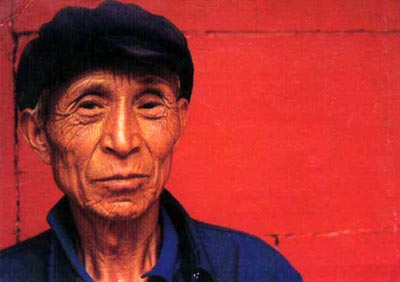
After all the dull brick and concrete of post-Communist China, Songpan is real. Wood and stone. Everything ihand-made. The main street was being reconstructed with a beautiful carved wooden facade, anticipating a coming tourist boom.
It’s hard to believe that I’m in China. At first glance this could be Alberta, pristine valleys and forests.
Songpan has long been a jumping off point for Chinese tour groups but it is only in the last 8 years that it has become a must for backpackers. They come for the Tibetan horse trek.
We spent 4 days on stunted horses. This was a first for me — travel on horseback, spending time with horse people. Our Muslim guides were the highlight.
The guides speak a dialect of Mandarin, but with the horses they use a completely different language, perhaps a former tongue. They are firm but patient. It’s true that horses are just like children, always testing the limits of how far they can go. We loved that the horses were allowed to graze free during the night, though it usually took 2 hours or more to collect them in the morning. We were surprised that they don’t name horses here, referring to them only by their colour.
The guides are great wilderness cooks; baking, making noodles, adding greens and wild mushrooms from the forest.
They are happy, laughing, hooting & singing all day long. They can drink Maotai all night and suffer no hangover. Dennis (a young German who spent the trip trying to smoke the local ganja, used here only as pig fodder) agreed that these horse guides have a superior quality of life than our own back home.
We later had dinner with the family of our 20 year old guide who was a little embarrassed about being poor. Ten of us sat comfortably about the wood stove, source of heat and food for all. We gorged on steamed buns stuffed with spicy meat and vegetables or potatoes. The house was soot-blackened, impossibly tiny, and very homey. Everyone participated equally in the lively family conversation. Moma still spits on the earth floor but the rest of the family has been educated not to spit, at least not when foreigners are around.
The horse trek is a tourist gig but still 2 or our party of 6 fell off their horses, and one of the guides got hung-up in a tree. The guides laughed about that one for days. The trail is really rugged with passes over 3800 metres.
There is no pollution over the Tibetan plateau. The air is clean. There were birds in number, animals in the wild. In China!
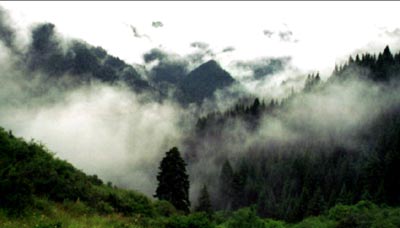
foothills of Tibet near Songpan
We were moved when we saw a farm woman carrying a huge Yak yoke. Like Christ carrying his cross.
All this breathing in.
On our return to Songpan town, I noticed smoke over the main street. Walking closer I could see flames licking the roof tops. Fire! Panic. The street was jammed. Shopkeepers desperately tried to carry goods to safety. Passers-by like myself tried to help, but in the chaos there were too many people, too much clutter.
A motorcycle cop arrived with 2 hoses, but it took at least an hour before any river water was pumped. The Chinese-made hose couplings would not stay sealed.
Residents fled carrying valuables, chasing pot-bellied pigs out on to the street. Chinese good luck firecrackers sounded in huge bursts. Explosions like bombs. Fuel tanks?
Women and girls sobbed in desperation. Men shouted and acted in brave but irrational ways. There was no organization, no leadership. Not even when the fire truck arrived, or when the army arrived.
Would the whole town burn?
I ran back to the guesthouse but it had already been locked, everyone turned out. Back at the terrible blaze the best way I could help was to stay out of the way. Others threw roof tiles at the advancing fire, or splashed mud and ditch water on their homes.
The failing sun cast a surreal eerie light. Thick smoke. These tears.
 Rick McCharles