
I find myself in Xi’an, the world’s largest and richest city — in the 8th century. Coming here I’ve broken at least 3 backpacker laws:
- I’m visiting a TOURIST ATTRACTION (Terracotta Warriors)
- I’m BACKTRACKING (2000 km!)
- I’m FLYING (to Tibet)
In my attempt to get to Tibet by bus I had gotten as far as Dunhuang in the Gobi desert and I was feeling invincible. It was tempting to fill my daypack with dry noodle soup, dehydrate, and climb on anunofficial bus. This is a buck-passing nation where special requests are invariably turned down, but where blatant trespassing is seldom challenged.
But the odds were stacked against me. Not manyillegals are making it through to Lhasa this year.
For another thing, I was sick. After urging other travellers to eat everything, and bragging that no one gets sick in China, I was sick for a week. Actually I was functionally healthy — I could travel and sightsee, but for days I was eating mainly yogurt, rice, eggs & coconut juice.
I had forgotten that China is a Galapagos Island for germs. One billion plus people and comparatively little travel in and out.
Actually traveller’s diarrhoea is not common here. This is a most sanitary and civilized country with boiled hot water endlessly available in huge thermos bottles.
The main worry is chronic bronchitis. Public spitting, coughing, chain-smoking, pollution, and overcrowded conditions all contribute to world record levels of respiratory infection. Public nose-playing and nasal evacuations don’t help. In the morning it sounds like an emphysema ward.
PREVENTION in China is to CLOSE the windows! Almost every traveller is stricken.
I travelled part of the Silk Road, the ancient highway along which camel caravans carried goods into and out of China.
In Dunhuang are the famed Magao Caves, featuring the most impressive & best-preserved Buddhist cave art in China & by far my favourite artworks on a yearlong tour. Dating from about 300 BC, these are works of itinerant monks travelling the Silk Road, spreading the message of Buddha out of India.
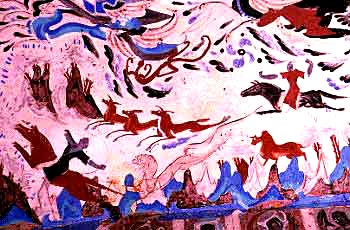
cave painting
Dunhuang is a desert oasis; cultivated fields with mountainous rolling sand dunes forming the backdrop. This was my first chance to scramble up really HUGE dunes. I went at sunset. Climbing dunes is unbelievably hard work. Bouts of 10 or 20 deceptively backsliding steps. The ridge seemed unreachable. Suddenly I stepped over the top — almost falling down the other side.
Under the star-studded desert sky I assumed that I would have the dunes to myself. But an owl kept doing fly-bys, checking out the intruder. I think he was looking for nocturnal lizards. Bats, as well, flitted by, awaiting insects blown up the side of the dune.
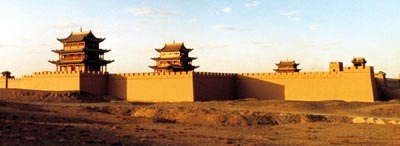
Next day I stood on the head of the dragon, the western terminus of the Great Wall of China which snakes 5000 km from the tail at the east coast. Used more as an elevated highway for moving men and equipment across mountainous terrain, I can understand why the Chinese didn’t want claim to the wastelands beyond.
The Jiayuguan Fort (& the Great Wall here) have been rebuilt for tourists & both are impressive.
We shot crossbows from the Fort wall into dummy horse & riders.
When I failed to find illegal transport to Tibet, I backtracked to Lanzhao. There I walked the appropriately named Yellow River, also aptly calledChina’s Sorrow for the millions it has drowned. Chiang Kaishek breached the banks deliberately in 1938 to slow Japanese invaders for a week or two. Over 1 million perished in that flood.
We had been forewarned that Lanzhao was an unattraction; a massive urban construction site best skirted. But we loved this young, booming, liberal, alive city on the edge of nowhere. It is the first place in China that I might call hip.
In a country suffering from a stupefying lack of diversity, Lanzhao looks to be different. There are weird, cool boutiques and a night street life that is FUN. Nowhere else have I felt the revolution of rising expectations as strongly. It is great that there are no foreigners here. No tourism. They are doing it on their own.
Modernization is moving from East (Beijing, Shanghai, Hong Kong) to West.
I speculate that INNOVATION may come out of the West. For example, the pioneering agricultural reforms started in the WILD West in Sichuan. Called the Responsibility System, the government doled out parcels of land to individual farmers on condition that a percentage of the crops be sold back to the State. This innovation swept through China and was later applied to industry.
It seems that China is on the right track despite the stop-go reforms of the doddering collective leadership. Deng (To get rich is Glorious) Xiaoping was the first Communist leader to realize that the government need merely get out of the way for China to move forward.
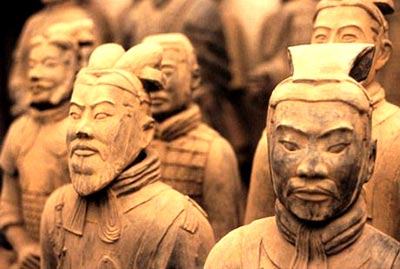
I write from Xi’an, where the 6000 life-sized terracotta warriors and horses are still arrayed in battle formation. Magnificent. These were funerary objects, as in Egypt, to help the first Emperor of a united China defeat his enemies in the afterlife.
Big Chinese cities like Xi’an are certainly at their best in the early morning. Older folks are out practicing Tai Chi, some with real swords. Others join ballroom dance groups, charming to watch. Some shuffle-jog in bad shoes.
Sweepers are busy. These cities are like movie theatres — you throw everything on the ground — next morning all has been swept clean.
All men in China now aspire to a Chinese Dream; an obedient wife, a son, a respectable paunch, a pager, a whack of keys hooked on to the belt, and a dangling American cigarette.
I bought beers for an English teacher who told me that he had 2 children, a daughter and then a son. He explained that when his son was born he went to the authorities to make a written confession, apologize, and to request to atone for his mistake by paying a fine. In his case it was about US$1000. If his second child had been a girl he might have given her up for adoption, or not registered her and later sent her to be married in a rural area. (There are too few wives for husbands in rural China due to female infanticide.)
The teacher understands that men and women are equal in the West. But the reality in China is that the parents must have a son to take care of them in old age. A daughter won’t do this as she is a possession of her husband’s family. This is the old age security system in China.
There’s the rub. As the rich get richer, the poor will definitely get poorer. There is no socialist safety net in China; nothing to compare with a true workers paradise like the Socialist Republic of Saskatchewan.
In China both school and health care operate on a cash basis.
I spoke with an intelligent, articulate student entering his 4th and last year of English study in Beijing. He was the first from his village to go to University. His family and his village borrowed his tuition money. The student was working hard towards being able to pay back the huge debt.
When I asked him what he aspired to do with his degree he replied proudly, I want to be a waiter in an expensive foreigner’s Hotel!
 Rick McCharles