
“This is Burma and it will be quite unlike any land you know.”
– Kipling, 1898
This is the kind of stuff I had looked forward to writing about Myanmar (the correct name of the country). I had expected to find another Cambodia which I visited a few years ago — a tortured, impoverished, backward country of suffering Buddhists.
Not so. Arriving in Yangoon in the evening, we were efficiently whisked from the modern airport through a bright city of wide streets and spacious architecture. Yacht Club. University. Our first impressions were good. The golden spires of pagodas light up the night.The hotel was spotless, new, friendly, and inexpensive. A Vancouver couple immediately took me out for beer and traditional Burmese food at a street restaurant which had never entertained foreigners. After dinner we joined up with one of the roving gangs of street musicians to sing old pop songs in Burmese and English. Bryan Adams is by far the most popular artist.
I was feeling pretty damn good about Myanmar and happy to be Quit of India after 4 months there.
Next morning was Easter Sunday. I went to Mass, conspicuously under-dressed, at the biggest Catholic church in town. I was over-whelmed with the warm welcome.
In the light of day I began to see the shabbiness and neglect, the socialist drabness.
Dozens of major construction projects, mostly hotels, were stalled or abandoned. Paint was peeling on most buildings. The huge sports complex, a gift from China, empty. The Yangoon Trade Centre (“Prosperity Through Trade“), deserted.
Still, the market was vibrant and oh so clean as compared with India. You can buy virtually anything. There has never been any kind of economic embargo of Myanmar except self-imposed isolationism. All of the multi-nationals are here with the exception of a few like Levis who opt not to do business with this regime.
I saw only 3 or 4 homeless people. When the police spot them, they are transported to some ghetto for the poor far from the city and prying eyes of tourists.
That evening we visited the famed Shwedagon pagoda, massive!, packed with tourists. The spire, built 1769, is covered with 53 tons of gold leaf and adorned with 5000 diamonds and 2000 other precious stones. Every 100 years the gold “umbrella” on top is replaced — this would occur on Buddhist New Years, a few days hence.

In Mandalay I stayed at the wonderful AD1 Hotel where I was fated to spend a lot of time on the roof, admiring the pagoda spires rising above the leafy green skyline. I had plenty of time to chat with the staff, especially the generous owner.
Older Buddhist people are soft-spoken, polite, and kind. All males spend some months as monks — it seems to have a lasting influence on their characters.
I was surprised, though, at how much this Buddhist nation is influenced by India. They eat communal meals with their right hand as in South India. The Burmese chew betel nut even more than do the Indians. One young man, teeth reduced to stumps, embarrassed, hiding his mouth behind his hand, told us, “I can’t quit. I like it too much.”
A more uniquely Burmese scene is an older woman smoking a huge cheroot.
This is the worst possible time to be in Myanmar and in Asia. Pre-monsoon the weather is insufferably hot.
The upside is that the annual heat wave coincides with the most important holiday of the year, the Water Festival. This party compares with Carnival in Trinidad or Rio in length and intensity. For 4 days people go nuts drinking and dancing. Costume, masks, make-up. And for 4 days you are soaked. Worst are the fire hoses and ice water kids.
After 1 day of drenching most tourists just want to hide in their hotels.
In Mandalay I got fever. Four nights I awoke, the sheets soaked with sweat. Then I would huddle in my sleeping bag trying to get warm despite cold chills.
I’d seen enough colonial graveyards to know that many foreigners die young of strange fevers. I decided to find a doctor.
Unfortunately, nobody works during Water Festival. Employees of essential services don’t show. I finally found a retired family doctor who works out of his home. He was British trained, perhaps 50 years ago. I made the leap of faith. A more sincere, kindly doctor I’ve never met. He took a stool sample and prescribed about 6 different kinds of pills including a sulfa drug. (I wasn’t sure I wasn’t allergic.)
I assumed the pills would cure or kill me.
Next day I was wiped. I could barely stand, never mind climb stairs. When I finally got back to his house I told him what I wanted — what was recommended in my guidebook. Of course he didn’t have that drug but prescribed an alternative antibiotic.
I hate taking any drugs. They mess you up and weaken your immune response. These chemicals had the side-effects of making me forgetful, stupid, and unlucky. Nothing went right. I even, somehow, lost the antibiotics.
To escape the heat and water I travelled up to the British hill station at Pyin oo Lwin.
Transport was by crappy Toyota pick-up — 20 passengers plus cargo.
The town is spacious, green, quiet, and quaint. The only taxis are brightly coloured horse-drawn stage coaches.
I stayed one night at Candacraig, former quarters of the Bombay-Burmah Trading Company. It’s an English country mansion constructed of teak. By far the best hotel of my trip.
Mr. Bernard, the cook, refused to leave after WW II and wouldn’t allow any alterations to building or menu (Roast beef, potatoes, English vegetables). He unfortunately eventually died there. Now the place is deteriorating apace with the other potentially gorgeous mansions.
The rich all seem to have a summer home here. I was charmed by the girls and young women who often stopped to ask, in careful English, if I needed directions. In Buddhist countries confident women hold-up far more than half the sky. And there’s been no “street-proofing” of kids yet.
 Burmese women smear coloured “thanaka” on their faces as a beauty cream and sun block. This is a paste made from a tree.
The rich young males are another story. Long hair, sun glasses, dressed in denim and Doc Marten boots. Serious bad attitude. A bit shocking for a Buddhist, asian culture.
They’ve seen all the violent American movies but the only English they’ve mastered is, “Fuck You“.
SLORC has encouraged traditional dress and Buddhist values. Now, in one of the least western-influenced countries in the world, they will suffer a huge backlash.
With some difficulty, I managed to get an air ticket to Bagan. If I was going to die, I at least wanted to see Bagan first. It’s one of the 2 great ancient sites in Asia along with Angkor Wat in Cambodia.
In Bagan I had to find yet another family doctor. He disagreed with my former medication anyway prescribing alternatives Metronidazole and Chloramphenicol.
At least the fever was gone and I was able to explore the 2000 pagodas of Bagan. By 1044 this was the rich trading hub for India – China. Unfortunately, Ghengis Khan rode in in 1287, utterly sacking the place.
These are really ruined ruins. Very little has been restored. It has an ancient ambience. I walked among the pagodas at night. Spooky. One day I hired a guide, horse and cart to take me to “excellent and unusual” pagodas. We started at 5 AM to avoid the heat.

Bangkok is the best place in Asia for a foreigner to be ill.
The airline suggested a flight that same evening. I jumped at the chance.
As it turned out, that was my first healthy day — my last in Myanmar and my first in Thailand — after 23 days of diarrhoea. (I reckon I caught this bug in Rishikesh, India.)
To be on the safe side, in Bangkok I immediately purchased “Ampicillin“, the antibiotic I couldn’t get in Myanmar.The Ampicillin gave immediate relief. I hope I’m cured.
In summary, I had cut short my seemingly jinxed visit to Myanmar. I saw only 3 of the 6 great sites in that country. I should go back some day. It’s my kind of place; untouristed, Buddhist, and beautiful.
People hope that Ne Win, now close to 90-years-old, will die soon. That might precipitate a major change for the better.
Every local I spoke with in private quickly agreed that their government was terrible. The biggest complaint was power cuts. Myanmar has mountains and rivers, but still doesn’t generate enough hydro-electricity.
The next complaint is the economy. Things have greatly improved since moderate pro-trade General Than Shwe was installed as leader. Actually, there has been steady growth since the regime abandoned socialism in 1989. Before that Myanmar was one of the 10 poorest countries in the world. Ne Win had nationalized every industry, even retail grocery shops.
Everyone has suffered under this crazy regime. Most were, until recently, reluctant to use banks as the government took a cut of every deposit.But hording cash was risky too.
SLORC would occasionally announce that notes of a certain denomination were now worthless — supposedly to combat counterfeiters.
Today there is a lot of money around. Count the Toyota Land Cruisers and Mercedes.
Where does the hard currency come from? Rice, drugs, gems, and hardwood.
Half the heroin in North America is made from Myanmar poppies. They have 75% of the world’s teak reserves. In fact, deforestation is probably the biggest long-term problem. They’ve denuded entire mountains just so rebels have no place to hide.
There’s been much criticism of the 100 lovely golf courses in this impoverished country. (Ne Win and his cronies are all big golfers.) But I find those cynics short-sighted. Just as the rich pagoda is a symbol of spiritual fulfilment, the golf course represents the secular.
Every mother’s son can aspire to become a military officer or a smuggler, and earn membership in the club.
The government mouthpiece newspaper, “The New Light of Myanmar“, is a comic, embarrassing propaganda rag. But it does cover golf scores from all over the world.
Huge out-of-place, out-of-time billboards proclaim:
People’s Desire:
- Oppose those relying on external enemies,
- Acting as stooges …
- Oppose foreign Nationals interfering in the internal affairs of State
- Crush all internal and external destructive elements as the common enemy.
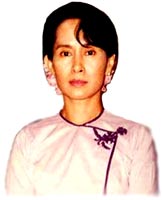 I didn’t sense any particular support for Aung San Suu Kyi who won 85% of the popular vote in the 1989 election. The Nobel Peace Prize winner has been under house arrest for most of the past decade since SLORC imposed permanent martial law.
The U.N. has documented the arbitrary arrest and torture of political opponents. SLORC has been ruthless. But western media has been particularly disinterested in Myanmar.
SLORC is a dictatorship that stifles free speech. One tourist waiting for a callback in the International Phone centre wandered upstairs looking for the toilet. He found a room full of people with headphones listening to the calls.
In another idiotic move, SLORC closed the University in ’89 and shutdown about half the colleges. Of course the University is the centre of dissent. SLORC would rather sacrifice their intellectual future than risk another uprising like ’88 where 3000 were killed during a 6-week period.
That’s Myanmar.
I never did look for Kurtz up the famous, atmospheric Irriwaddy river. It was at low flow. There was a big risk of getting hung-up on a sand bar. I did manage one short boat ride on this most evocative of rivers. Lovely.
 On to Thailand and good health!
 Rick McCharles