
my trip report from Apr, 1999
Every backpacker is on their way to Laos. Some are already speaking of (shudder) “Thailand North“.
Actually, “Visit Laos Year” begins November 1999. It is being orchestrated by General Cheng whose tourism credentials include French Paratrooper school and Russian Military Academy.
Just a few years ago everyone avoided Laos. I was frightened off by malaria stories. There is malaria, but don’t worry — I’m one of the few actually taking his malaria tablets. Mefloquine. The same fine preventative used by our boys in Somalia. I washed the last pill down with whiskey, just before bed.
Laos has been the under-populated, forgotten backwater (though landlocked) of Asia, developing at a snail’s pace in relative isolation after near 300 years of war.
So why Laos? Why now?
I don’t know. Transportation is impossible. It’s a dusty land. The most unique of the few tourist attractions, the Plain of Jars (giant, mysterious stone jars) most don’t visit because the road is infested with bandit rebels. In fact the entire infrastructure for tourism is sorely lacking. E-mail is recently available but never seems to work.
Yet everyone loves Laos. Everyone loves Cafe Lao — fantastic strong, tasty coffee mixed with sweetened condensed milk. ($.20) Match that with a fresh baguette veggie omelette sandwich ($.80) and you’re off to a happy day.
After the coffee, people are the principal draw of Laos. I would guess that half the photos taken here are of cute children.
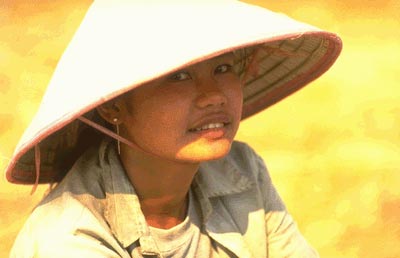
Lao people are laughing, joking, goofing. They don’t take themselves (or tourists) too seriously. They’ve been generously protected from tourism and Western culture by communism and bad roads. And (formerly) a maximum 15-day tourist visa. You can’t go far in Laos in 2 weeks.
I arrived from Thailand via the “Friendship Bridge“, built 1994. Amazingly, this is only the second span over the Mekong, the river that dominates so much of S.E. Asia.
Soft entry. Vientiane, the capital. Though it’s no longer a sleepy French colonial city of wide boulevards filled with bicycles, it’s still walkable and likeable, especially in the evening.
I quickly got “kipped” — 710,000 kip for a $100 U.S. traveller’s cheque — and set out to try to spend it. I had to carry the stacks of cash in my daypack. The largest denomination note is 5000K.
And Vientiane is just about the only place in the country where you can get unkipped. Life is not at all uncomfortable for the many conspicuous “expats“; diplomats, NGO representatives, business men.
I hung-out at the Canadian run “Healthy and Fresh Bakery“, chatting with a young guy from Cranbrook working the counter, listening in on the conversations of expat wives who all, obviously, have maids back cleaning their huge homes.
You can party Friday night at the Australian Embassy. Play rugby, touch football, bridge. Run with the Hash House Harriers on Monday night.
You can fine dine though you need an expat salary to eat at the French restaurants (menu priced in dollars not kip). All the imported luxuries are available. There’s a better selection of French wine than in Saskatoon.
I met a Calgary cowboy experimenting with different cattle breeds on the local grasses. He’s got a better chance of success than those working “crop substitution” — convincing opium poppy farmers to switch to mulberry trees (for silk).
3 sights not to miss in Vientiane:
1. A wonderfully weird Lao-style “Arc de Triomph“. The Americans sent concrete and cash so the military could build another runway for U.S. jets. The general, instead, completed the “Arc” as a memorial for Lao war dead.
 2. The symbol of Laos (replacing the hammer and sickle on the national emblem in 1992 is the wonderfully weird “Great Stupa” which looks like some kind of gilded missile cluster. It was peacefully deserted when I was there. I never saw anything like it in all my Buddhist travels.
3. Best for last, the entertaining “Revolutionary Museum“. Here I learned how French soldiers drowned children by throwing them into wells and the evils of running-dog-imperialist American warmongers. (Napalm victims, bombed-out pagodas) No mention of the North Vietnamese 1975 invasion which installed the communist Pathet Lao government which remains in power today.
History is indeed written by the victors.
Unlike everywhere else, I rarely heard a bad word about the government. The dissenters have mostly left. They cross the Mekong into Thailand, which actually has more Lao speakers than Laos.
You can still find a portrait of Vladimir Ilyich in the library but Marxist-Leninist ideology was abandoned in about 1991. The regime talks of “new thinking” not capitalism. The soviet-modelled one party system persists.
When I heard of an “eco-resort” 55 kms away, I hopped a local bus. I was seated on the floor on my padded day pack. Even close to Vientienne, this was already the “real” Laos full of happy, curious rural folk & their animals travelling to or from the market.
Even better was the boat trip down a remote tributary. Disembarking, swarmed by butterflies, climbing the muddy bank, I was still unsure I was in the right place until I saw the sign, “Bar 106 metres“.
Up on a scenic bluff an Austrian had converted an experimental eucalyptus reforestation plantation to a resort where one can “nature walk through monsoonal forest” and then enjoy a solar chilled beer.
Me and a Swedish guy, the only other guest, sat up on the terrace watching singing locals paddle their sampans home at dusk, using rubber flip-flops as paddles.
Ecology is a new concept in Laos. You rarely see a bird. But you see men and boys walking every road with ancient muskets. Any meat is fair game. One dusty village shop had a dead marmot in a basket. Skewered bar-b-q rat is enjoyed in every market. (tastes like chicken, I’m told.)
I’d advise go vegetarian in Laos. There’s mystery meat in the traditional noodle soup.
North on highway 13, the only “good” road in the country, to Vang Vieng. What a great place.
A string of recently-improvised guesthouses converted from traditional wooden homes. It’s a new Mecca for trail-blazing backpackers. The Lao people, many struggling to learn their first words of English, are enthusiastic and eager to please. One joint even serves-up French toast with Canadian maple syrup!
It’s not hard to keep our rabble happy. Tiny Vang Vieng is fronted by pretty tree covered limestone hills, shrouded in cloud, honeycombed with caves and tunnels. I joined a “tour” (me and a Kiwi travel agent) to an underground river which can be walked (and swum) 4 km under the mountain. We sloshed perhaps 800 m before our guide turned us back. Great experience!
After an authentic Lao lunch (a gamble gastrointestinal) we climbed on to inner-tubes for the 3 hour float back to town. It’s timed so we would arrive back at sunset. At the “sunset pub“.
Beerlao flows freely. But a surprising number of tourists later in the evening try opium. It’s easy. Find an “opium den” (any house on the side street), lie down in the fetal position, affect a vacant stare, and, as if you are already helpless, a woman will minister the long pipe to your lips. You only need enough energy to inhale.
You hear stories of disappeared tourists who finally wake-up in some mountain village after a couple of weeks, nothing left but a passport. At $.40 / pipe, that’s a lot of smoke.
When Paul Thoroux visited Vientienne in the early ’70s, he observed, “The brothels are cleaner than the hotels, marijuana is cheaper than pipe tobacco, and opium easier to find than a cold beer.”
Those were crazy days. The rickshaw pullers were mostly addicts. They would smoke all night then drink “cafe electrique” (black coffee laced with amphetamines) to work.
Fortunately, a morally-principled communist regime put an end to the flagrant sinfulness, driving it into back alleys where it belongs. On taking power in 1975 the Pathet Lao rounded-up about 3000 prostitutes and petty criminals banishing all the men to one penal island and all the women to another.
Back to Vang Vieng. I suspect the cheap opium tourists are puffing is pretty weak stuff (to keep them out of real trouble). Nobody was much affected.
The big problem isn’t tourists but rather in the villages. Opium is a vice traditionally condoned only for elderly men. But with the bad example of tourists, now young people are trying it and even heroin. The number of young Lao addicts is increasing.
North to the highlight destination of Laos, Luang Prabang. It’s the kind of place “people forget to leave.”
 Actually, some come because this is a nexus of tribal peoples. Colourful costumes, metallic headgear, fascinating customs. Hill tribes practice “swidden” (slash and burn) agriculture. Not pretty, but apparently the environment can sustain the low population.
 Rick McCharles
Great trip report and great writing, Rick! I sat there and read the whole damn thing instead of dong the stuff I was supposed to do! Damn you, McCharles! 😉 DA Date: Wed, 11 Jun 2014 14:33:22 +0000 To: funnflip@msn.com