
I’ve always considered lottery tickets a government sanctioned tax on stupidity. About 50% of Americans buy them every year.
… Don’t tell me Americans get $60 billion entertainment value from them. Gambling is addictive.
But I’ve no rant on the topic. Often a percentage of that tax money goes to good works, including amateur sport.
But couldn’t we spend those misguidedly optimistic dollars more wisely?
Here’s one way – Prize-Linked Savings (PLS).
I learned about it on Freakonomics:
… PLS is a kind of savings account that pools some of the interest from all depositors and pays out a big lottery prize every month or so. It combines the thrill of the lottery with the safety of a savings account. It’s sometimes called a “no-lose lottery,” since a depositor is automatically entered into the lottery but can’t lose the original money she deposits.
And while PLS might play well in the poorest parts of Africa and Asia, there’s a group of researchers who feel that PLS is very badly needed right here in the U.S. …
Freakonomics Radio: Could a Lottery Be the Answer to America’s Poor Savings Rate?
The only problem, it’s illegal almost everywhere in the USA, aside from Michigan.
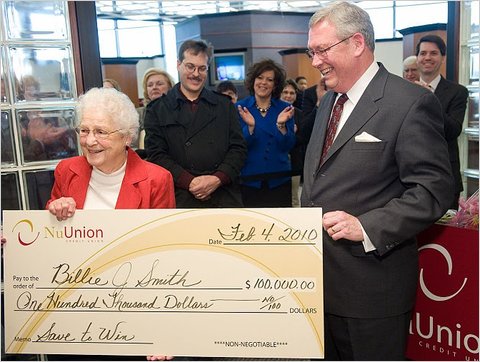
Here’s the first “Save to Win” winner, an 87-year-old Michigan woman who had deposited $75.
This is innovative thinking. The best way I’ve heard to encourage people to actually put some of their dollars into a savings account.
A similar savings scheme has been working in the U.K. for over 50yrs.
Freakonomics: A Rogue Economist Explores the Hidden Side of Everything is a 2005 non-fiction book by University of Chicago economist Steven Levitt and New York Times journalist Stephen J. Dubner.
Freakonomics Radio is an audiocast by the same two guys available from iTunes. I recommend it.
 Rick McCharles