
A nation that can run Bullet Trains safely bungles Nuclear Power. Surprising.
The Fukushima Daiichi nuclear power plant disaster has been a tourism & public relations disaster too, of course.
There’s as much confusion as information. Bloomberg cites the highest radiation levels yet, while the Financial Times tells that levels around Greater Tokyo have fallen.
 Politicians are driven to publicity stunts like this — drinking a glass of water taken from puddles inside the damaged plant.
Personally I’ve not been worried at all for my safety over 7wks here.
The government is handing over $64 billion to Tokyo Electric Power. Part goes for compensation to 89,000 people.
That company needs to be nationalized, temporarily, at least. Japan needs power.
This is what gives me nightmares.
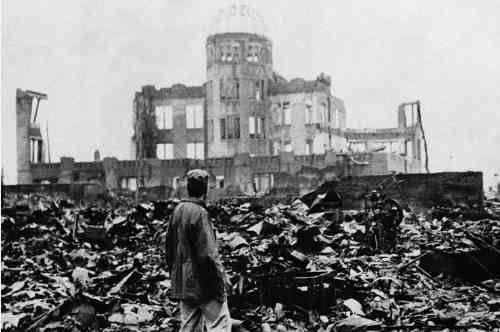
more photos of Hiroshima on The Big Picture
If you want to worry about something, worry about what will happen when some dictator or terrorist uses a nuclear weapon. It would be highly unlikely that the attacked nation would not retaliate in some way shape or form.
If you had told me when I was age-20 that I’d be visiting Hiroshima at age-54, I’d have laughed out loud. I was convinced that the world would be destroyed by now, by Nuclear war.
… yet somehow the planet has lasted this long.
Hiroshima had been left largely untouched by American bombing campaigns; that was, however, intended to ensure a more accurate measurement of the atomic bomb’s effect.
On Monday, August 6, 1945, “Little Boy” was dropped … directly killing an estimated 80,000 people. By the end of the year, injury and radiation brought total casualties to 90,000–140,000.
For those killed immediately (mostly women and children), it was a fast death. For the rest — horrific.
Three days later a second bomb was dropped on Nagasaki. Another 80,000 were dead by the end of the year.
… I’ve always wondered whether it was necessary to drop the second bomb so soon after the first. Yet it was another 6 days before Japan surrendered. Emperor Hirohito requested an end to the war personally.
Another big factor in the Japanese surrender was the Soviet Union launching surprise attacks at the same time.
Actually, the USA had a timetable for more bombs. We’re lucky that only two were used.
… Secretary of War, Henry L. Stimson, had honeymooned in Kyoto and argued to keep it off the list for as long as possible. One small blessing.
 Rick McCharles