
Very well written. Super original.
Though I didn’t like her subsequent book, Yellowface — Babel is great.
BUT it would have been better if half as long. In fact, you could read just the first half of Babel and be impressed.
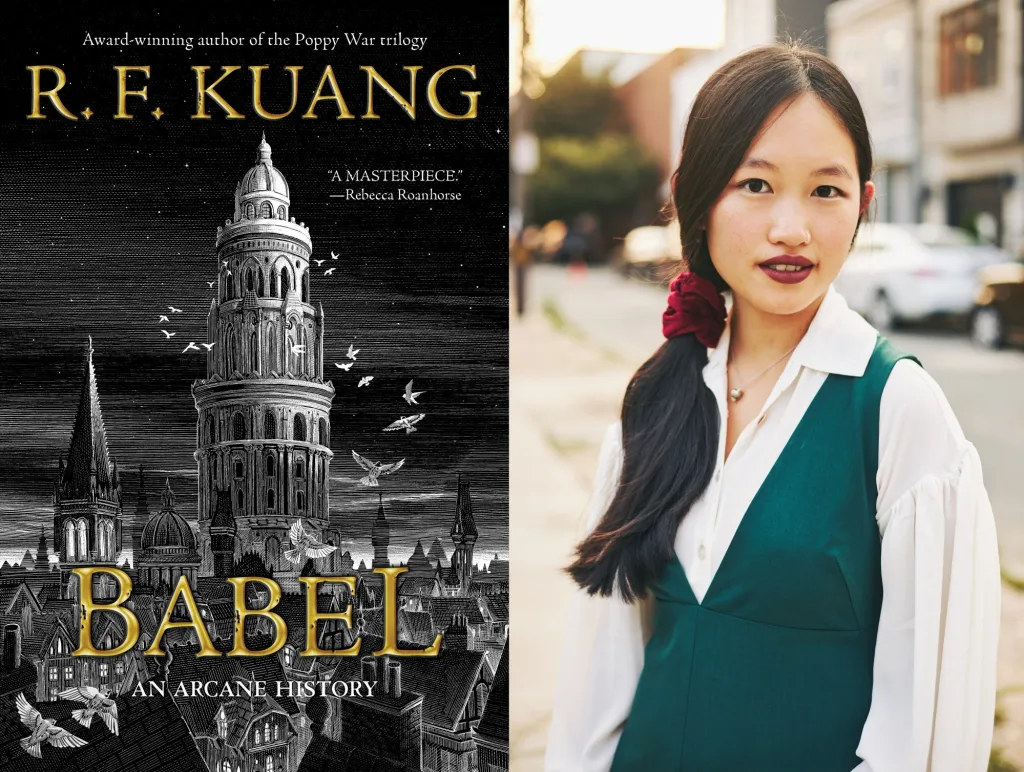
Rebecca F. Kuang is only age-28 as I post. An American, born in Guangzhou, China.
She has degrees in Sinology from Magdalene College, Cambridge, and University College, Oxford, and is currently studying at Yale.
Kirkus said it was “ambitious and powerful while displaying a deep love of language and literature“.
I’d never thought much about the art and science of translation before.
Babel: Or the Necessity of Violence: An Arcane History of the Oxford Translators’ Revolution won the 2022 Nebula Award for Best Novel.
Babel is set in an alternative-reality 1830s England in which Britain’s global economic and colonial supremacy are fuelled by the use of magical silver bars.
Their power comes from capturing what is “lost in translation” between words in different languages that have similar, but not identical, meanings.
Silver bars inscribed with such ‘match-pairs’ can increase industrial and agricultural production, improve the accuracy of bullets, heal injuries, and more.
To harness this power, Oxford University created the Royal Institute of Translation, nicknamed “Babel“, where scholars work to find match-pairs.
… focused on four new students at the institute, their growing awareness that their academic efforts maintain Britain’s imperialist supremacy, their debate over how to prevent the Opium War, and the use of violence.
Class obsessed England needs diversity in Babel to optimize Silver production. 😀
Friends in this book thrown together as outsiders: Robin from China, Ramy from Calcutta, Victoire from Haiti, and Letty, a white British admiral’s daughter. (In our reality, women were not invited to be students at Oxford until 1879.)
The administrators of the 2023 Hugo Awards, held at Chengdu Worldcon (in China), ruled Babel not eligible for nomination without further explanation.
A later report based on emails shared from the awards’ administrative panel revealed that the book was likely ruled ineligible in an attempt to avoid running afoul of Chinese censorship laws
 Rick McCharles