Two-Dollar Bill (2005) is one of the most unlikely plots in the Stone Barrington series.
Not long after Stone and his ex-partner Dino make the acquaintance of Billy Bob—a smooth-talkin’ Texan packing a wad of rare two-dollar bills—someone takes a shot at them.
Against his better judgment, Stone offers Billy Bob a safe haven for the night but almost immediately regrets it. The slippery out-of-towner has gone missing and someone has been found dead—in Stone’s town house no less.
Now, Stone is now stuck between a stunning federal prosecutor and a love from his past, a con man with more aliases than hairs on his head, and a murder investigation that could ruin them all.
John Sandford’s introduction of Minnesota Bureau of Criminal Apprehension investigator Virgil Flowers was an immediate critical and popular success …
Indeed, he’s my favourite of the Sandford characters.
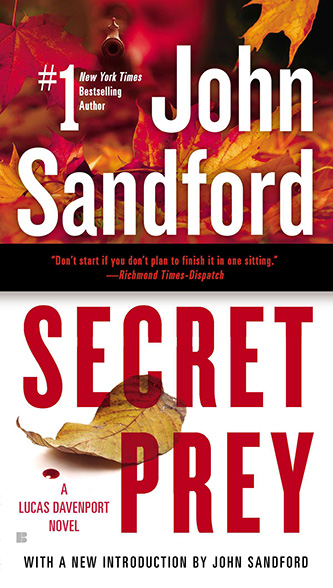
It’s a hot, humid summer night in Minnesota, and Flowers is in bed with one of his ex-wives (the second one, if you’re keeping count), when the phone rings. It’s Lucas Davenport. There’s a body in Stillwater — two shots to the head, found near a veteran’s memorial. And the victim has a lemon in his mouth.
Exactly like the body they found last week.
The more Flowers works the murders, the more convinced he is that someone’s keeping a list, and that the list could have a lot more names on it. If he could only find out what connects them all . . . and then he does, and he’s almost sorry he did. …
Butler-detective Helen Thorpe returns to help a wannabe influencer get her life in order—and solve the murders of her fellow content creators …
When Buddhist butler Helen Thorpe is loaned out to help Cartier Hightower get her life in order, Helen finds herself working for a young woman entirely unbound by the fetters of good taste or sound judgment.
One of Cartier’s fellow content creators has recently died in a strange accident. Soon after Helen arrives, another is killed in an equally bizarre way.
Cartier begins to drag Helen around on the influencer circuit, where neither of them is particularly welcome. Then comes the terrible incident at the EDM nightclub that turns Cartier into a global pariah, at least according to social media.
Helen hopes a period of simplicity and reflection and an internet detox will help Cartier find her true nature and maybe acquire some social graces. But Helen’s job getsmuch harder when Cartier’s friends show up at the lavish ranch where Cartier and Helen have retreated.
Soon, Helen finds herself trying to avoid becoming Instafamous while bringing some peace to a girl who very much needs it. This task turns out to be even more impossible when it becomes clear that they have been followed to Weeping Creek Ranch by a murderer.
Late one summer (1975), the town of Monta Clare is shattered by the abduction of teenager Joseph ‘Patch’ Macauley. Nobody more so than Saint Brown, who will risk everything to find her best friend.
But when she does: it will break her heart.
Patch lies alone in a pitch-black room – until he feels a hand in his. Her name is Grace and, though they cannot see each other, she lights their world with her words.
But when he escapes: there is no sign she ever even existed.
Left with only her voice and her name, he paints her from broken memories – and charts an epic search to find her.
As years turn to decades, and hope becomes obsession, Saint will shadow his journey – on a darker path to hunt down the man who took them – and set free the only boy she ever loved.
Even if finding the truth means losing each other forever…
… now that Stone Barrington, on a Florida trip, has helped nail the guy who killed Holly Barker’s fiancé, Orchid Beach police chief Holly comes to the Big Apple to involve him in her hunt for a mobbed-up fugitive from her brand of justice.
Even though he’s a killer many times over, second-generation criminal Trini Rodriguez (Blood Orchid, 2002) can’t be brought to book because he’s an FBI informant who’s repeatedly called on to testify against higher-ups presumably even worse than him …
A skeletal thriller, evidently written on the back of a series of cocktail napkins, that’s most notable, like Woods’s other recent novels, as a pretext for bringing his stable of stock heroes and villains …
YES you should ignore the plot. It doesn’t make a lot of sense.
L.A. Dead (2001) is mainly important because this is the one where Stone Barrington marries a fiery Mafia princess in Venice.
His biggest mistake yet.
The celebration is cut short by a frantic phone call from halfway around the world.
A celebrity murder has Los Angeles in an uproar—and a former flame pining for Stone’s help in more ways than one.
When he lands amid Hollywood’s sun and sin, Stone must plumb the depths of film society to find the killer, before a court trial rips away his last chance at a life he once desperately wanted…
The woman Stone actually loves is accused of murder. Stone must defend her. … But is she guilty?
Tom returns home to find his wife, Karen, vanished—her car’s gone and it seems she left in a rush. She even left her purse—complete with phone and ID—behind.
Police knock on the door. Karen’s had a bad car crash and is suffering amnesia from concussion.
Near the crash a murder victim is found. Had Karen something to do with that?
On the other hand, he’s hobnobbing with the rich and famous. Staying in a luxurious hotel. Driving unique and expensive vehicles.
When sidekick Dino Bacchetti of the NY Police arrives — a fish out of water — it gets really funny. 😀
The plot is complicated and confusing for most of the book. That’s OK because we are mainly enjoying all the many, many mistakes made by Barrington. Almost nothing goes right, not even the many beautiful women throwing themselves at him.
Barrington is just as confused as we are.
As someone put it on Goodreads “Anyone who gave this book a bad review might want to re-think why they read Stuart Woods’ novels. They are not classic literature. They are escapist fiction. You need to check your disbelief at the door.”
Actually, this might be a good entry point for anyone considering starting up with this long series of murder mystery novels.
By the time Lucas Davenport was called in, the police were up to fifteen bodies and counting. And as if that wasn’t bad enough, when Lucas began to investigate, he made some disturbing discoveries of his own. The victims had been killed over a great many years, one every summer, regular as clockwork. How could this have happened without anybody noticing?
Because one thing was for sure: the killer had to live close by. He was probably even someone they saw every day….