travelogue – this is the end – Asia

I’m back.

Back in the best country in the world.

Where better be than a sunny Canadian summer?

I’m a year older than when I left home — 41, and still clinging to life.

Actually, I feel good. Undiminished. Not yet a “Silver-back packer“. I was buoyed by the “New Passages” research that found, over the last generation, people are thinking and doing 10 years younger.

It has been a bad hair decade, though.

And I’m still unadorned as a Mahatma — lacking rings, tattoos, jewels, chains and piercings all which, as I understand it, make a face handsomer. (apologies to Count Leo)

The highpoint of my trip?

Definitely the wild frontier of the Himalayan plateau in China between Chengdu and Lanzhao; horseback mountain trek, endless grasslands, hundreds of thousands of yaks and goats, the largest Tibetan monastery in the world. Amazing sights. Great times.

That was Sept. ’98 when I was still euphoric. I lay awake nights planning multi-year, worldwide itineraries.

Travel euphoria exhausted itself by Christmas. I learned that 4 months is the longest I would want to be away in future.

Wandering the world for amusement; escaping the tangles of “reality” at home; meeting and travelling with people from all over the world might sound good … It is! I recommend it.

But not for TOO long.

What are my future plans?

I’m thinking of shaving off my beard. Beyond that? I guess a year wasn’t long enough to answer that question.

When considering my future, first priority is a simple, healthy, happy lifestyle.

I want to be able to “follow my bliss“. Spend my time doing those things that I most enjoy; those things that enervate me, compel me; interest me in a sustained way. And still earn a modest living.

The Internet attracts me. I’d love to find some way to work on the Web and do gymnastics as a hobby.

I still want to travel.

And you? Dreaming of an adventure holiday?

If you go to Asia I’d first recommend Nepal; fantastic ancient and modern attractions, Buddhist and Hindu cultures, the Himalayas — almost hassle free. (My friend Liba is going on the Annapurna Circuit trek in October.)

If you crave more excitement then definitely Cambodia, Laos, or Myanmar.

The most under-rated country? Malaysia. It’s an Islamic version of how Thailand used to be.

Finally, to challenge yourself, test your limits, “change your life” — go to India.

Did this trip change my life? I don’t think so. No transformation. Perhaps I’m slightly less deluded. Perhaps slightly more appreciative of the magic moments in life.

No great romance to report. There’s a lot of sex on the backpacker circuit, but mostly for chickens, dogs, goats, monkeys and (most frantically) yaks.
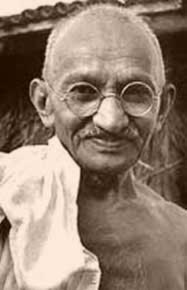
Gandhi shoulderWithout question the most meaningful experience was the week at Gandhi’s ashram. I was really inspired by Gandhi and his follower Vinoba, their philosophy of service to mankind. I’m still ruminating on how that inspiration might change my life.

Vinoba said that the established religions will continue to decline, replaced by personal “spirituality” (which can certainly be practiced with others). We need some new mechanism with which to educate youth in ethics and morality.

As for me, I have firm principles that I occasionally stick to. I admit it. I’m a compromiser. The utilitarian formula (“greatest good for the greatest number“) is good enough for me. I sleep great.

Suspect extremism. Look for a middle path.

Almost all backpackers in Asia are attracted to Buddhism. That philosophy challenges many of our ingrained cultural preconceptions. It has something to teach us.

Most of the press goes to colourful Tibetan Buddhism, mainly, I think, because the Dalai Lama is a great world spiritual leader.

For the record, “real” Buddhism to me is that practiced in Sri Lanka, Myanmar, Thailand, Laos, Cambodia. There they are more disciplined and more closely live the philosophy.
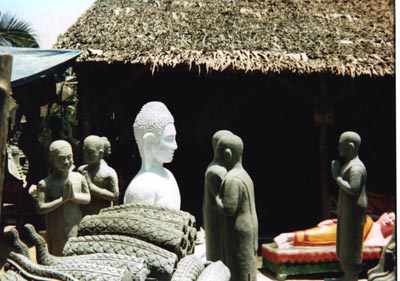
Buddha factoryBuddha factory, Cambodia

I took no camera on this trip. It’s much more relaxing to travel without being slave to the photo-op. It helps me, a little, to “live in the moment“.

And there is something wasteful about photography. Maybe I’ll go digital when the resolution gets good enough. (I’m conflicted. I love looking at photos, but hate taking them.)

I keep notes on my travels but fewer, I noticed, this trip than ever before. And I never even glance at junky tourist souvenirs.

Since I have a terrible memory, as time passes only these e-mails will remain.

Actually, I’m fairly happy with them. They’ve touched on most of the important themes of the trip. Given a glimpse into where my head’s been.

Warren Long has been posting them on his personal web site. I’ll clean them up a little, add some additional photos, and then let you know where you can find it on the web. (If I’m smart I’ll use some pseudonym. Can you think of an anagram of my name?)

Web-based email (e.g. Hotmail) is a glad revolution for travellers. Even the brokest backpacker is lavish, often spending more on computer time than on food and accommodation combined.

You can imagine how notoriously unreliable Internet Cafe computers in the developing world would be. And Hotmail, software from the evil empire of Microsoft, makes many, including myself, break down and cry at times.

(I just read that 1/4 of all Internet users are registered in Hotmail. Over 50 million! It’s time I get out.)

I’ve totally enjoyed writing these e-mails, though. It’s a selfish pleasure. I hope I haven’t offended too often. I can rarely resist the vanity of a smart-ass remark. As a traveller I’m not nearly as arrogant and condescending as I sometimes sound in these missives.

I worry that sometimes my canons have been aimed at my allies. Have you suffered friendly fire?

If so, I apologize for my offence. Just trying to keep the monologue lively.

A very special apology if you are a Communist, smoke, support the Chinese liberation of Tibet, speak French, are a beggar or other societal parasite, own a suitcase, or drive a Mercedes.

Like a reporter, I admit I sensationalized at times, highlighting the freakish, pathetic, extreme, hyperbolic.

But the beauty of e-mail is that you can skim and delete. I know that terrible sinking feeling of opening a loooooong e-mail when you’re very, very busy. I’ve got an itchy (delete) trigger finger myself.

I would never have sent you these e-mails as letters. You would have felt obliged to actually read them.

Cost of the trip?

I’ve yet to calculate it but, wild guess, no more than C$600 / month plus airfares. That’s about average, I would think, for the typical Lonely Planet backpacker in Asia. It’s very inexpensive.

This is not the end. I’m booked for most of the summer hiking, camping, visiting.

Hope to see you soon!

travelogue – The Great Leap Homeward – China

May, 1999

The first time entering China I was justified in being paranoid. It is a challenging country for backpackers.

This time, coming from Laos, I was oddly at ease though I had no guidebook and could only remember a few words of Mandarin.

The only bignose at the remote border crossing, I rode a sleeper bus north for 23 hours, never sure of my final destination.

It was, indeed, Kunming, (pronounced “Kunming”) the funky booming capital of Yunnan province. No matter how I pronounced “Kunming”, no one on my bus could understand where I wanted to go.

I had heard glowing reports of Yunnan; “more like Laos than China”, “friendly, honest people”.

I was glad to have returned to civilized China — perhaps “civilized” is misleading. Organized. Structured. Uncompromising.

At the Chinese border, as if on cue, men began spitting on the floor of our open truck taxi. I was back in a land of hawking, gobbing, chain-smoking, shouters. (Lung disease is the leading cause of death in China. High rates of TB directly linked to the habit of spitting in close quarters.) Still, I was happy to be back.

Quickly to Dali, a travellers haven, cool and breezy ‘tween picturesque mountains and lake.

The Chinese are pumping mucho RMB (“people’s money”) into Yunnan to fast-track it into a “famous” tourist destination. Entire blah-nd neglected cities are being Frankensteined into Sino-California — palm tree lined streets, western-style parks, fountains, “modern” statues.

In Dali the “old” city looks brand new, rebuilt to the taste of hordes of Chinese tourists. Much is contrived. And I’m convinced there is no Mandarin equivalent for “tacky” — they’ve highlighted the ancient city walls in green neon, for example.

Everyone loves Dali anyway, forgiving the excesses.

We moved up to Lijiang (Land of Horses), even prettier with 5500 m Jade Dragon Snow Mountain looming.
Lijiang town is “everything China should be, but isn’t”; a delightful maze of twisting, turning, cobbled streets and gushing canals.

In 1996 a Richter 7+ quake struck causing $500 million U.S. damage. They seem well on their way to recouping that investment. Flag-waving guides lead armies of Chinese tourists, each careful not to bend the brim of their identifying yellow tour group baseball cap.

Old Lijiang is run by a species of Tibetan called the Naxi. It’s an interesting matriarchal society where women run the town. They have their own language and fascinating pictographic script.

We had assembled a mini-Commonwealth (Brit, Kiwis, Ausies, Canucklehead) by the time we reached the Tiger Leaping Gorge trek.

You may have guessed that a fantastically talented tiger escaped pursuit here. At least that’s the story the hunters told.

It was a scenic, flat and dusty tramp though, by the time we reached the halfway guesthouse we needed the Chinese recovery medicine provided — a spray to “dispel wind-evil and water-evil”.

A wonderful nightfall looking up 4 km from river to peak. And we didn’t have to sleep alone. A teddy bear was provided for each bed.

So far I had avoided big-city Eastern China, travelling mainly in frontier areas. I reluctantly bought a plane ticket to Beijing where half the attractions of China are still to be found — even though Mao’s minions destroyed much of old Peking. In 1940 you could visit 8000 monuments. By 1960 only 150 remained. The “Temple of the God of Fire” was converted to a lightbulb factory, for example.

I expected Beijing to be another cosmopolitan “world city” like Bangkok, Delhi, or Toronto. Not. It might be Cosmopolis someday — if they ever finish the construction. It’s a city of cranes and girders. There are perhaps a dozen projects on the scale of Canary Wharf in London.

Beijing has been described as “soulless and functional”; “an inhuman vastness”; “an endless sprawl of apartment buildings”.

I’d add “shoddy” and “anonymous”. Even now I can’t “picture” Beijing.

Perhaps the most appropriate adjective for the “Soviet Realist” architecture — “rectalinear”.

Beijing is THE place to make money. It dawned on me here that the Chinese are at an earlier stage of the Cultural Evolution than we. Status symbols are all important.

Even in Beijing, girls are still impressed if you rev the motor of your 100cc motorbike and swagger like James Dean, cigarette dangling from your lips. (Why do smokers always look like posers?)

One in every 3 cigarettes is inhaled in China. Yet none of the women smoke. (Except a few slutty city girls with their tight stretch pants and their padded bras, they MUST be padded … sorry, this is more than a parenthetic digression.)

I yearned for western Canada where smokers are properly reviled and ostracized.

Beijing was not at all a write-off destination, though. I enjoyed my daily STARBUCKS coffee. And the backpacker hotel there is a hit. Recently westernized with a dirty, freezing pool and a 24-hour bar, it’s located out in the middle of desolate urbania, an hour from anywhere, beside a reeking, fetid canal. From the parking lot cafe I watched the welders assemble another apartment.

But the showers are hot; the cold beer the cheapest! in Asia so, on balance, this hotel is a winner.

I reunited with my cadres from the Tiger Leaping Gorge long march. More fun topped-off with a Chinese feast of Beijing Duck, all you can eat and drink. $4!

Rod, a prototype hard-travelling Aussie, reminded me of the ad slogan, “Think like an Australian. Drink like an Australian.”

Some of the sights of Beijing are world class. I loved the “Temple of Heaven” and its marvelous quiet park.

The “Summer Palace” is touristy but well worth the 3 hour bus struggle to get there.

Summer Palace

This Beijing spring, Tianamen Square was a disappointment, closed for a face-lift. Story is that the Chinese wanted it unusable on the anniversary of the Tianamen massacre and the Tibetan Uprising massacre, but ready for the 50th anniversary of the PRC on Oct. 1st.

They’ve planted some grass! This is progressive thinking in a town where, over the years, authorities ordered all dogs killed (eaten), all sparrows, then grass was banned.

Mao’s mausoleum seemed to be closed. That murderer, personally responsible for the deaths of tens of millions, is hip again. Officially he was “70% good, 30% bad”. But Mao memorabilia is 100% cool.

There is even a nostalgia food craze. I tried to find the “Compare Present Happiness with Past Misery” restaurant but, like everything else, it had been torn down.

I was keen to visit the People’s Liberation Army Military Museum, keen to see the doctored photos of the army being fired upon by rioters at Tianamen in 1988.

On arrival I was waved over to a special photo exhibit. Genocide! A bloodbath! An outrage! It was made clear to me that these aggressors were murdering butchers. Still, even though it was discounted on the street, I didn’t buy the t-shirt, “NATO = Nazi-American Terrorist Organization”.

The “Forbidden Palace” is, of course, a must-see. Watch “The Last Emperor” before you go. Huge, impressive, but, for some reason, it left me a little cold.

I dropped in on the Chinese Gymnastics National Team Training Centre. Unfortunately, some of the top gymnasts and coaches had just left for a meet in Korea. The gym was functional but surprisingly run-down. I was also surprised at the relaxed training atmosphere. The coaches were very quiet. The youngest group of boys played — no coach appeared.

Two main stories here:

China will host the World Championships in a few months.
A terrible accident. One of the girls was partly paralyzed in ’98 during a meet in the States. Personable and well-spoken, she’s become something of a national celebrity. I watched an hour long T.V. special on her recovery.

We side-tripped to Datong, home of more huge Buddhas content in their caves.

Nearby is the “Hanging Monastery”, constructed impossibly on a cliff face. Tourists must buy insurance before they scale the rickety plank walkways.

Datong produces 1/3 of China’s coal. The landscape is black, scored, blasted, and desolate. My sandaled feet were coal-stained for days.

I should offer-up filthy coal pollution statistics and report long caravans of coal trucks. I won’t because (I think) some of my own ancestors came to Canada to mine coal.

Don’t worry. When the Chinese are “rich”, then they will clean-up the environment. Surely when the mega-controversial 3 Gorges Dam is completed they will reduce coal consumption.

Lastly, of course we climbed the Very Good Wall (at rugged, remote Simatai).

As that instant Sinophile Tricky Dicky put it, “This is a Great Wall and only a great people with a great past could have a great wall and such a great people with such a great wall will surely have a great future.”

High hopes for Shanghai. For one thing, I had heard they have 1500 Internet cafes, something rarely spotted in the uptight government town Beijing.

The Internet is key to the coming Sino-century. What they desperately need is near instantaneous language translation software.

Yet the Internet may be the Tianamen Square which finally topples this totalitarian house of cards. When intellectuals have access to “free” information they can quickly organize on-line.

The government would love to restrict access to the Web (as in Myanmar) but they are far too greedy to resist the huge profits. China Telecom seems to have a telephone monopoly selling access to me in most cities for 10 “glotneys” / hour. Legal private enterprisers need charge about 30 / hour.

But illegal computers offer access for as little as 4 / hour.

In Shanghai we couldn’t find any of the hidden, mostly illegal services.

This is the kind of efficiency which flourishes under communism.

My guess is that China can persist for about 10 more years before true democratic reforms will be voluntarily introduced. They’ve had no Gorbachev to speed the process. (The only argument left defending one party rule is that STABILITY is the priority. They want to avoid what’s happened to democratic Russia.)

Shanghai is stunning. On one side of the river is “The Bund”, an impressive promenade of solid colonial buildings. You might be in Europe.

Across the water is Padong, the “New Bund”, an outrageous (trillion dollar?) mega-project conceived so Shanghai might recapture its position as East Asia’s leading city, a status it held before WW II.

Rather than pay C$20 to ride the elevator to the top of the space age Oriental Pearl Tower, I wandered the construction sites of Padong. Wow!

Partly built, the New Bund already offers more office space than all of Singapore. Wild sky-scrapers in mirrored yellow, purple, green — you’re going to love or hate Shanghai.
I love it. One of the great cityscapes of the world on par with Manhattan, Chicago, and Hong Kong.

Backpackers stay at the historic Richard’s Hotel, expensive at $12 / dorm bed but almost worth it to experience an ambience described as “Victorian insane asylum” — polished wood floors, echoing corridors, high ceilings, huge rooms. Indifferent employees barge in anytime, day or night.

Shanghai’s rep. is “hip”. The best (whoopee) nightlife in China. The most business savvy. Cutting edge clothing. I did find many broke fashion victims, the ladies worried what to do when their really high shoes come plummeting out of style.

(One bizarre Shanghai fashion trend is to wear your silk PJs out in the street.)

Shanghai was the “Whore of the East”, the Paris of China, the playground of the rich. It was the home of the most infamous mobster, “Big-eared Du”. (No wonder he was so mean.)

The Chinese would have Shanghai vault past Hong Kong as quickly as possible.

Don’t hold your breath, Mr. Zemin.

After China, even after Shanghai, you feel you’ve died and gone to traveller’s Heaven when you arrive in Hong Kong. It’s ultra-modern, compact, beautiful. Public transportation is a dream. There is much to see and do including a side-trip to Portugal. (The colony of Macao. For a few more months anyway, then it reverts to China.)

“Hong Kong is too expensive.” I hear that a lot. You can piss money away here as fast as anywhere in the world. But I always speciously argue that it is POSSIBLE to do Hong Kong on the cheap. Nobody ever does, of course. The temptations are too enticing.

Back to where I started this trip, high on Mount Davis.

I sat up with a bottle of red wine; admiring gorgeous Hong Kong harbour; reflecting on my trip, my life, my fate.

I didn’t get anywhere — just drunk and sleepy. 🙂

travelogue – India Cheap and Best!

A puffed-up poet named Charles March Blackride wrote to challenge the “comprehensivity of my India reportage“, and my sanity. He may have a point.

A couple of weeks Quit, the bubbling vat of my India experiences is starting to congeal.

Cheap and Best!” is the highest praise possible from any street tout. They always display a “great and misplaced enthusiasm” for whatever product or service the tourist is hurrying past.

Cheap and Best? India is ridiculously inexpensive and offers much. There must be more World Heritage Sites here than in any other country.

My first visit to India was the big city touristic fast lane; Varanasi, Agra (Taj Mahal), Jaipur, Udaipur, Bombay. I was quite critical of India that trip, though I loved it and wanted to return as soon as possible.

This time I visited many smaller places. Check-out this random list of some of my favourite spots including (population):

– Pushkar (13,000)
– Dharamsala (19,000)
– Rishikesh (82,000)
– Kodaicanal (31,000)
– Varkhala Beach (41,000)
– Darjeeling (83,000)
– Hampi (930)
– Sevagram (10,000?)
– Jaisalmer (46,000)
– Mt. Abu (18,000)
– Bharatpur bird sanctuary (millions of birds)

The smaller centres are better for me as my greatest griefs are big city griefs; traffic and pollution (air, water, noise). Indian cities have “all of the vices and few of the virtues of civilization“. (Mattiesson)

I thought China was noisy but India is much worse, reaching ear-damaging volumes. The Muslim call to prayer is amplified 5 times a day. (Actually, this one I like. “Allah, Akbar. Prayer is better than sleep.”) Christians and Hindus blare their speakers in religious competition. Simultaneously, vehicles and shops play Hindi film songs at “diabolical volumes” (Dervla Murphy)

This cacophony is punctuated by the many air horns found now on all manner of vehicles, even putt-putt Vespa motor-scooters.

Every citizen I talked to blamed most of India’s problems on over-population. I think the main problem is cultural. There are many regions in other countries just as crowded, just as poor, which are organized, happy, neat and tidy. (Northern Myanmar, for example, from where I write. I haven’t caught a whiff of stale urine, India’s national odour, since I got to this country.)

Nowhere else in the world but India will you find such conspicuous inefficiency, ignorance, and injustice. The reason is simple, said Gita Meha, “conservatism, massive passivity, opaqueness, apathy, and nearly sanctified prejudices“.

India just doesn’t seem to adapt to changing times. 50 years ago you should throw all your trash on the street — it was quickly eaten by roaming cows.

Now we have plastic.

50 years ago you could defecate and urinate just about anywhere. It would be “smulched” into the soil.

Now we have concrete.

Just a few years ago in India tea was served in a clay cup which you smashed when finished. Now they use plastic cups.

I have no faith at all in the government to educate the population.

Governments seem almost powerless in India. Not even Sonya Gandhi, with her vast wealth of political experience as Rajiv Gandhi’s widow, offers any hope.

Corruption seems to be a source of perverse National pride. Many told me, “India is the most corrupt country on Earth.” Actually, I read they ranked 8th worst on the Transparency International ranking. (Perhaps the committee was bought-off.)

Certainly much has improved even since I was here before. Trains and buses now depart close to schedule. Newspapers are excellent. The Elite of India are rising quickly to 1st world standard.

So am I being too critical of India?

Perhaps I just need more hyperbole to balance the vitriol. (Ah, but the villain is always more interesting than the hero in any picture.)

No, I’m not being over-critical. India needs more teachers, leaders, constructive critics — not fewer. As Gandhi said, “All criticism is not intolerance“.

This is an ancient culture, but a baby nation. Much was left undone over the past 50 years.

HIGHLIGHTS

EloraI was blown away by the Kailasa Hindu rock temple at Elora. It’s been acclaimed as one of the “most audacious feats of architecture ever conceived“. Carving stone from the top down, artisans cut out a complex twice the size of the Parthenon in Athens. That being difficult enough, the precision and detail of this monolith is also fabulous.

I visited the most fantastic Jain temple complex at Shatrunjaya. This is a hilltop strewn with over 800 gleaming white immaculate temples.

Gorgeous. Jain temples are always first class, usually constructed of fine marble.

The very best Jain temple is Dilwara on Mt. Abu. There you will find, some say, the finest marble carving anywhere in the world, so fine it is translucent in places. A giant lotus flower hangs down from the centre of the temple dome carved from a single block of marble.

I liked a lot of the stone carving, especially the erotic images. Indian Gods, like movie stars, must be respectably chubby. Goddesses are voluptuous, consorts Hefneresque. Those ancient carvers must have enjoyed their work.

The Rat Temple near Bikaner is unique. Rats are holy here. Like all Hindu temples, bare feet are demanded. I stood patiently until one of the thousands of rats finally scampered over my feet (very auspicious!) before I scampered out myself. Actually, the rats look small and sickly despite the mountains of food offerings they get.

Rat Temple

I liked better the nearby camel farm. I tried to confirm the rumour that camels have been bred so as to be unable to mate without human assistance. Not true. But they are somewhat incompetent so the handlers usually assist with insertion.

For me the biggest attraction to India this time was the Jaisalmer Fort. Of all the amazing forts in fort-studded Rajasthan, this is everyone’s favourite.

Straight out of the ‘Tales of the Arabian Nights’ … captivating, romantic, and unspoiled … no one who makes the effort to get to this sandy outpost departs disappointed.”

Jaisalmer Fort

You really need to see it at sunset, massive and sprawling, washed in a golden desert glow. Unforgettable.

Another favourite was Daulatabad Fort. Very “Indiana Jones” with defences including crocodiles, poisonous snakes, rock-hewn spiral passageways, fire traps, boiling oil. A 6 km escape tunnel leads to the plains below.

Certainly impregnable, this fort was never taken by force. (The gate guards were bribed.)

The Sultan of Delhi liked the fort so much that he marched the entire population of Delhi 1100 km to make it his new capital. His unhappy subjects dropped like flies in their new home. He finally marched them back again 17 years later.

Being a jock philistine, the Arts are a low priority for me on these trips. But I did manage to stumble on to some amazing acts.

I saw a frantic 12-year-old girl tabla prodigy. The tabla is like a bizarre double bongo which can produce wild sounds. Indians play jazzy rhythms unknown to me. But I like them.

Of course I saw sitar players several times. (Once on a hotel roof overlooking the Taj Mahal. Magic.) But the best of all was an old fellow playing an inverted clay pot, drumming with his hands, special rings on his fingers. This gives a unique percussive sound.

I enjoyed the Kathakali dance performed in Kerala. Dynamic, dramatic, with unbelievably detailed make-up and masks. The dancers put something in their eyes to make them large and red, expressive eye movements being the highlight of Kathakali.

The next day we had a charismatic boat captain described by Anna from Finland as “one of most beautiful human beings she had ever seen“.

Turned-out he was a Kathokali dancer. He ran that ship as he danced.

In Delhi I dropped in to a place called the “Crafts Museum“, not expecting much. I was the only one there. It turned out to be the funkiest, hippest folk art gallery I’ve ever seen. Craft work from all over India, but displayed in tasteful and interesting ways. I loved everything.

I had wanted for a long time to visit the Golden Temple of the Sikhs in Amritsar. It is glorious! I stayed in the pilgrim complex too, for free (donation).

Golden Temple

Sikhism puts high importance on social service. For example, every temple has an attached free kitchen. At the Golden Temple they feed 40,000 / day, all sitting on the floor as equals (no caste). They feed anyone; the poor, Hindus, Muslims, even me.

This is what all religions should be doing.

Every Sikh I’ve met has been courteous, educated and affluent. These people are so industrious they’ve made their state the richest in India.

I was very lucky to meet Gopi and Chitra. Gopi was born in India and educated in Canada and the U.S. He married Chitra who was born in Edmonton. They now live in Pondicherry with their 6-year-old daughter.

I spent a good deal of time with them, meeting both sets of parents. (Chitra’s parents live in Vancouver but come over for a few months each year.) Chitra & Gopi are certainly an Indian couple, but with western sensibilities and understanding. They answered all of my questions about Indian society in 1999.

The family “keeps” a 12-year-old untouchable girl as a baby-sitter and companion for their daughter. This is quite common for progressive families. The “servant” does odd chores, as well, in exchange for room, board, and a little spending money. It seemed to work well. The two were best of friends.

elephant

Every time you turn a corner in India there is something to make you grin:

  • an ox-drawn lawn-mower
  • an elephant in downtown Delhi traffic
  • the “village idiot” mental health care system
  • street clothes-pressers using big brass irons filled with charcoal
  • postal workers emptying the mail box and hauling away the mail by bicycle
  • feeding the street cows my paper garbage
  • kohl-eyed toddlers (black eye make-up)

At one of Gandhi’s memorials I was outraged to see women cutting the lawn, sitting, using tiny hand scythes. Then I thought, “How Gandhian“. He always said India didn’t need mass production, but rather production by the masses. At least until the population is fully employed.

Everything is done in the most labour intensive way possible. For example, men carry milk from the plains up to Mt. Abu every morning. A really heavy load. A very steep 5 hour climb. Yet there is a perfect road up. The milk could be driven.

Crazy things still happen in India every day. Pick up any paper and you are likely to read:

  • Father beheads his two sons as offerings to the Goddess Kali.”
  • Mother dies while being exorcised of a ghost by loving son.” The exorcism is not detailed — but called “torture“.
  • unlicensed “sexologist” prescribes arsenic and crushed pearls instead of Viagra
  • 40-year-old doctor weds Krishna.” The story goes on to detail that she will sleep with a full-size statue of the God in her bed.
  • Matrimonial ads are great fun. “Homely spinster with wheatish complexion“, or, “Christian gentleman with sober habits for an R.C.

You’ve noticed the Indian peoples have “only imperfectly mastered the Canadian language”. Actually its a quaint “Hinglish” (Hindi-English):

  • ads for “Suitings, Shirtings, Ready-mades
  • I’m still pondering his building signage: “Suck well-cum-Pump house

Varanassi; the sacred centre of Hinduism, he most atmospheric and filthiest place in India. If you visit only one city, this is it. You will find all of India down on the river ghats.

To die in Varanassi is immediate release from the cycle of rebirth and a direct ticket to Heaven. Pilgrims drown themselves or their children in the holy Ganges, swimming out tied to empty clay pots. (Actually the British put a stop to that in the early 1800s.)

The diseased and aged make their way here, many begging. Usually I can smile, greet them, and walk on, leaving them to work out their own salvation.

But for the first time I was really shaken. A young woman. Wasted. Obviously dying. AIDS? I walked past, but haunted.

What to do? Mother Teressa’s hospice for the Dying Destitute is a few metres away. Yet she chooses to beg in the street.

In the morning I returned, still unsure. Of all the beggars working the cremation ghat, she was the only one still left wrapped-up in her dirty sheet. I waited 5 minutes but could detect no sign of breathing.

At a loss, still, I walked away. I hope she finds release.

I returned along the river ghats looking for sweepers. India is filthy because these people are despised and under-paid. Each untouchable I could find, I patted on the back, thanked, and then offered a cash tip (disguised in a candy wrapper not to draw too much attention).

Each and every one stared back at me blankly — “This is a madman.” — then took the cash.

SivaSiva devotee

travelogue – Laos rebuttal by Peter Long

Laos Rebuttal (from Peter Long) (Rick in italics)

Hi Rick:

At last a letter I know something about!! i.e. Laos

Every backpacker is on their way to Laos. Some are already speaking of (shudder) “Thailand North”.

Don’t shudder too much – Laos before Thailandization was pretty primitive from many points of view: security, health, education. Subsistence living may look romantic, but in fact is grubby, stunting and short.

So why Laos? Why now?

I don’t know. Transportation is impossible. It’s a dusty land. The most unique of the few tourist attractions, the Plain of Jars (giant, mysterious stone jars), most don’t visit because the road is infested with bandit rebels.

You’re right, I never went there. The Germans were financing the construction of Highways 6 and 7 when I was last there, which should open things up.

In fact the entire infrastructure for tourism is sorely lacking.

Wow! You should have seen it in the ‘good old days’ Gummint hotels (in the capital), sheds elsewhere, filthy, although the Russians didn’t seem to mind, better than being at home I expect.

Yet everyone loves Laos. Everyone loves Cafe Lao — fantastic strong, tasty coffee mixed with sweetened condensed milk. ($.20)

We remember that well from Thailand in the 60s. Made by pouring water through a sock filled with coffee (Joyce has just reminded me that you got a chaser of tea to clean your mouth!). Good coffee in Lao, comes from the plateau in the south. I met a weird fellow there who was helping them develop coffee (he grew up in Kenya), but quality control ws a problem, and Lao is not a member of the coffee cartel and can’t get MFN status from the US because of involvement in the drug trade.

Match that with a fresh baguette veggie omelet sandwich ($.80) and you’re off to a happy day.

Veggie omelet – Luxury!! Breakfast was rice soup (with pork), and lunch was rice soup (with chicken). Dinner was rice soup etc. The day after the order was reversed.

Lao people are laughing, joking, goofing. They don’t take themselves (or tourists) too seriously. They’ve been generously protected from tourism and Western culture by communism and bad roads.

Also by being shot if they tried to cross the river, and a security guard in the hotel to see that no-one switched the TV to the Thai channel. And Migs at the airport. All in the good old days of course.

I arrived from Thailand via the “Friendship Bridge”, built 1994.

I went over the bridge when it was under construction – a very efficient Oz operation. I usually arrived via the airport, but crossed the bridge once when I was bounced from the flight ,and took the train to Nong Khai. It took about 3 hours to cross the bridge.

And Vientienne is just about the only place in the country where you can get unkipped.

I did change a traveler’s cheque once in Luang Namtha!

You can party Friday night at the Australian Embassy. Play rugby, touch football, bridge. Run with the Hash House Harriers on Monday night.

I went with the hash. Ran through some noisesome mud, (Joyce threw my socks out when I got home)

You can fine dine though you need an expat salary to eat at the French restaurants. (menu priced in dollars not kip) All the imported luxuries are available. There’s a better selection of French wine than in Saskatoon.

Wow!!

I met a Calgary cowboy experimenting with different cattle breeds on the local grasses.

I did not see much grass, other than rice. most cows appear to be in the bush/forest. I think you need a hardy local breed to survive, but I think beef is an important export to Thailand and China.

He’s got a better chance of success than those working “crop substitution” — convincing opium poppy farmers to switch to mulberry trees (for silk).

You need a high value crop when you have to walk out 2 days with the load on your back.

3 sights not to miss in Vientienne:

1) A wonderfully weird Lao-style “Arc de Triomph”. The Americans sent concrete and cash so the military could build another runway for U.S. jets. The general, instead, completed the “Arc” as a memorial for Lao war dead.

I think it was completed after the ‘liberation’

2) The symbol of Laos (replacing the hammer and sickle on the national emblem in 1992) is the wonderfully weird “Great Stupa” which looks like some kind of gilded missile cluster. It was peacefully deserted when I was there. I never saw anything like it in all my Buddhist travels.

However, I was there on the national day with thousands of people and hundreds of monks

Unlike everywhere else, I rarely heard a bad word about the government. The dissenters have mostly left. They cross the Mekong into Thailand which actually has more Lao speakers than Laos.

NE Thailand has an indigenous Lao population, they are not all dissenters.

North to Vang Vieng on highway 13, the only “good” road in the country.

Highway 13 is the old French numbering of a ‘Route de l’interet regionale’. It ran from Saigon, through Cambodia to the Chinese border. There is a statue of the French engineer on the road to the south of Vientiane

After an authentic Lao lunch (a gamble gastrointestinal) we climbed on to inner-tubes for the 3 hour float back to town. It’s timed so we would arrive back at sunset. At the “sunset pub”. Beerlao flows freely

Pleased to say the World Bank financed the expansion of the brewery in Vientiane..

– the “Secret War” in Laos where, in contravention of the 1962 Geneva Accord, U.S. pilots (code named “Ravens”) dressed as civilians and flew dangerously obsolete planes into battle.

The DC3 Dakota was a fine plane!

– the illegal bombing of Laos, especially the Ho Chi Minh Trail. Eventually the U.S. dropped more tonnage on this little country (about half a tonne / person) than they did in all of WW II. Unexploded ordinance (UXO) still kills about 130 people / year, about 40% children. (In Cambodia the number might be closer to 800 / year.)

You need to be careful digging for bridge foundations.

The end of the line for me was Muang Sing, a sleepy little village right in the middle of the Golden Triangle. In fact, the muddy, messy square was once the greatest opium market in the world (under French sanction).

I can’t believe that you got to Muang Sing. I have been there several times. Our stays were based in Louang Namtha, but I went to Muang Sing (and south of there to Muang Long, and once all the way to the Me Kong, from where I travelled down the river in a ‘long tail’ boat, trying to hunch down and not look like an American, who are not welcomed by Khun Sa’s men on the Burmese bank of the river. More of this another time).

The old opium market was restored with German aid, they had a nice installation in Muang Sing, with, at that time, the height of luxury of Mercedes jeeps, everybody else had terrible Chinese jeeps. They reconstructed all the pillars of the market while Klaus (?) was on leave, but when he came back they were not in a straight line, so in good Teutonic fashion he had them demolished and done properly.

It’s mainly know now as an exit point for automobiles being smuggled from Thailand to China. I saw huge convoys of (supposedly protected) hardwood too, heading north.

The porousness of the border appears to vary. On my last trip there were hundreds of cars sitting in the bush for a year. You could buy one very cheaply.

Actually, some come because this is a nexus of tribal peoples. Colourful costumes, metallic headgear, fascinating customs. Hill tribes practice “swidden” (slash and burn) agriculture. Not pretty, but apparently the environment can sustain the low population.

You are right about the mix of several tribes. Did you get acquainted with the one where if you get a massage you are worked on by a team of 6 girls simultaneously (so I’m told!)?

A guesthouse has opened up 8 km out of town so I spent a couple of rural days. I could have trekked to different minority villages. I did walk to one but found the experience awkward. What to do when the old woman runs out shouting, “Money, money, MONEY”.

On the Muang Long road once, we tried to take a picture of one of the girls with Joyce, but she was so spooked by Joyce’s white hair (maybe thought she was a ghost) that she screamed and ran into the creek. Too bad because she had good looking breasts casually revealed by her open jacket. The tiny pack horses were similarly spooked by the jeep, and the drivers were not much better either, also diving for the ditch.

After advising everyone I’ve met for the past 6 months NOT to backpack in China (unless they speak Mandarin), I’m really looking forward to the Middle Kingdom. It’s so much more … “civilized”.

Except for the toilets, the worst I have ever seen (smelt!) and heaved over, and watch for the phlegm first thing in the morning and the chicken bones on the restaurant floors.

Really enjoyed all your accounts and philosophy.

Cheers

Peter


travelogue – Laos

Every backpacker is on their way to Laos. Some are already speaking of (shudder) “Thailand North”.

Actually, “Visit Laos Year” begins November 1999. It is being orchestrated by General Cheng whose tourism credentials include French Paratrooper school and Russian Military Academy. …

For the complete travelogue & photos jump to the permanent webpage in Rick’s travelogue archive. OPEN icon

travelogue – Thailand R & R

Topless beaches, nightlife, unique cuisine, Buddhist culture; Thailand is the most popular tourist destination in S.E. Asia. I’d been here before, the first time in 1996.

But I’m not a total fan. IMHO Thailand is over-touristed, over-rated, and relatively expensive. (too many “suitcase” tourists)

Thailand is “the beaten track“, enduring millions of demanding “farang” for too many decades. Thai people working in tourism appear to be fed-up with us.

Another part of the problem is Bangkok. Sprawling, polluted, congested, this city boasts that it has consumed more concrete over the past 10 years than any other in the world.

Most everyone gets stuck in Bangkok for longer than they want — waiting for a visa, organizing forward travel, or … recovering from illness.

Most stay on Khao San Road. All day and all night vans and buses deliver swarms of backpackers to this tourist ghetto. Western restaurants blare rock music or offer current release (pirated) movies so customers can laze away the hours.

Bangkok is westernized — 7-11, Baskin-Robbins, Dunkin’ Donut. All this familiar comfort is seductive. Travellers get lethargic. I met many who had been on Khao San for a week and not yet visited the Grand Palace, Wat Pho, or the National Museum — all within 15 minutes walk.

You KNOW Rick McCharles would never get sucked into Khao San sloth.

He’s the kind who denounces McDonalds, that most conspicuous of all western imperialist icons. (This trip I hit on a more devious strategy than boycott. I patronized McDonalds, fouling their spotless washrooms, soaking up the air con, but purchased only “loss leaders“, the ice cream cones. I hoped I might drive rotten Ronnie out of Asia through insolvency.)

So why, you might ask, did you find Rick drinking Gatorade, scarfing Pizza Hut pizza, and watching “Jurassic Park, The Lost World” in his room on HBO TV?

When I came to Bangkok I had been sick for 3 weeks. I relaxed for a couple of days, seemingly recovered. I was well, but fatigued. I needed R & R so I headed for the beach.

Ko Tao

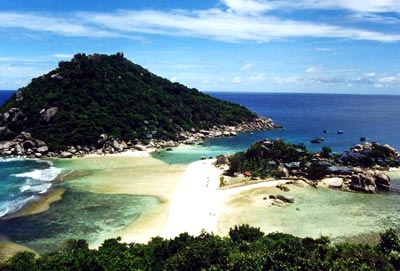
Ko Tao (Turtle Island) is a newish Thai sandy paradise. I was there a few years ago and I liked it — no paved roads, no electricity, quiet beaches, one small beach techno bar (“The Drop Zone“).

The tiny island has developed rapidly. Now there is one paved (5 km) road, much construction, and far too many motor scooters and electrical generators.

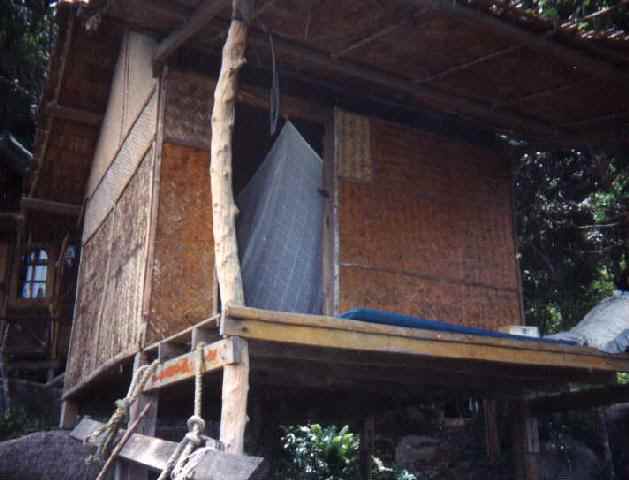
I retreated to the remote “CFT Resort” (assortment of huts) hidden in the jungle on a rocky cliff.

Just to prove my stereotype wrong, the Thai manager Pat was friendly and enthusiastic.

Two minutes after I arrived she threw me the keys to her motorcycle … (so I could retrieve my pack stashed back at a restaurant. I only used the bike ONCE) … “Careful. The brakes don’t work very well.”

I rested here for 6 days reading Michener on the porch of my cliff shack, snorkelling, admiring sunsets from the Bluewind restaurant.

cliff shack

I do like Thai food. In fact the “glop” I make at home is a variation of “Pad Thai“, a woked rice noodle dish.

Great fruit! Especially rambutan and mangosteen. Green coconut curry on rice with fresh seafood. Coconut soup is similarly tasty. A late night treat is “rotee“, a folded crepe with banana, raisins, or whatever your sweet tooth desires. Pour sweetened condensed milk on top.

Walking beside the beach one night I spied a thick rope on the path. I paused to watch it slither away. This was the biggest snake I’d seen in the wild, over 2 m long.

I ran to the nearest restaurant to alert a waiter. He just laughed.

Later at CFT one of the tourists ran up the hill yelling. “Snake!” Pat wasn’t sure whether the 80 cm viper! was dangerous or not. “Better leave it alone.

We all had “monsters” (big lizards) in our huts at various times. We sleep with the door open to wind and surf. One night I had an insect infestation on my walls. By morning they were gone without a trace.

Bugs are usually no problem. We keep our mosquito nets carefully sealed. And you get accustomed to the chainsaw-like Cicadas.

There are many unbelievable insects in Asia. The Praying Mantis is my favourite.

Street vendors serve up some of the big ones; deep-fried scorpions, beetles, grubs, and locusts. Free samples for foreigners.

I love the cheetah-like street cats, especially the Siamese. Lean, angular, wild. In most of Asia cats are bad luck or worse. But Buddhist countries are more feline tolerant.

(Hey, Toms got balls!)

Ko Tao was just what the doctor ordered — often cool, windy and overcast — anticipating the coming monsoon. Eventually, though, I grew restless and moved on to Krabi, the favourite Thai destination for many.

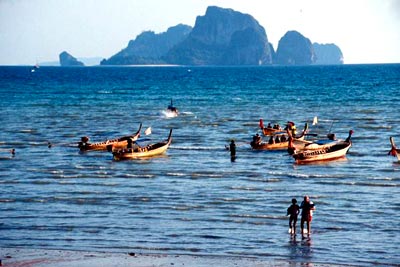
Railly beach at Krabi, I must say, is the prettiest I’ve seen — a sweeping white crescent with striking limestone cliffs. This is a fully developed resort. It couldn’t be more touristy. Yet I liked it because it is isolated, accessible only by boat. There is luxury accommodation aplenty, but I found a unique “tree house” for C$3.50 / night.

Krabi has emerged as a world-class rock climbing site. Bring your own gear, tent on the beach, and a wealth of cave and cliff climbing is yours. Ocean kayaking is big too.

boats

The Leonardo of our age had been filming “The Beach” at nearby Phi Phi island. Based on the badly written, wildly popular cult book of the same name, it’s a backpacker “Lord of the Flies“. Many here are anxiously awaiting release, hoping to see themselves painted-up, dancing in the Full Moon Beach Party scene.

(I shudder to envision the Thai islands over the next few years as Leo’s fans in the hundreds of thousands make pilgrimage to Ko Phi Phi.)

Then it was back to Bangkok where I was admitted (for a few hours) to the highly regarded “Mission” hospital. The diarrhoea, which I thought was cured, was back. The doctor thought it might just be a “blip“. She prescribed charcoal pills of which I had never heard saying, “You’ve had enough antibiotics.

Loafing Khao San Road again. I didn’t want to depart until I was sure I was healthy.

Thence, Pizza Hut, Gatorade and Lost World!

Come to think of it, wasn’t I the one who said, “Give me convenience or give me death!” (Or was it the Dead Kennedys?)

I wasn’t a complete slug. But I had previously visited all of the main tourist attractions of Bangkok and even developed a like-hate relationship with the megalopolis.

Then I heard of a new bizarre attraction — theMuseum of Forensic Medicine. It was a bit queasy-making. Samples of skin with knife and bullet wounds. Hundreds of morgue photos; high voltage burns, train crash victims. Two murderers preserved in wax and resin! Yuck.

Last time visiting this shopping town I investigated the ultra-modern World Trade Centre (a predictable duty-free shopping mall) where cleaners scuttle about wearing jackets labelled “Anti-dirt“.

More interesting was the urban slum out back. The poor live a traditional village lifestyle in the midst of city glitz. Each family finds a niche; the kitchen expands to restaurant specializing in fried fish, popcorn, or coconut sticky rice. On family sets up a barber chair. Another repairs electrical goods. Another sells socks.

It seemed a restful, if limited, existence. People sleep when tired. Dogs, cats, and chickens take care of most of the garbage. Even here there is no smell of urine.

Patpong, the famous red light district, was busier than ever. It’s becoming more of a tourist attraction than brothel. There are many female visitors and I’ve even seen entire families with cameras there. And it’s probably the best street shopping night market in town.

The sex shows are novelty acts involving a lot of pingpong balls, bananas, darts, and razor blades. It’s no kind of serious red light district like Hamburg, for example. (Imagine a whorehouse of Germanic efficiency; behind tall barriers, an entire apartment building, every window red lit!)

Thailand’s reputation for prostitution grew out of the Vietnam war when GIs were sent there for R & R. Actually there are now more sex workers / capita in Manilla and Taipei than Bangkok. The serious sin tourists are moving on, perhaps to Eastern Europe and Russia.

Very common in Thailand, though, is to see a tall Western man with his petite (bored?) Asian “girlfriend“. They miscommunicate in incomprehensible broken English. I always assume these women are “package” prostitutes. In Germany you can book your Thai vacation (3 weeks with escort) calculated down to the last pfenning.

This trip I met a number of these couples. Actually, all were married or in long-term relationships.

Prostitution is common in Asian cultures though. In India I never once in 6 months saw a “working girl” while in Chinese cities I saw them every day.

I was wandering Lhasa at dusk when I saw hundreds of pretty, young, made-up women walking in the opposite direction. I turned around.

The Chinese have recently built a massive Casino complex in Tibet to help justify their more massive investment in that barren plateau. These ladies were on their way to work.

Arriving in south China I was astonished at the number of barbershops, sometimes entire streets of them. Twice I ended up in one of these tiny brothels, a couple of beds separated only by curtains. We chatted with the ladies (through a translator) and had drinks.

I didn’t stay for a styling.

PS

I’m next to the mountains of Northern Laos. It’s getting a little hot and wet in Thailand. I need to gain altitude and latitude.

Everyone is raving about Laos — “a backpacker’s paradise“.

I’ll let you know.

travelogue – Burma, Metronidazole, Chloramphenicol, Ampicillin, me & SLORC

“This is Burma and it will be quite unlike any land you know.”

– Kipling, 1898

The iron fist of SLORC (State Law and Order Restoration Council) squeezes the citizens of Yangoon, the capital, through the day. After curfew, the dark, empty streets are over-run by giant, fearless rats. Postal clerk turned dictator, Ne Win, (hugely wealthy, married 7 times) has controlled this detested military regime since 1958.Officially retired since 1988, Ne Win continues to pull the strings from his residence where he surrounds himself with ‘wizards and astrologers’.

This is the kind of stuff I had looked forward to writing about Myanmar (the correct name of the country). I had expected to find another Cambodia which I visited a few years ago — a tortured, impoverished, backward country of suffering Buddhists.

Not so. Arriving in Yangoon in the evening, we were efficiently whisked from the modern airport through a bright city of wide streets and spacious architecture. Yacht Club. University. Our first impressions were good. The golden spires of pagodas light up the night.The hotel was spotless, new, friendly, and inexpensive. A Vancouver couple immediately took me out for beer and traditional Burmese food at a street restaurant which had never entertained foreigners. After dinner we joined up with one of the roving gangs of street musicians to sing old pop songs in Burmese and English. Bryan Adams is by far the most popular artist.

I was feeling pretty damn good about Myanmar and happy to be Quit of India after 4 months there.

Next morning was Easter Sunday. I went to Mass, conspicuously under-dressed, at the biggest Catholic church in town. I was over-whelmed with the warm welcome.

In the light of day I began to see the shabbiness and neglect, the socialist drabness.

Dozens of major construction projects, mostly hotels, were stalled or abandoned. Paint was peeling on most buildings. The huge sports complex, a gift from China, empty. The Yangoon Trade Centre (“Prosperity Through Trade“), deserted.

Still, the market was vibrant and oh so clean as compared with India. You can buy virtually anything. There has never been any kind of economic embargo of Myanmar except self-imposed isolationism. All of the multi-nationals are here with the exception of a few like Levis who opt not to do business with this regime.

I saw only 3 or 4 homeless people. When the police spot them, they are transported to some ghetto for the poor far from the city and prying eyes of tourists.

That evening we visited the famed Shwedagon pagoda, massive!, packed with tourists. The spire, built 1769, is covered with 53 tons of gold leaf and adorned with 5000 diamonds and 2000 other precious stones. Every 100 years the gold “umbrella” on top is replaced — this would occur on Buddhist New Years, a few days hence.

Shwedagon
Tourists are dismayed with the amount of money Buddhists donate to temples. We all quickly resolve to donate to people (Buddhist Home for the Aged Poor, School for the Deaf) not buildings. As in Tibet, we do everything we can to minimize the number of dollars going into government coffers.As quickly as possible I left Yangoon, heading north on the road to Mandalay which was the capital until the British took-over. En route we passed an endless military graveyard. In Burma 27,000 allies died in WW II, 200,000 Japanese.

In Mandalay I stayed at the wonderful AD1 Hotel where I was fated to spend a lot of time on the roof, admiring the pagoda spires rising above the leafy green skyline. I had plenty of time to chat with the staff, especially the generous owner.

Older Buddhist people are soft-spoken, polite, and kind. All males spend some months as monks — it seems to have a lasting influence on their characters.

I was surprised, though, at how much this Buddhist nation is influenced by India. They eat communal meals with their right hand as in South India. The Burmese chew betel nut even more than do the Indians. One young man, teeth reduced to stumps, embarrassed, hiding his mouth behind his hand, told us, “I can’t quit. I like it too much.

A more uniquely Burmese scene is an older woman smoking a huge cheroot.

This is the worst possible time to be in Myanmar and in Asia. Pre-monsoon the weather is insufferably hot.

The upside is that the annual heat wave coincides with the most important holiday of the year, the Water Festival. This party compares with Carnival in Trinidad or Rio in length and intensity. For 4 days people go nuts drinking and dancing. Costume, masks, make-up. And for 4 days you are soaked. Worst are the fire hoses and ice water kids.

After 1 day of drenching most tourists just want to hide in their hotels.

In Mandalay I got fever. Four nights I awoke, the sheets soaked with sweat. Then I would huddle in my sleeping bag trying to get warm despite cold chills.

I’d seen enough colonial graveyards to know that many foreigners die young of strange fevers. I decided to find a doctor.

Unfortunately, nobody works during Water Festival. Employees of essential services don’t show. I finally found a retired family doctor who works out of his home. He was British trained, perhaps 50 years ago. I made the leap of faith. A more sincere, kindly doctor I’ve never met. He took a stool sample and prescribed about 6 different kinds of pills including a sulfa drug. (I wasn’t sure I wasn’t allergic.)

I assumed the pills would cure or kill me.

Next day I was wiped. I could barely stand, never mind climb stairs. When I finally got back to his house I told him what I wanted — what was recommended in my guidebook. Of course he didn’t have that drug but prescribed an alternative antibiotic.

I hate taking any drugs. They mess you up and weaken your immune response. These chemicals had the side-effects of making me forgetful, stupid, and unlucky. Nothing went right. I even, somehow, lost the antibiotics.

To escape the heat and water I travelled up to the British hill station at Pyin oo Lwin.

Transport was by crappy Toyota pick-up — 20 passengers plus cargo.

The town is spacious, green, quiet, and quaint. The only taxis are brightly coloured horse-drawn stage coaches.

I stayed one night at Candacraig, former quarters of the Bombay-Burmah Trading Company. It’s an English country mansion constructed of teak. By far the best hotel of my trip.

Mr. Bernard, the cook, refused to leave after WW II and wouldn’t allow any alterations to building or menu (Roast beef, potatoes, English vegetables). He unfortunately eventually died there. Now the place is deteriorating apace with the other potentially gorgeous mansions.

The rich all seem to have a summer home here. I was charmed by the girls and young women who often stopped to ask, in careful English, if I needed directions. In Buddhist countries confident women hold-up far more than half the sky. And there’s been no “street-proofing” of kids yet.

woman with sun blockBurmese women smear coloured “thanaka” on their faces as a beauty cream and sun block. This is a paste made from a tree.
The rich young males are another story. Long hair, sun glasses, dressed in denim and Doc Marten boots. Serious bad attitude. A bit shocking for a Buddhist, asian culture.

They’ve seen all the violent American movies but the only English they’ve mastered is, “Fuck You“.

SLORC has encouraged traditional dress and Buddhist values. Now, in one of the least western-influenced countries in the world, they will suffer a huge backlash.

With some difficulty, I managed to get an air ticket to Bagan. If I was going to die, I at least wanted to see Bagan first. It’s one of the 2 great ancient sites in Asia along with Angkor Wat in Cambodia.

In Bagan I had to find yet another family doctor. He disagreed with my former medication anyway prescribing alternatives Metronidazole and Chloramphenicol.

At least the fever was gone and I was able to explore the 2000 pagodas of Bagan. By 1044 this was the rich trading hub for India – China. Unfortunately, Ghengis Khan rode in in 1287, utterly sacking the place.

These are really ruined ruins. Very little has been restored. It has an ancient ambience. I walked among the pagodas at night. Spooky. One day I hired a guide, horse and cart to take me to “excellent and unusual” pagodas. We started at 5 AM to avoid the heat.

pagodas
Actually, I was more impressed by the “newer” pagodas of Mandalay. As I flew out of that city I’m sure I saw over 2000 structures there too.When I judged myself healthy enough, I booked a bus back to Yangoon. On arrival I went to Thai Airways to explain my health problems, to see if I could move my flight sooner.

Bangkok is the best place in Asia for a foreigner to be ill.

The airline suggested a flight that same evening. I jumped at the chance.

As it turned out, that was my first healthy day — my last in Myanmar and my first in Thailand — after 23 days of diarrhoea. (I reckon I caught this bug in Rishikesh, India.)

To be on the safe side, in Bangkok I immediately purchased “Ampicillin“, the antibiotic I couldn’t get in Myanmar.The Ampicillin gave immediate relief. I hope I’m cured.

In summary, I had cut short my seemingly jinxed visit to Myanmar. I saw only 3 of the 6 great sites in that country. I should go back some day. It’s my kind of place; untouristed, Buddhist, and beautiful.

People hope that Ne Win, now close to 90-years-old, will die soon. That might precipitate a major change for the better.

Every local I spoke with in private quickly agreed that their government was terrible. The biggest complaint was power cuts. Myanmar has mountains and rivers, but still doesn’t generate enough hydro-electricity.

The next complaint is the economy. Things have greatly improved since moderate pro-trade General Than Shwe was installed as leader. Actually, there has been steady growth since the regime abandoned socialism in 1989. Before that Myanmar was one of the 10 poorest countries in the world. Ne Win had nationalized every industry, even retail grocery shops.

Everyone has suffered under this crazy regime. Most were, until recently, reluctant to use banks as the government took a cut of every deposit.But hording cash was risky too.

SLORC would occasionally announce that notes of a certain denomination were now worthless — supposedly to combat counterfeiters.

Today there is a lot of money around. Count the Toyota Land Cruisers and Mercedes.

Where does the hard currency come from? Rice, drugs, gems, and hardwood.

Half the heroin in North America is made from Myanmar poppies. They have 75% of the world’s teak reserves. In fact, deforestation is probably the biggest long-term problem. They’ve denuded entire mountains just so rebels have no place to hide.

There’s been much criticism of the 100 lovely golf courses in this impoverished country. (Ne Win and his cronies are all big golfers.) But I find those cynics short-sighted. Just as the rich pagoda is a symbol of spiritual fulfilment, the golf course represents the secular.

Every mother’s son can aspire to become a military officer or a smuggler, and earn membership in the club.

The government mouthpiece newspaper, “The New Light of Myanmar“, is a comic, embarrassing propaganda rag. But it does cover golf scores from all over the world.

Huge out-of-place, out-of-time billboards proclaim:

People’s Desire:

  • Oppose those relying on external enemies,
  • Acting as stooges …
  • Oppose foreign Nationals interfering in the internal affairs of State
  • Crush all internal and external destructive elements as the common enemy.

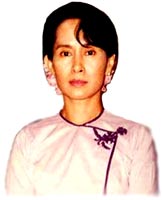
AungI didn’t sense any particular support for Aung San Suu Kyi who won 85% of the popular vote in the 1989 election. The Nobel Peace Prize winner has been under house arrest for most of the past decade since SLORC imposed permanent martial law.

The U.N. has documented the arbitrary arrest and torture of political opponents. SLORC has been ruthless. But western media has been particularly disinterested in Myanmar.

SLORC is a dictatorship that stifles free speech. One tourist waiting for a callback in the International Phone centre wandered upstairs looking for the toilet. He found a room full of people with headphones listening to the calls.

In another idiotic move, SLORC closed the University in ’89 and shutdown about half the colleges. Of course the University is the centre of dissent. SLORC would rather sacrifice their intellectual future than risk another uprising like ’88 where 3000 were killed during a 6-week period.

That’s Myanmar.

I never did look for Kurtz up the famous, atmospheric Irriwaddy river. It was at low flow. There was a big risk of getting hung-up on a sand bar. I did manage one short boat ride on this most evocative of rivers. Lovely.

057On to Thailand and good health!

travelogue – some concerns – India

From Charles March Blackride:

Subject: McCharles

I beg your forgiveness if I am overstepping my slight acquaintanceship with your Mr. McCharles, but having just scanned his most recent email from India, I’m somewhat disturbed. His letters are getting longer, more frequent and, dare I suggest, possibly manic-depressive. McCharles would appear to be on course to declaring as one of the very mystics he rightly ridicules. Perhaps one of you who understands him better than I should alert him that he is Kurtz.

My apologies, once more, if this electronic mail is an over-reaction.

Sincerely yours,

Charles

travelogue – there is no God and McCharles is Her prophet – India

Nehru called India “a madhouse of religions“.

Spiritual tourists” like me are certain we will discover secrets here in a country where we can’t even find the train station. This is the land of saints and sages. Six million sadhus can’t be wrong.

None of us are dissuaded when we learn that the Indian sex manual (Kama Sutra) was written by a celibate.

The XX Century is done. Y2K looms. India tramps are hearing much talk of “Kaliyug“, the “age of darkness“, the “end time“.

This helps fuel the “enlightenment industry“. (Gita Mehta) Buzzwords attract tourists like flies — “tantric“, “karma“, “dharma“, “nirvana“. No worry they are so over and mis-used they’ve come to mean anything and nothing.

India is a place where people will embrace spiritual novelty. Any self-proclaimed prophet can quickly attract credulous devotees. The most enthusiastic are promoted to the inner circle.

India, Japan, and the U.S. boast the lions share of religious con-men, but they’re found world-wide.

An Indonesian prophet Petrus Ratu required his followers to wear their underwear on their heads. He was last seen in 1996 on his way to prison — with his underwear on his head.

Indian astrologers can veto weddings, corporate mergers, and wars. Gandhi said it all:

I know nothing of the science of astrology and I consider it a science, if it is a science, of doubtful value, to be severely left alone.”

I’m embarrassed how many pathetic dupes are fleeced of $20 – $30 U.S. by street fortune-tellers. (I was savvy enough to limit my loss to $20 Canadian.)

I travelled with Harry; educated, articulate, sun-burnt, “square” — a prototype Brit. He started out to get his palm read and finished hugging the seer. Both naked.

Harry couldn’t explain how this happened except to emphasize that it was never threatening or coercive. They separated on excellent terms, the palm-reader looking forward to meeting Harry’s wife.

Channelling? Rebirthing? Angeology? Put up a poster and westerners will appear. (10 minutes early to get a good seat.)

I was considering a Gandhi-inspired fast until a Colorado “rolfer” advised a 10 day “cleansing“; drinking salt water, “chomper” pills, electric “zapper” (to kill parasites), twice daily enemas. “Long black oily strings are still coming out day 10.”

A group of travelers nodded approval. One packed-up and headed to Goa to sign-up.

I told “Rolf” I had decided, instead, on a “gorge“. I hurried to the bakery.


Brahma Kumari (Daughters of God)

A guidebook promised much; “an indisputable force for good in the world“, “integrity is unquestionable“, “perhaps the least corrupt organization in India“.

I climbed Mt. Abu to investigate their “World Spiritual University” (excellent!) and “Forest of Honey” administrative headquarters which oversees 4500 branches worldwide.

Mt Abu

The BKs (Hindu Shivites) promote:

  • morality
  • women in leadership roles
  • universal peace
  • celibacy
  • social work
  • yoga and meditation

I attended a couple of introductory classes at their “Academy for a Better World“. My instructor Nagraj had a good message, but no teaching technique. The pitch compared badly with the sophisticated wooing of the multi-level marketing companies of the west. Nagraj could learn much from pyramid schemers.

(One point of similarity — MLM companies always include a prophet, usually the corporate founder. The BKs deify a Calcutta diamond merchant who had bizarre visions.)

I descended the mountain feeling warm and fuzzy, memories of happy, smiling people all dressed in white. Like Heaven.


ISKCon

I dropped by Krishna’s hometown to check-out Hare Krishnas India headquarters. The place was surprisingly run-down.

Blue GodThough the blue-skinned God is understandably respected for satisfying 900,000 milkmaids one night — at his ashram: no sex, intoxicants, meat, or gambling.

There’s a daily requirement of at least 16 rounds of the Hare Krishna mantra.

Entering the temple I was immediately hit-on to “adopt a cow“. When I innocently asked, “Why not a goat?”, I was nearly throttled by a sputtering, enraged little fellow. This was profane mockery. Krishna is the “sacred cow-herd“.

I fled (my usual exit from Hindu temples) but ran directly into a shouting match between two shaven, orange-robed devotees.

Bad karma. They should be singing and dancing ecstatic with Krishna.

Thinking I’d just caught ISKCon on a bad day, I tripped to their gorgeous new temple / recruitment centre in Delhi. Conch shell horns sounded, curtains swept open, all fell in prostration to Krishna. It was an impressive show.

At the gift shop I couldn’t find a copy of “the book“, “Monkey on a Stick“, a damning expose of ISKCon U.S.A.


It was only 15 minutes walk to the stunning new (1986) Lotus Temple of the Baha’i — immaculate gardens, pristine pools. Really fantastic.

But the “park” between was a stinking cesspool. This is India. A slum latrine between two spiritual palaces.

Lotus TempleLotus Temple, Delhi

Baha’i

A modern (1850), common-sense religion:

  • improve quality of life on Earth
  • social service work
  • condemns superstition and prejudice
  • equality of men and women
  • abolish extremes of poverty and wealth
  • permanent world peace
  • common foundation for all religions (they all produced great teachers)

The Baha’i have an interesting system of decision-making. They elect leaderless committees of 9 who are expected to arrive at a consensus. Even if there is some disagreement behind closed doors, all support the final decision.

Other innovations: no priesthood, donations accepted only from Baha’i, gossip discouraged. Courtesy, modesty, and decency are expectations.

I had a few concerns; the cult of personality around the Persian founders, they are a bit inflexible on alcohol and drugs, and (inconsistently) only men can serve at the embryonic world government, the “House of Justice” at Mt. Carmel, Israel.

The Baha’i have no hang-ups with sex, so long as its monogamous, wedded, and not over-frequent. Homosexuality is an aberration that, thankfully, is treatable.


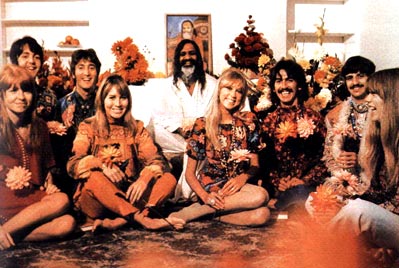
BeatlesBeatles

Rishikesh

Shanti“, man. The Holy Ganges still flows clean as it emerges from the hills. Quiet, relaxing. A perfect space to write that novel, play bongos, or watch your hair grow.

Rishikesh is “The Yoga Capital of the World“.

Yoga? I know nothing of the science of Yoga. But it seems to me they obfuscate a practice (stretching and light conditioning) done safely and effectively by 7-year-olds.

Practitioners would highlight the mental discipline, a total lifestyle. This is true for serious yogis as it is for dancers and martial artists. But I just can’t stand mute when someone extols the “topsy-turvy manoeuvre” as religious experience.

It’s a headstand! We teach it to 6-year-olds!

Still, students in Rishikesh were all mellow-happy. I should make time to try yoga. (Should I choose Bhakti, Hatha, Laya, Kundalini, or Raja yoga?)

Rishikesh is replete with dozens of massive ashrams, housing untold thousands of Hindu pilgrims. Yet there was no place for me.

One gatekeep looked like a sadhu, but acted more soldier than sage. (Ex-military in the British tradition, as it turned-out.)

Later he warmed to me, after I concurred that most backpackers are complaining cheap-skates. Suddenly a great Ganges-view corner room became available. I camped on my balcony looking over to the cremation ghat.


GodGod?

In 1900, God was a “given“. But by 1980, 20% (worldwide) of people said they were non-believers. (World Christian Encyclopaedia)

Einstein believed in God. Feynmann found only “a mysterious universe without any purpose“.

Particle physicists have a better chance to answer the question than philosophers. They seek the G.U.T. (Grand Unified Theory) which will explain “everything“.

Many a genius concluded that God exists. Saint Vinoba was asked, “Do you feel as sure of God as you do of the lamp in front of you?

I am sure, quite sure, of God. But as for the lamp …

Gandhi heard what he assumed to be the voice of God tell him to undertake a 21 day fast. Gandhi did not lie. Was it a schizophrenic episode?

Psychologist Antony Starr noted that unprovable beliefs shared by a few are delusion, but those shared by millions are religions.

Scientific rationalists should not believe in God. Nor should they fall in love, or feel fear watching a horror movie.

The Dalai Lama (officially an “atheist“, but the most religious atheist I can imagine) pointed out that we are born into this world not needing religion, only affection.

The historical Buddha told his followers clearly that there is no God. After his death they rushed to fill the void with … The Buddha.

Gandhi said that all religions are different leaves on the same tree.

But what is the tree?

Joseph Campbell called the myths and religions of man, the “masks of God“.

But what lies under the mask?

Even the most devout atheist will agree that E=mc2. Matter is energy. The atheist might even go along if you call that energy “God“. It’s just a word.

The debate really starts when you claim that God is sentient, creates or destroys, intercedes on Earth.

This is difficult to defend as “it rains on the just and the unjust“. Bad things happen to good people. None of the religious rationalizations, I’ve heard, convince me.

Yet I don’t have the conviction to deny that your God exists. Some microbe in my small intestine might deny that I exist. It would be mistaken.

Obviously a God might “be” which we can’t yet perceive. Perhaps God is unaware of our existence too. (Could you call him “God” then?)

Microbe that I am, I still can’t condone any God which calls you to hurt yourself or others. I get suspicious if your religion:

  • is exclusive (“chosen people“)
  • demands surrender to God or guru
  • emphasizes recruitment or donation
  • includes “extreme” doctrines (better is a “middle path“)

Ethics and morality can certainly exist autonomous from religion. Best is if your religion reinforces the (ever evolving) mores of society. At a minimum it should not conflict with our current standards of human rights.

Me? I’ve been studying monkeys.

We and the apes evolved from a common ancestor. Thence we came — tribal bands of pesky hunter-gatherers.

Life was short and brutish for primitive man. (We sired 20 offspring in order that 2 survive to adulthood.) Life was precarious. Drought, flood, disease, invasion. A dangerous world of evil forces.

The only defense was to “call upon powers which were a match for these adversaries or to propitiate the malevolent forces themselves“. (Roger Housden)

Superstitions, rites, rituals for protection evolved in every clan. The “evil eye” was feared the world over.

The first deity of which we know is the “fertility goddess“; “Earth Mother“, “Maha Devi“.

The miracle of life. The profound sense of wonder at the magic of birth was akin the awe of the mountains, thunder storms, the sea.

Energy.

Often She was represented by a clay figurine. I know because a friend once made and gave me such a fertility goddess — a fine gift. (Mine hasn’t worked yet, Mary.)

You must know that a female supreme deity can’t last long in a male-dominated species like ours. She was usurped by male warriors like Zeus, Thor, Indra.

But for me the original God is female. And She is energy.

prayer

… of course I could be wrong. Perhaps my Truth is some sort of ignorance I’ve mistaken for wisdom.

I should go back to Tibet, search out Shambala, consult the “Spiritual Masters” of the Theosophists who have been monitoring the progress of mankind.

Hard RockI was mad to have missed the chance to ask Satya Sai Baba, near Bangalore. Two Texas Indians married at his ashram assured me he’s a true fakir.

Sai Baba is the #1 guru of all time, a “man of miracles” who can materialize Swiss watches, heal the sick, and once turned into a sea serpent in front of hundreds of witnesses.

Sai Baba out-draws everyone but the Pope. He fed a million people for a week at his 70th birthday party.

A founder of the Hard Rock Cafe knows he’s for real. He donated $54 million. “Love All. Serve All.”

PS

I’m Quitting India. I’m gone down the Irrawaddy to hunt down Kurtz.

McSadhu

travelogue – the story of my experiments with truth – India

Once upon a time a Calcutta boy grew to become a great scholar, philosopher, and writer. In the French colony of Pondicherry he established an ashram teaching a new “Evolution“. The aim not a departure of this life to any Heaven or Nirvana, but a perfection of life on Earth.

Matter manifested into life. Life evolved “mind” (a consciousness of our existence). Next is the transition to a kind of Superman, with supramental understanding that all life is part of the same “Energy“.

This sage is Sri Aurobindo. You may never have heard of him, but you know his work. He made a supramental intervention at Dunkirk, turning the war in favour of the allies. Later he declared India “free” for his 75th birthday, Aug. 15, 1947.

Sri Aurobindo Mother

Aurobindo had a disciple and partner, a French woman known only as “The Mother“. She was an artist, an occult mystic with even greater telekinetic powers than her mentor, and a tennis nut. She conceived a utopian “experiment in international living where men and women could live in harmony above all creeds, politics, and nationalities“, as long as they could speak French.

The community would be called Auroville, City of Dawn. Configured in the shape of a spiral galaxy, communities would have names like Eternity, Gaia, Quiet, Fertile. The spiritual heart would be a Zeiss crystal sphere enclosed in a spare white marble meditation chamber, housed in a giant dodecahedron. Star Trek architecture.

AuroThis new Eden attracted idealists from all over the world. Even Saskatoon! I moved in immediately.

I was impressed with the courage of trying to build Paradise, an experiment material and spiritual. Anyone can meditate in a cave. Auroville took guts. Plato would be proud.

Since it opened in 1968, Auroville has struggled. Settlers were starving in 1976. Utopia is a work-in-progress.

After the Mother left her body in 1973, an acrimonious power struggle was inevitable between the ashram (which controlled the money) and the increasingly pragmatic Aurovillians.

In 1988 the Indian government finally transferred power to a committee representing all interest groups. Progress is slow. All talk no action. Too much democracy?

Evolution was faster with Mother as benevolent dictator.

(As a neo-Confucius wandering state-to-state looking for a potentate to install my ideal government, I’d be happy to take over. Aurovillians would fly right, or be drinking the special Cool-aid.)

Auroville is clean and green. Mongoose run bold as house cats.

All life’s necessities are available; ayurvedic medicine, reflexology, pranic healing. You can get your lymphs drained.

Library, computer lab, health food. It’s a cashless society, everything done on account. I liked the “Free Store” — used clothing and toys dropped-off and picked-up as needed.

Jazz on Sunday nights. Theatre Sports Fridays.

My guesthouse provided bikes and motor-scooters so I could explore the communities and get to the beach.

Aurobindo’s ashram itself (in town) was disappointing, but Frenchified Pondicherry was a treat! Wide, clean boulevards, Hotel de Ville, red-capped Gendarmes. The Tricolour flies the Consulate.


Gandhi poleGandhi’s Ashram, Sevagram

The Story of My Experiments with Truth” is Gandhi’s autobiography. A tale simply told.

Gandhi was a normal boy, a little rebellious. He stole money, smoked, ate meat — then repented, submitting a written confession to his father.

Some years later he became the impossible, a truthful man. He said he had “no regrets about any word spoken or written“. A lawyer for 20 years, he never lied. How about that?

The essence of lying is in deception, … a lie may be told by silence; by equivocation; by the accent on a syllable; by a glance of the eye; attaching a particular significance to a sentence; and all of these lies are worse and baser by many degrees than a lie plainly worded.”

– John Ruskin

Ultimately Gandhi declared “Truth is God“. Truth in word, deed, motivation & thought.

A week at Gandhi’s, I was overwhelmed by his story, by the self-sacrifice and altruism he inspired. I was brought to tears dozens of times as I visited his many memorials across India.

Gandhi’s commitment to truth made me consider my own “weakness for dogmatic and exaggerated statements“. (Herzog) I’d like to claim a comic style a la Hunter S. Thompson or P.J. O’Rourke; that I’m sacrificing the boring, literal truth on the higher alter of humour. The Mahatma would not approve, I know.

Then I considered my use of unattributed quotations. These scribblings are mostly anecdotes I’ve liberated from books and fellow travellers. Precious little is divinely inspired. A friend (kindly) suggested I wasn’t a plagiarist but, rather, a “jewel thief“. (Becket?)

Osho International (Bhagwan Shree Rajneesh)

Remember Osho, the “sex guru“? His scandalous Oregon Rajneeshpuram ashram? His fleet of Rolls Royces?

The “man” charged Osho with immigration fraud, fined him $400K, and deported him back to Pune, India in 1985.

My guidebook urged me come see “hundreds of disaffected maroon-clad yuppies being individuals together“. I couldn’t resist.

Before admittance to the ashram you must pass an (intriguing) HIV negative test. Inside the leafy, immaculate compound there is no hint you’re in India. Pretty people, some sitting close, cow-eyed. Others lead blind-folded partners in a trust game. Unseen speakers pipe new-age music. Classes are offered in Chinese, Sufi dance, calligraphy, koan study, archery, and “zennis” (zen tennis).

Osho’s the rogue guru who could be counted on to do or say anything. Still his most popular practice involves laughing, crying, or being “a watcher on the hill” (sitting) for 3 hours / day. “This is the most important breakthrough since the Buddha 25 centuries ago.”

Osho was his own worst enemy. His most astute business move was to leave his body in 1990. With no more fear of scandal, the ashram is booming. It’s the #1 Club MEDitation in the world.

Osho’s market has always been rich Westerners. The kind who believe James Redfield (“Celestine Prophesy“) to be a spiritual genius. They load up with “new” (carefully re-edited) Osho videos and books before flying home to New York or Milan. Audio tapes of his silent communion with devotees sold briskly.

Everyone I spoke with who spent time there left disappointed. But I thought it looked fun and harmless.


Dharamsala

I write from a scenic Hill Station in the Tibetan foothills. This is the Tibetan Government in Exile. Dharamsala is the main refugee centre and home of the Tibetan Children’s Village, a residential school with over 2000 kids.

I’m in a mellow place. Dharamsala is still surprisingly undeveloped; pot-holed, muddy roads, littered hillsides. The Dalai Lama had lunch in a local eatery with Tenzin Palma (American nun who spent 12 years in a cave retreat) — nobody pestered them.

Dalai LamaGere’s here. And Goldie Hawn. The Dalai Lama is teaching an advanced tantric initiation.

Can you believe this? A charity golf fund-raiser. Pounding golf balls for merit off a makeshift mountainside driving range. (The Dalai Lama has a terrible slice, rushes his swing.)

We marked the 40th anniversary of the Tibetan uprising. Recently, 6 hunger-strikers were force-fed after 49 days. One, 60-year-old Thupten Ngodup, then set himself ablaze. Their (ignored) demands were:

  • U.N. debate Tibet
  • U.N. investigate Human Rights violations
  • U.N. Special Envoy to facilitate dialogue

Dharamsala attracts an interesting mob; Tibetan pilgrims, fresh-faced volunteers, hangers-out, and wanderers.

For the first time I’m staying at a Buddhist retreat. A founder, Lama Yeshe, died in 1984. But he’s still here in his new incarnation, a Spanish teenage monk. Smoking, alcohol, sex, theft, and lying are forbidden — this is truth.

Each evening Westerners get together for meditation and a “teaching“. The theme, appropriately, is “delusion“. But our teachers, mostly American nuns, babble free of any confines.

There is far too much emphasis on the teacher-student relationship, a throwback to the times of oral transmission of wisdom. Those with spiritual accomplishment and experience are assumed to be educators.

I quickly tired of long debates on whether a Buddhist should rescue a fly trapped in a web. But I did feel compassion for the sincere, muddled seekers caught up in the complexities of ancient text and ritual. They are an intelligent, thoughtful group, but unenlightened as the rest of us.

The Western mind has difficulty melding with Buddhism. The Dalai Lama is constantly advising not to change religion. He’s seen the damage far too many times, especially when Westerners put on Buddhist robes.

Yet there is something excellent in Buddhism. Eastern Buddhist are radiant, serene, full of fun and laughter.

Buddhist masters are capable of incredible physical and mental feats. One Rimpoche refugee was assigned brutal Himalayan road construction. He worked joyously, unaware of the cold, mentally transforming a frozen quarry into a “pure realm“.

I tried to reduce Buddhist philosophy to a few USEFUL elemental CONCEPTS & TECHNIQUES.

Life is IMPERMANENT; birth, aging, disease, death. You are travelling by train, 3rd Class, or perhaps 1st Class A.C. The only thing certain is that your train will crash. You just don’t know when. So enjoy the ride.

I’ve always denied death, but Buddhists find it liberating. The Dalai Lama rehearses his death moment every day (to get it right when the time comes). He’s always talking of living and dying in peace.

The founder of Tibetan Buddhism meditated in a charnel ground. Buddhists make instruments of human bones, bowls of skulls.

DETACHMENT. No clinging or despising. Renounce the world and accept it back each day as a one-time-only gift.

SUFFERING is part of life’s cycle. Should we ignore it? Call on the Gods to intervene? Can we be “happy” when others are suffering?

The Buddha said we should not rely on external saviours. Instead, cultivate our own “Buddha-nature” (call it “Christ-spirit” if you prefer) — LOVE(be happy when others are happy) and COMPASSION(be sad when others are sad).

When the Dalai Lama first visited the States in 1977 he noted that Americans only show affection for their dogs and cats.

A useful concept is KARMA — accumulate “merit” (like a bank account) through good action and thought. MOTIVATION is critical. Karma makes more sense to me than sin-all-week, repent-on-Sunday Christianity.

Buddhists believe meditation is essential. I find it difficult and frustrating, the posture uncomfortable. Neither meditation nor prayer have ever done much for me.

I liked the chanting we did at Gandhi’s. I’m thinking I’d like my own spoken mantra of favourite quotations set to a musical score. Regular quiet time. Gandhi, the most practical Holy man you’ll ever find, suggested to sit in a chair or stand if that helps concentration.

VISUALIZATION is the next step. Buddhists are filled with calm when they see the Buddha. Sunlight sparkling off the lake might do it for me.

The Buddha, a reformer, said we must not believe in tradition simply because it is written in religious texts. Do not blindly accept authority of teachers. Keep testing and reinventing. When you find something that agrees with reason, conducive to the good of one and all, accept and abide by it.

I can disregard reincarnation, enlightenment, Buddhahood. It’s enough to aspire to be a little more generous, patient, persistent. Less susceptible to that “sudden, temporary madness“, anger.

Truth?

That greater seeker, Gandhi, always disclaimed, “In my search for truth I have disregarded many ideas and learned many new things.”

Me too.

Nietzsche argued that there are no truths. Heisenberg proved it — “Nothing is certain“.

Be assured at least this travelogue is truthful. Even my golfing with the Dalai Lama. We golfed and chanted.

Actually we just chanted. I don’t think His Holiness is a golfer.

Continuing my experiments with truth,

– Shri Swami McBhagwan

PS

Perhaps I’ll follow the Beatles to Rishikesh. (Though George fell out with Maharishi Mahesh Yogi after the giggling guru fondled Mia Farrow.)

Where is Alanis? I haven’t bumped into her yet.