
Though I keep checking the tick box on my income tax form, I still don’t seem to be registered as a voter.
A special trip with copies of utitility bills, etc. might be needed for me to weigh in on the Canadian election.
Here’s how the polls stand:

Though I threatened the conservative M.P. in my riding to support someone else, the offending legislation I was railing against has been, for now, dropped.
If they allow me to vote, likely I’ll vote Conservative. They are the most fiscally responsible party. And we need fiscal responsibility right now.
There’s a panic mentality.
Economist magazine likes incumbent Conservative Prime Minister Stephen Harper. Here’s their article — a big shot in the arm for his party, sinking in the polls right now.
… the Toronto stock-exchange index tumbled another 401 points—making for a cumulative drop of 3942 points or 28.6% since September 1st—prices for oil and other commodities softened, and the Canadian dollar dropped. Outside the hotel, unionists belonging to the Canadian Auto Workers mounted a New Orleans-style funeral march, complete with brass band and a coffin to symbolise the 67,000 manufacturing jobs lost in the past year. …
Did Harper do enough to protect those stock holders?
… in relative terms, Canada is doing rather better than most other rich countries. Its banks have declared some losses from dabbling in American sub-prime mortgages. But they remain in “considerably better shape than their international peers”, according to Mark Carney, the governor of the Bank of Canada, the central bank. Banks continue to borrow and lend money. Late last month, Teck Cominco, a mining firm, managed to borrow $9.8 billion to take over Fording Canadian Coal.
The carnage on Wall Street has not threatened institutions, but it has rattled nerves. For most borrowers, credit has tightened. That has prompted Mr Carney to inject liquidity. On October 8th the Bank of Canada cut its benchmark interest rate by 50 basis points (to 2.5%) in a co-ordinated move with the other main central banks around the world.
The economy is still growing, albeit slowly. The growth is mainly in the resource-rich western provinces. The fall in commodity prices will certainly slow things down. The plunge in the oil price means that some of the $110 billion of projected investment in Alberta’s oil sands may be postponed. But Alberta’s government still ran a half-page ad in the New York Times earlier this month to try to lure American workers north. …
Canada is sitting pretty compared with the carnage in the USA.
But panic from those hurt by collateral damage from the USA may sink the Harper ship yet.
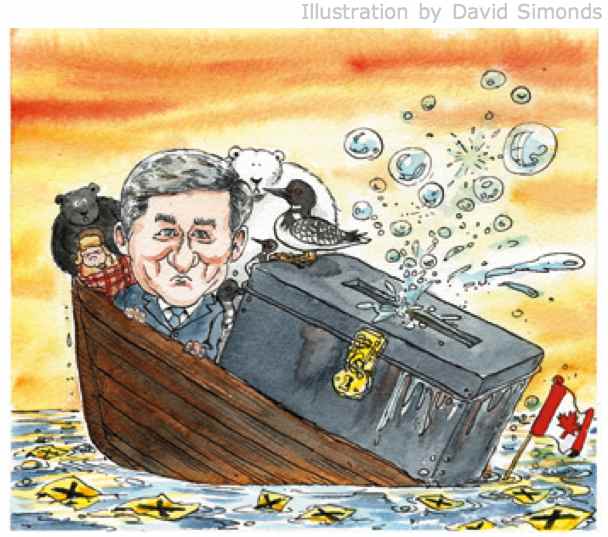
Economic fears ambush Stephen Harper’s hopes of a majority – Economist
In the end, it does not matter much. Liberals and Conservative are almost the same. Minority or Majority government. There are pros and cons to both.
Likely I won’t bother voting.


I live in Calgary West, the (electoral) home of Rob Anders. I say his electoral home because as far as I know, he hasn’t even appeared in Calgary West once this election. In fact, a friend of mine got a letter from the Rob Anders campaign that, first, didn’t mention Rob Anders’s stand on ANY issue even once and, second, was written and signed by Rob Anders’s CAMPAIGN MANAGER. I can’t decide if this is evidence that he is so far hidden they can’t even get Anders to sign his own name or that Anders is so cocksure that he just can’t be bothered. (Other possibilities exist, and are also fun to contemplate.)
Lots of people are similar to me in this respect that they simply will NOT cast a vote for this guy, even if they would ordinarily vote Conservative. I can’t vote Liberal (the stink of Chretien lingers), and NDP and Green Party both come from a paternalistic, socialist perspective that I would have a hard time even considering. There is an independent candidate running, but I know nothing of him except his gender.
Therefore, I think I will be voting preferentially. I will either cast a 1 beside the independent, and a 2 beside Jennifer Pollock (whom I like despite her being Liberal), or I’ll switch those; a 3 beside the Green candidate, a 4 beside the NDP candidate, and if anybody else but Anders appears on the ballot, that person will get my 5.
I am aware that this will spoil my ballot, and that saddens me. Still, I think it is worth it. I realize that people are sick of the current first-past-the-post system, and I hope we are able to move to a preferential voting method. My further hope is that by marking my ballot this way, people will see that it is not hard to implement such a system.
There are lots of benefits of a preferential voting system. The most important is that no voter’s vote is ever wasted. Each voter who fills out his ballot correctly will always vote either FOR the eventual winner, or AGAINST that person. He may or may not get his first choice, or even his second, etc. but he will always get the choice to vote either for or against the eventual winner. In these days when voter apathy runs rampant and more to the point in a system WHERE IT IS REASONABLE THAT VOTERS STAY HOME, an alternative system in which every vote counts looks (and smells) as fresh and compelling as freshly home-baked bread.
Another benefit of the preferential voting method is that similar candidates don’t need to worry about splitting the vote. (Instead of splitting the vote and allowing a third candidate to come up with a plurality, one of the two similar candidates will eventually fall to the wayside, and the other will presumably pick up his votes.) The direct result of this is that voters are provided with more candidates from which to choose and in particular, from that part of the spectrum that is more likely to win. In Calgary West, if such a system were in play, we might well see a whole ice cream store of conservatives and be able to choose from among such flavours as Middle of the Road; socially progressive; socially conservative; fiscally conservative; Christian Right; Muslim Conservative (since Calgary West is the home of a lovely mosque and a large muslim minority); libertarian; War-supporters; War-opposers; and all sorts of permuations. Can you imagine the debate and the horse-trading in a standard 28-day campaign? I feel fairly confident that Rob Anders gets in each time because of some lockdown with his constituency association, but with a preferential system of voting, his constituency association becomes unimportant as a backer of any ONE candidate and might even become more a clearing house of conservative ideas, holding debates, etc.
The less obvious but just as important justification for moving to the preferential system is that we actually get to know how our neighbours think about issues of the day. Under a first-past-the-post system, a non-mainstream candidate may decide to run, even if his campaign is doomed to lose, simply to provide a forum to get his alternative views across. Unfortunately, though, he will never know to what degree his campaign caught the attention of the constituency precisely because each voter is going to be skeptical of “throwing away his vote”. Under a preferential system, a similar non-mainstream candidate GETS TO SEE TO WHAT DEGREE HIS VIEWS RESONATE precisely because no voter ever has to worry about throwing his vote away.
As an example, imagine a conservative who is really opposed to the Afghan war and who is deciding whether she should run in a race that has already a pro-war Conservative, a pro-war Liberal, and an anti-war NDP candidate. Under a first-past-the-post system, she may not even run, as every vote she gets from her fellow conservatives takes away from the only Conservative candidate, and every vote she gets from anti-war supporters who would otherwise vote for the NDP candidate takes away from the only anti-war candidate. In short, she may well simply be paving the way for the non-conservative, pro-war Liberal candidate. Should she decide to not run, we never get to find out how strong the anti-war segment of the constituency is.
In a preferential voting system, this strategic voting concern vanishes. If on the first ballot, she takes away votes from her conservative brother or from the NDP candidate, then she either rides those votes to the second ballot or she is eliminated. If she is eliminated, the voters who supported her are still in the game and in fact now get to choose between the pro-war Conservative and the anti-war NDP candidate. A real choice. If she is not eliminated, then either the Liberal, the other Conservative, or the NDP will be. If it’s the NDP candidate who is eliminated, then especially if she’s done some courting of this vote in the campaign, maybe she’ll be able to ride the anti-war support through to the next ballot. (If not, at least she gets to see how strong the anti-vote really is.) If it’s the Conservative who is eliminated, then those Conservative supporters are going to have to decide if they want a war-opposing Conservative or a pro-war Liberal, which again, is a real choice. (Presumably, they’re not going to switch to the war-opposing NDP candidate.) The main point here is that because voters never throw away their vote, we actually get to see what our neighbours think.
For all these reasons (and believe me, I could go on and on … ) I think it is essential to good government that we move to a preferential systme of voting. If it sounds good to you, take your body to the polling booth tomorrow and cast your preferential ballot. Though it is a complete waste of your vote this time, maybe enough people will do it that we get a real choice sometime soon.
I find it hard to believe that the Conservatives are fiscally responsible, just because Canadian banks haven’t failed, and that would be a good enough reason to vote for them. Certainly Paul Martin’s deficit slaying track record beats anyone else’s in recent memory? I can see that a person would vote C because they always do, or that they agree with the larger agenda of the Harper coalition, but the reality of the Conservatives is that it is a group of fragments held together by an astute strategist in Harper, and if not for his expertise in managing his party and the spin (reason why never heard from Anders, perhaps?), he would not still be in power, the Liberals being tainted by obvious corruption.
I agree with Brian’s voting system. It seems logical to me.
However, as citizens, we are responsible to vote. Please vote for a candidate, at least for now, for whatever reason you can muster. And, in the future, work towards establishing a debate regarding preferential voting. Since this is a Conservative stronghold, that may be an obvious reason not to vote, but if you are going to vote for the winner, what is the problem? I see more of a problem in voting for the loser – and we know all of them. Which loser do you choose? Personally, as a protest against the lack of a responsible agenda towards the planet by the Conservatives, I will vote Green.