
 March 23, 2003
Kiwis have a great affection for lakes. But it would take one filled with beer to much interest a Canadian.
For me the unreported yet pre-eminent highlight of New Zealand are the many varied and fantastic waterfalls. These are the long drops of which I speak — though long drop is also Kiwi slang for a toilet in the wilderness.
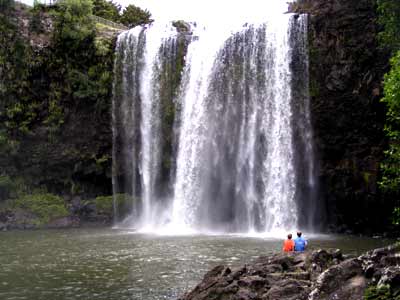 Pride of place goes to Sutherland Falls, near Milford, the highest and most hyped waterfall in New Zealand. The water pounds down with unbelievable force. I tried to walk behind the watery curtain but was driven back by the wind generated by the Falls.
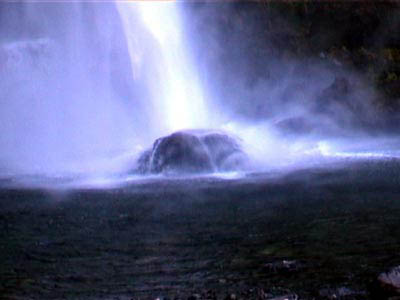 Sutherland was a Scot, the first white man to settle permanently in remote, wet Milford Sound. Alone but for his dog Groatie; he was known as The Hermit of Milford. He discovered and named the falls asserting they were the world’s highest — 5000 feet. Tourists began to flock to Milford the following year though the falls were eventually measured to be only 1904 feet over 3 leaps.
Scots like Sutherland were bred to migrate to the cold, wet, dark extremes of the world. They had the wrathful Hellfire of a vengeful Presbyterian God to keep them warm.
The south of the south island in New Zealand is Scotish. Reminders of Scottish heritage are everywhere though the only whiskey distiller recently went bust.
The largest southern city is Dunedin, Celtic for Edinburgh. A statue of Robbie Burns welcomes sons of Scotland to the town centre.
I, gone south to hike the southern alps, lucked into a spot on the coveted Milford Track — the finest walk in the world, as it is called. This sobriquet is much mocked by hikers, each listing better Tracks. (The West Coast Trail, for example.)
The controversy began in 1908 when a London Spectator editor changed the title of an article on the New Zealand track from the author’s A Notable Walk to The Finest Walk in the World. The appellation stuck.
Yet, as one hiker rationalized, Travelling New Zealand and missing the Milford Track would be like travelling to Paris and missing the Eiffel Tower.
Fact is the Milford is a fantastic hike unfairly diminished by detractors most of whom have not hiked it. It is particularly fantastic in good weather — I had perfect weather. Endless highs, man.
The highlight of the trip for me was the stunning Mackinnon Pass. Vistas in every direction. I scrambled part way up a peak adjacent to the alpine saddle.
My friend RC contends I hike mainly so I can dangle my feet off cliff ledges. He’s right. I was told it would take me about 12 seconds to reach the hut 800m below this sign on Mackinnon Pass.
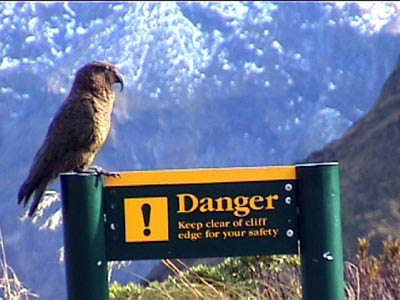 Providing much entertainment for hikers is another outlandish bird, the Kea, the only alpine parrot. This one did a proficient job of unzipping my pack!
Huge blunder on the Milford; I forgot my long pants in the van. There are two spots called Sandfly Point in New Zealand — you pass both on the Milford Track! Fjordland and the West Coast are notorious for these sneaky, blood-sucking vampire bugs.
Most National Parks are places where you cannot step off the trail lest you bruise lichen — but where fish can be hooked, suffocated, bludgeoned and devoured. Such are the inconsistencies in a world where Tequila is legal, Peyote not.
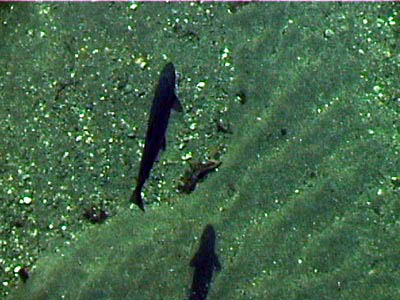 lunker Rainbow and Brown trout thrive in the incredibly clear Clinton
Milford is different. All mammals (except bats and hikers) are fair game. If you have a license you can shoot anything you want — but at least 1 km. off the track please.
For many years I went slackjawed at photos of Milford Sound and dreamed of visiting. It is a classic Fijord with vertical walls. The famous photo is The Mitre, reputed to be the second highest mountain (after Hawaii) that rises directly from the sea.
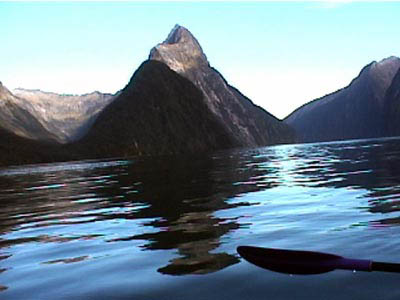 I signed on for a kayak tour with Rosco’s, a great outfit with a bit of a scandalous reputation. The comic guides paddle and entertain every day of the year from the wettest settlement in New Zealand. (9m of rain in 1988)
I am not sure the guides are actually paid — as the main remuneration seemed to be picking-up tourist chicks.
No doubt that Queenstown resort in the Remarkables is the four-season adventure capital of the world. What other destination might be a contender? Chamonix?
Bungie jumping was first popularized in Queenstown and the world’s highest tourist jump is here; a 134m platform suspended by cables over the Nevis River.
Queenstown is the draw but ET prefers Wanaka, the mellower, secondary adventure capital. My favourite activity in Wanaka, actually, was taking in a film in the retro theatre there now called Cinema Paradiso. It is filled with old sofas, pillows, even a Morris Minor. Patrons lounge where they like. At intermission you are offered fresh cookies, coffee, or can pre-order dinner to enjoy during the second half of the movie. Brilliant.
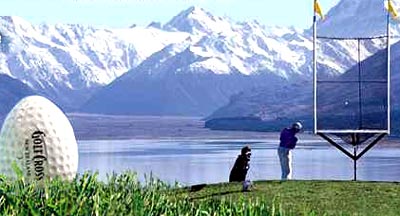
I also golfed in Wanaka. Leave it to Kiwis to cross golf with rugby, creating a football-shaped golf ball. No putting — instead you birdie by landing the ball in a net target.
 Driving in this country is the biggest adventure thrill ride of them all. Of course it is dangerous — the number of traffic fatalities almost equals the number of deaths from teen suicide!
Still some of my best moments have been driving narrow (one way) winding scenic minor highways. Paradise, near Glenorchy, lived up to its name.
I had hoped to sell my beloved van for close to what I paid for it — unfortunately I had to sell at half the purchase price. That was the biggest downer of my Kiwi travels by far.
Only about 20,000 people live on the magnificent west coast of the south island. Why? Rain and sandflies drive normal people insane. Westcoasters pride themselves on being rogues and outsiders.
West coast precipitation (similar to S.E. Alaska and Patagonia) heaps snow in massive quantities on coastal mountains. Gravity pushes the resulting glaciers towards the sea while warm (tourist!) temperatures at lower altitudes melt them.
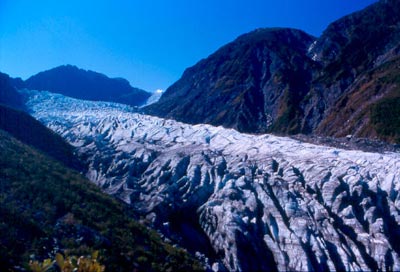 I hiked atop Fox Glacier with guide Shells (she had seashells in her dreadlocks) enjoying a most entertaining day. Finally, after many attempts, I saw the oft-clouded top of Mt. Cook and equally impressive Mt. Tasman.
Delightfully unpretentious, the Wildfoods Festival in west coast Hokitoka was a hoot. A crapulous block party with 22,000 drinkers, wild food is also available; westcargots (snails), beer-flavoured ice cream, wallaby, horse, wild goat, offal, mountain oysters, chamois, grasshoppper, meal worm, salmon with sandfly sauce, seagull, scorpion, eel and more. I stayed away from the bull penis sausage but sampled bambi burger, paua pattie, ostrich pie and managed a swallow of chocolate hoohoo grub, a West Coast favourite.
The primo west coast feed is whitebait and locally brewed Monteith’s beer. White bait is fish, each less than 2 cm long, caught by hand net and usually fried into a patty. Mmmm.
The entertainment is gleefully bad. (ie Elvis impersonators, men dressed as naughty nuns, droll British colonial administrators giving folks stick, etc.)
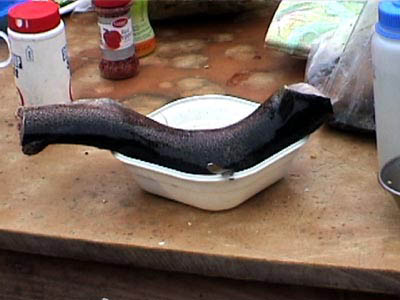
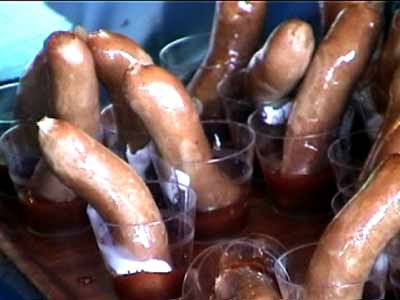 bull’s penis sausage
My last day of travel started with Wild Foods and finished at Castle Hill in the alps, scrambling limestone boulders and sloshing an hour through an underground river. A superb and appropriate last day.
New Zealand is magic. Photos do not do it justice — excepting those of Ted Scott, the Kiwi photo laureate.
 Rick McCharles