
A man brought in a little girl. He said she was four years old. She looked about two. I knew she was dying. Her father asked if we had any medicine. I said we didn’t; he’d have to take her to the hospital. He looked at me as if I’d suggested he take her to the moon.
– Monica Connell
____
This story of old rural Nepal is one I heard many times. Unlike Tibet, every kind of pestilence can flourish in this climate; rats, leeches, bedbugs, roaches. Dysentery was a big killer. TB a plague.
Things have improved immensely since Tenzing and Edmund climbed Everest. Communication, transportation, schooling, health care; all much better due largely to the advent of foreign attention and Trek tourism.
I’d like to report that Nepali cultures, the environment, and tourism exist in a harmonious symbiosis. But I don’t think it’s quite true — yet.
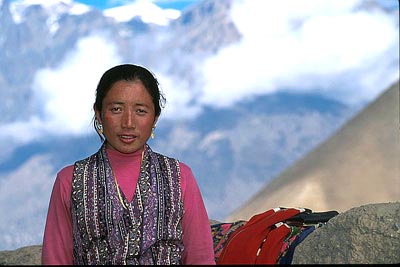
Sustainable tourism? Why not? Nepal is as good an example as anywhere in the developing world.
Trekking here is not a “wilderness” activity. You can’t get away from people, 75% of whom still live in small villages of between 15 – 80 families. The subsistence economy is non-monetary. Villages can grow and trade for almost everything they need.
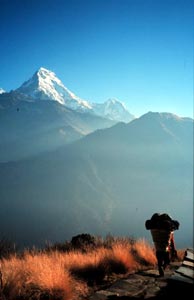 That balance is disturbed in those areas frequented by “rich, lavish, and foolish” Westerners who think it’s fun to walk up and down mountains. (No Sherpa would walk one step further than he must.) And nowhere in the Himalayas is more disturbed than Annapurana, by far the most popular hiking destination. The best hiking in the world, in my opinion.
The Annapurna Circuit is 3 weeks walking up and over the Himalayas to the Tibetan plateau, crossing a monster pass, & back down again to jungle. I did the last half of the Circuit, the Jomson Trek, acclaimed for views of 2 of the highest peaks in the world (Dhaulagiri and Annapurna) and even more famous for the best trekking teahouses anywhere. On Jomson you stroll from one terrific lodge to the next, struggling only whether to order the apple crumble or the baked “Snickers” (reportedly a Scottish invention).
In Tibet we had scornfully poopooed Teahouse Trekking; we pictured 3 week warriors, highwayslittered with unburned toilet paper.
Annapurna is not real hiking. But it is fun.
I started as high, dry, and Tibetan as I could in Kagbeni village; closely packed mud houses, dark tunnels and alleys. Protection from the constant wind.
Kagbeni is Tibet. The same arid luminosity. This is the northernmost point I was allowed to travel; the gateway to Lo Mustang, the last of the Forbidden Kingdoms of the Himalayas, still forbidden. The Tibetan trading caravans pass by Kagbeni as they always have, horses festooned with mirrors and dyed plumed headgear.
Nepal claims 9 of the worlds 14 highest mountains (over 8000 metres) none of which had been climbed in 1950 when Herzog’s expedition arrived here. He had permission to climb either Dhaulagiri or Annapurna. His team, the elite of French climbers, were badly hampered by the best maps of the day — all completely wrong.
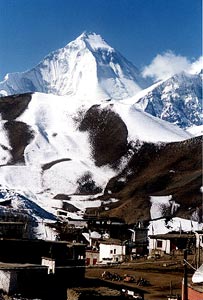 Inspired by Herzog’s journal, I set out first to climb up to the Dhaulagiri Icefall, reportedly a 9 hour sidetrip — if you find the correct route. I wasn’t worried as I carried a tent, food, and all the gear. There was no trail but I ascended as far as humanly possible up to a spectacular waterfall. I couldn’t see Dhaulagiri but had wonderful views of the Annapurna massif 30 km. across the valley.
Up there were only the huge condor-like Lammergeyers, and me, though I’m sure I heard voices and whistling coming from the waterfall at night. (Perhaps I’m becoming an Anamist?)
That balance is disturbed in those areas frequented by “rich, lavish, and foolish” Westerners who think it’s fun to walk up and down mountains. (No Sherpa would walk one step further than he must.) And nowhere in the Himalayas is more disturbed than Annapurana, by far the most popular hiking destination. The best hiking in the world, in my opinion.Inspired by Herzog’s journal, I set out first to climb up to the Dhaulagiri Icefall, reportedly a 9 hour sidetrip — if you find the correct route. I wasn’t worried as I carried a tent, food, and all the gear. There was no trail but I ascended as far as humanly possible up to a spectacular waterfall. I couldn’t see Dhaulagiri but had wonderful views of the Annapurna massif 30 km. across the valley.When I poked my head out of the tent in the morning, a big old Yak was peering back at me. The herd had climbed all the way up just to drink at the waterfall. They love to get high, these beasts.
Dhaulagiri. Would it go?
Bung Ho!
I stashed my pack in the rocks and went to search the impassable cliffs and ravines. I finally found a dry waterfall which formed a perfect ladder/staircase. It ended in an overhang. I resolved reluctantly to turn back. (Perhaps I’d learned some common sense after getting lost in the Andes overnight last trip.)
Descending I spied another possible traverse which couldn’t be seen from below. Precipitous grass slopes, thorny shrubs, several more dry watercourses, a long ridge, several false summits. Finally, eyeball to eyeball with a glacial icefall spilling out massively from beside the Dhaulagiri summit. Beautiful and terrible. This was the glacier which killed 7 U.S. climbers in ’69 (avalanche). In ’73 another U.S. team summited having had supplies air-dropped. (including 2 bottles of wine and a live chicken. Of course the sherpas would not allow the chicken to be killed on the mountain. It was carried down snowblind and frost-bitten.)
Herzog’s team climbed up here, returning to report that the glacier was too dangerous. I concurred with their recommendation, “Let’s have a go at the other fellow.”
However, it took Herzog a month just to find Annapurna 1. That massif has perhaps 50 peaks! This put their expedition very late in the season. Monsoon was coming. Climbing would then be impossible.
I too had to traverse over mountains to reach Annapurna. I was lulled into a false ease on Jomson where you can hike with your hands in your pockets. Now I was into more typical Nepali hiking; high ridge top down to river valley, across amazing permanent (and temporary!) bridges, and back up to ridge top. Exhausting. I had a number of really tough days.
But I was inspired. The Annapurna Sanctuary is one of the most incredible glacier basins in the world, completely surrounded by huge peaks; Hiunchuli, Modi, Fang, Annapurna 1, Glacier Dome, Gangapurna, Annapurna 3.
These mountains are indescribably impressive. I won’t try.
The gate is guarded by everyone’s favourite peak, Machhapuchare (Fishtail). Jimmy Roberts climbed, in 1957, to within 50 metres of the summit but turned back due to the steepness of the final ascent. On his return to Kathmandu he suggested to the Nepalese government that they keep at least this one peak unclimbed, a symbol of the inviolate. No permit has been issued to this day.
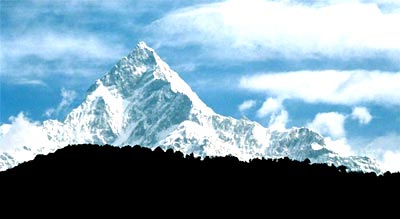 Machhapuchare (Fishtail)
Access to the Sanctuary is via an intensely scenic gorge; a narrow, winding trail through dense bamboo and huge trees. You scramble over river boulders; gnarled, polished hardwood roots; traverse the most recent avalanche tracks; climb bamboo ladders.
There are no permanent settlements here. This is the only major trekking route in Nepal subject to serious avalanche risk. Occasionally backpackers are trapped at basecamp when tons of snow collapse into the gorge from the unseen. On November 11, 1995 a freak early winter storm resulted in the death of 63 people in Nepal. This caused a bit of unease when it started raining, hailing, and snowing while I ascended to the notch of the Sanctuary gate.
The basecamp itself is bleak. An eerie calm. No wind, though clouds swirl in every direction up on the mountain tops. The scene is dominated by huge, white, vertical Annapurna — one of the most difficult faces ever climbed. On Christmas day 1997 an avalanche here killed Anatoli Boukreev, the Tiger Woods of high altitude, and subject of the best seller, The Climb.
In high season there are more backpackers than beds. Many sleep on tables or the floor. Of course I was snow snug in my tent. In the morning I pulled open the flap to watch first light on Fishtail.
A Canadian woman in our lodge said that it had a bit of a Christmas dinner atmosphere. True. It was snowing yet we were toasty around a big table draped with heavy carpets. A kerosene burner blasted underneath, keeping our feet warm. A boisterous night. Rum and hot chocolate. Canadians were in the majority at the table. (Jomson was visited by only 400 Canadians in 1997 but this year it felt like I met 400 on the trail. We are easy to identify. MEC gear and a Maple Leaf — except the Quebecois, of course.)
Herzog survived Annapurna and so did I. Actually, Herzog is the only one left alive of the team, still a National hero, though a hero without any toes or fingers.
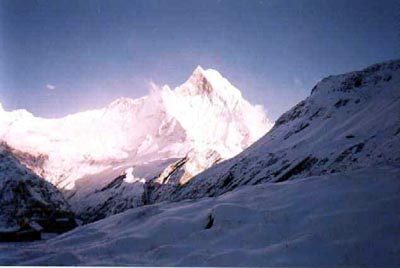
Annapurna Sanctuary as seen from my tent
I’d recommend Annapurna to anyone. A high level of fitness is not required. If you can walk 4-5 hours with a day pack, you can do the 300 km. Circuit. Actually less than a quarter of walkers carry their own pack — most hire porters. French groups mount unnecessary expeditions (like Herzog), a massive entourage carrying tents, kitchens, toilets, and food. We met one elderly Brit who had somehow signed on to one of these monstrosities. He sheepishly admitted that for 16 tourists they started with a support team of 47! (I wondered how many of the French walkers, if any, were embarrassed to see their coolies humping dining tables over the 5400 metre Thorong La.)
I’d like to do the whole circuit with a trained, certified cultural guide who could explain the village ways, point out the flora and fauna along the way through the various climatic zones. Pack horses would be better than porters. A group would all enjoy the Circuit. The faster, more adventurous could sidetrip, meeting-up at specified lodges at the end of the day.
I’d consider trying a Trekking Peak. These are hills(only peaks with permanent snow cover are called mountains here) that require a guide but no particular mountaineering expertise. I talked to many who had Peak permits, but not one who actually made it to any summit. All of the designatedhills are higher than any mountain in Canada.
But is this Trek tourism sustainable? Can tourists actually help more than they hurt?
I think so. The best of the Trek villages are wonderful — clean, happy, friendly. You might be walking in the Swiss Alps. People don’t ruin natural beauty, motor vehicles and electrical wires do. Stone fences and irrigation canals, terraced fields, villages clinging improbably to ridge tops — all very pretty.
And local artisans are flourishing. And I’ve seen that tourism can promote cultural reclaimation.
I rode back to town on the top of a bus with a second generation Tibetan woman (she had been born in a refugee camp). She was articulate, educated, self-confident and very proud of her heritage. She was well groomed and very well dressed. She shouted encouragement and waved at the dusty Tibetans bringing their horse caravans in to Pokhara to trade. “Can you believe it?”, she exclaimed. “They NEVER bathe!”
 PS
PS
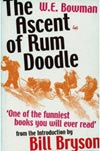
Herzog’s book Annapurna is the classic of traditional mountaineering exceeded only, perhaps, by Bowman’s Ascent of Rum Doodle.
PPS
I saw the Tibetan phenomenon of a blue and gold striped sky many times in Nepal. As the sun sets behind high mountains, the entire sky is filled with a golden glow, except for bluer shadows from the highest peaks, some of which are out of sig
PS
