
Newspapers are dying more slowly than I anticipated.
… On the other hand, my journalist friend Tom Mangan just took severance from the San Jose Mercury News. He’s moving out of California to look for a new job.
Papers funded their news rooms with revenue from classified ads?
No wonder that model is failing. That disconnect was stupid in the first place.
People should pay news reporters for news.
I’ve never had any worries about what will replace newspapers. If there is a market for news, entrepreneurs will fill that demand.
A good example is Politico:
In 2006
… John F. Harris and Jim VandeHei left The Washington Post to become Politico’s editor-in-chief and executive editor, respectively. …
Why would they leave that esteemed newspaper?
… The Politico is an American political journalism organization based in Arlington, Virginia, that distributes its content via television, the Internet, newspaper, and radio. Its coverage includes Congress, Washington lobbying, and the 2008 presidential election. It was a sponsor of the 2008 Republican Presidential Candidates debate at the Ronald Reagan Presidential Library on May 3, 2007, and the 2008 Democratic Presidential Candidates debate at the Kodak Theater on January 31, 2008. …
Oh, so they could report on politics the way they wanted. Here’s their Mission.
… A 2009 profile of the organization in Vanity Fair said Politico had an editorial staff of 75 and a total staff of 100. Its circulation is around 32,000 and as of summer 2009 its web traffic was around 6.7 million unique visitors per month. This is less than the 11 million it had during the high point of the campaign, but most political news outlets have lower traffic outside election years. As of July it was expected to have annual revenue of around $15 million, primarily from the printed product, enough for the publication not to lose money. …
A sample page:
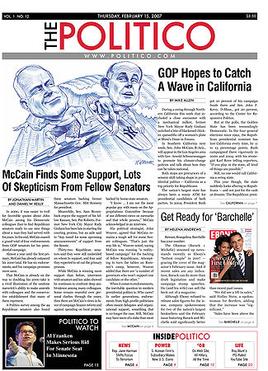
The Huffington Post is another success story, though much different than Politico. Established only in 2005 it’s already the most linked to blog anywhere. Attracts big name celebrities, academics and policy experts as guest bloggers.
And has no problem finding new investors.
 Rick McCharles
Rick,
You get what you pay for when it comes to journalists, as with everyone else. The Huffington Post, for example, pays very few of its journalists. People who are amateur (read: unpaid) journalists don’t have the time or energy to investigate stories thoroughly and in person. I don’t know how this plays out in the U.S. but Canadian newspapers are getting worse and worse. I know you’ve never been a newspaper fan. But if you want poorly written stories full of typos, written by people who are volunteering their time just to see their names in print, check out local newspapers across the country. A friend of mine just wrote a story for a national newspaper for free — just so she could cash in on the freebies she’d be able to get by saying she was writing for that paper. How good is that story going to be? How ethical is it for a newspaper to charge its advertisers full price and pay its writers nothing?
Kate
Ha.
I didn’t know Huffington Post did not pay.
Amazing they have been so successful.
Sounds like Politico is better.
… my hope is that one day everyone online will be paid by micropayment. If I read Kate’s blog, she will get $.04.
If I read a story on Politico, they will get $.04.