
Initially keen on following the American Health Care reform process, … I eventually lost interest.
Once the bill was signed I waited on two sources to dissect the result:
• Slate Political Gabfest audiocast
• Economist magazine audiocast
On Slate, the post-mortem by John Dickerson, David Plotz, and William Saletan was terrible, their worst broadcast yet.
Economist was good, perhaps the best summary I’ve heard to date.
Over half of Economist analysts feel that having the bill passed is slightly better than it not having passed. It’s a “marginal improvement“.
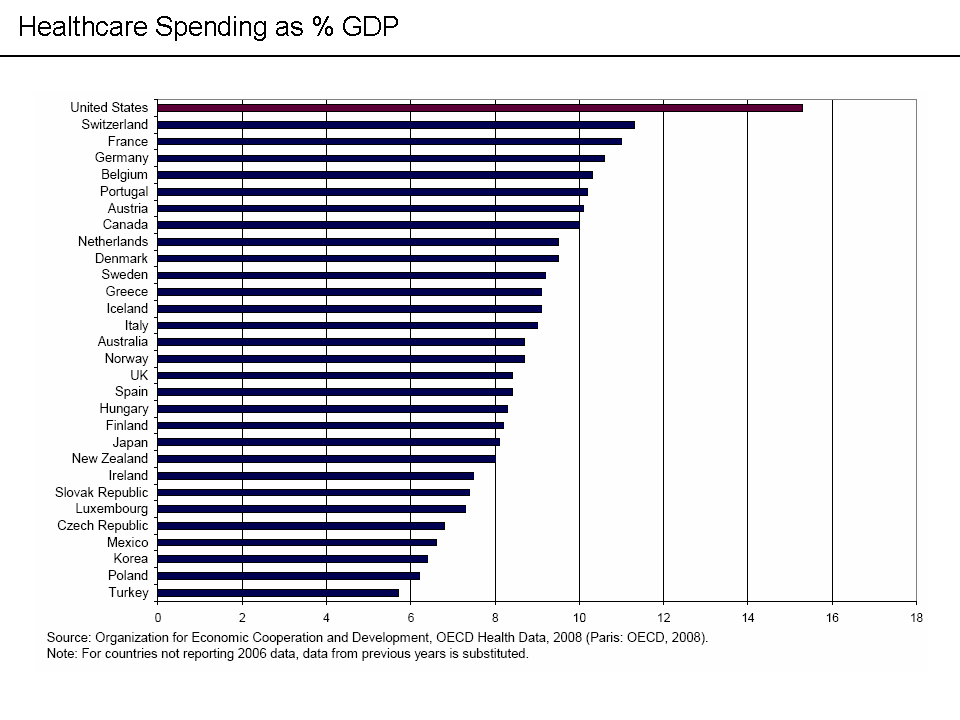
The complaint of Economist magazine is that the biggest problem was not addressed in the bill, the ludicrous cost of Health Care in the U.S.A. … It’s more expensive than anywhere else in the world, with no evidence that the service is any better.
… In spite of the amount spent on health care in the U.S., according to a 2008 Commonwealth Fund report, the United States ranks last in the quality of health care among developed countries.
The World Health Organization (WHO), in 2000, ranked the US health care system 37th in overall performance and 72nd by overall level of health (among 191 member nations included in the study). International comparisons that could lead to conclusions about the quality of the health care received by Americans are subject to debate. The US pays twice as much yet lags other wealthy nations in such measures as infant mortality and life expectancy, which are among the most widely collected, hence useful, international comparative statistics. …
What America has gained with the bill passing, perhaps they’ve lost in making the nation even more divided than ever between Democrat and Republican. Recent polls still show over half of Americans against the Obama bill.
I highly doubt the Republicans will ever repeal what’s been gained, but they should if they believe even 20% of what they’ve been saying to the media. (I made a special trip to bypass Searchlight, Nevada the other day.)
What should the Americans have done?
Here’s the Rick McPlan:
1) All citizens must have Health insurance. Failure to do so results in an escalating series of warnings, fines and stints in a “work camp”.

2) All insurance companies must offer to insure any citizen. None can be declined for any reason. Any insurance company not wanting to do business in the nation, we show the door.
3) Private companies can offer any Health Care product … under license.
4) Phase out government health care services over 20 years, or so.
… Let the free market sort it out. But with a good safety net for anyone and everyone willing to pay for insurance.
Obviously a percentage of the population are too incompetent or stupid to ever get themselves insured. They’ll be cleaning highways and removing graffiti for the rest of their lives. (That’s the biggest downside to my scheme, so far as I can see.)
Switzerland is the nation, so far as I’ve heard, most closely using this kind of simplified scheme. (It’s the second most expensive in the world, though.)
Should the Americans simply have adopted the Canadian model? … HA!
God no. Ours is totally unsustainable over the long term.


Two quick points.
One: how would private insurance companies be “forced” to accept everyone? I’m not sure what corners private insurance companies might cut in order to remain “competitive” but I can’t imagine it being good for patients.
Two: Repeating the mantra that “Canadian health care is unsustainable in the long run” does not make it a “truth”. Why, and under what conditions, is it “unsustainable”? It appears to me that the right is always quick to promote just about any public safety net as “unsustainable” (e.g. EI, CPP, etc.). Of course, the right has also done a great job with the mantra “lower taxes good, higher taxes bad” that no government is even willing to look at when raising taxes might actually be in the best interests of all (not to forget, either, that the proportion of taxes paid by companies and corporations has fallen as a percentage of the total taxes collected in Canada).
Thanks for the feedback, Peter.
Obviously I’m no expert.
But you’d agree health care costs will continue to rise in Canada, exceeding revenue. Where will that money come from if the government continues to pay?
Baby boomers are retiring. The costs to pay for them will be massive.
Your other question is easier to answer. No insurance company can decline anyone. But they can charge a higher premium for high risk.
If the free market works, another company will offer coverage at a lower cost. Eventually the “right” price will be determined for every risk.
If you can’t pay any of the companies, it’s off to the work camp.
My scheme could work, I think.
But if it won’t. Or won’t be acceptable by a majority of the population, what’s the alternative?