the internet hates McCain

Must be the sites I visit. I NEVER see a good comment for John McCain online.

Here’s a typical attack on him, supposedly by a private citizen.

Slightly more balanced is another private citizen’s video comparing the two lead candidates for President in the face of the current economic crisis.

One more bit of propaganda for Obama: Economists Support Obama Over McCain By More Than 2 to 1

are Republicans good fiscal managers?

The U.S. may have to borrow an extra $700 billion to $1 trillion to fund the biggest rescue of the financial system since the Great Depression, according to Barclays Capital Inc.’s Michael Pond.

Federal takeovers of Fannie Mae, Freddie Mac, and American International Group Inc.; the central bank’s expansion of lending to financial firms; and a slowing economy will add $455 billion to the Treasury’s borrowing needs, the New York-based interest-rate strategist estimated. …

U.S. Debt May Grow $1 Trillion on Rescue, Barclays’ Pond Says

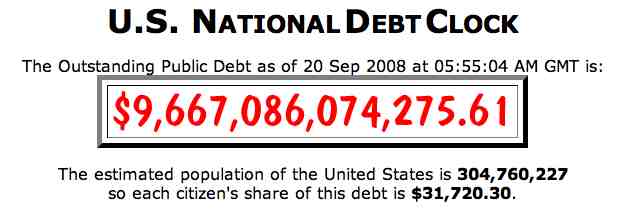
U.S. NATIONAL DEBT CLOCK

What more can the Republicans do wrong before voters are convinced the Democrats are worth a try?

Canada out of Afghanistan in 2011

Canada will withdraw the bulk of its military forces in Afghanistan as scheduled in 2011, Conservative Leader Stephen Harper pledged on Wednesday, saying the Afghan government “at some point has to be able to be primarily responsible” for the country’s security. …

“You have to put an end date on these things,” Harper said.

He added that while Canada’s military leaders have not acknowledged it publicly, a decade of war is enough.

“By 2011, we will have been in Kandahar, which is probably the toughest province in the country, for six years,” Harper said.

CBC

I agree. Congratulations Prime Minister.

Troops will stay ‘in some technical capacities’

do not trust politicians

A close election brings out the worst in candidates and their strategists.

liar
liar

… Since July, John McCain and his campaign have made 11 political claims that are barely true, eight that are categorically false, and three that you’d have to call pants-on-fire lies—a total of 22 clearly deceptive statements (many of them made repeatedly in ads and stump speeches).

Barack Obama and Joe Biden, meanwhile, have put out eight bare truths, four untruths, and zero pants-on-fire lies—12 false claims. These stats and categories come from PolitiFact, but the story looks pretty much the same if you count up fabrications documented by FactCheck.org or the Washington Post’s Fact Checker, the other truth-squad operations working the race: During the past two and a half months, McCain has lied more often and more outrageously than Obama.

Slate

Republicans are dirtier and better at it than Democrats. Seems you need to lie to bring in votes. Yet American politicians do not lose votes when caught.

The “lipstick on a pig” distortion is the most recent example.

It’s only going to get worse:
Barack Obama hits back at ‘lies’

Green election in Canada?

A far more boring election campaign has just begun. I guess I should decide who to vote for.

Surprisingly, the ENVIRONMENT looks to be a make or break issue.

by Ledaro
by Ledaro

They do it fast up here; 36 days from the announcement until the election. But then unlike the States, all the leaders are in place and well known, all of the policies and platforms ready to go, as the Conservative Prime Minister Stephen Harper tries to get a majority government. Stephane Dion’s Liberals used to be known as the Natural Governing Party, having been in power for most of the 20th century, but the center/ left is now split among four parties- the Liberals, the New Democrats with Jack Layton as leader, the Greens with Elizabeth May, and the Quebec Separatist Bloc Quebecois. …

Treehugger

As a resident of one of the biggest polluting areas of the world, perhaps I should take notice. Normally it’s assumed that “green” is simply political posturing. That politicians will never walk the walk, anyway.

Still researching …

United States of Obama

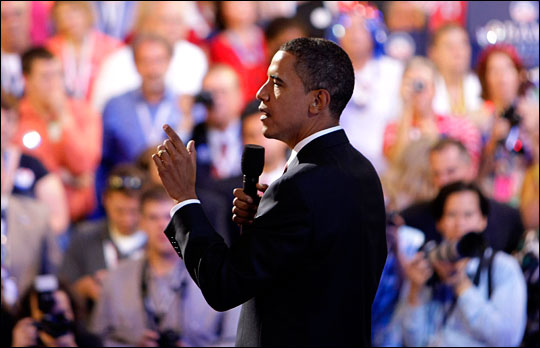
I watched the entire Obama speech at the Democratic Convention.

Though the audience was rapt, it wasn’t the most inspiring performance I’ve seen. Seems he’s decided to mute his “usual high-level rhetoric in favour of a more down-to-earth approach”.

Alex Brandon / AP
Photo: Alex Brandon / AP

Senator Obama directly confronted the charge that his popularity is merely that of an insubstantial celebrity. He reminded his audience of his early life, of being raised by a single mother who once resorted to food stamps, and by a grandmother who scrimped on clothes to support him and added: “I don’t know what kind of lives John McCain thinks that celebrities lead but this has been mine.”

I’m not sure he can “change” the USA. I hope so.

I’d love to see him try. He’s certainly the most exciting statesman I’ve seen in my lifetime. Better than a young Trudeau. Better than a young Bill Clinton.

While Senator Obama made few references to the historic nature of the night, it was underscored by other speakers, including the son and daughter of Martin Luther King who celebrated the nomination on the 45th anniversary of King’s “I have a dream” speech, delivered at the Lincoln Monument in 1963 before 250,000 people.

the great American consumer crash

James Quinn is senior director of strategic planning, the Wharton School, University of Pennsylvania. He posted a very gloomy projection on Prudent Bear:

The 6,000 sq ft McMansion buying, BMW leasing, $5 Starbucks latte drinking, granite countertop upgrading, home equity borrowing days are coming to an end. …

… the tremendous prosperity that began during the Reagan years of the early 1980’s has been a false prosperity built upon easy credit. …
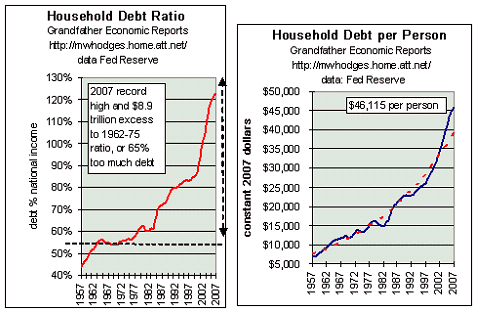
I have been accused by many of my friends and family as someone who sees the glass as half empty. I disagree with their assessment. I see the glass as it is. I find myself scratching my head trying to figure out why a society that always saved for a rainy day, consistently saving between 8% and 11% of their disposable income, now has a negative savings rate. …

In the past, the USA could have grown economically out of this kind of debt. That time is over.

… the gathering storm has arrived. It will be long, painful and destructive. Those who prepared for the storm by not taking on excessive debt and living above their means, will ride it out unscathed. Those who built their house on sand by leveraging up and living the “good” life, will see their house swept out to sea. The storm will pass and we will rebuild. Our country is resilient. …

There has been and will be resistance to the inevitable deep recession that is coming. The American consumer is not cutting back willingly. They are being dragged kicking and screaming towards the joys of frugality. The “material generation” needs to dematerialize. My biggest concern is that our politician leaders and their cronies running our government will continue to try and reverse the normal capitalistic course of recession and expansion. Companies need to fail, housing needs to find its bottom based on supply, demand and price. Those who gambled must be allowed to lose and suffer the consequences. …

It’s worth reading the entire impassioned post: The Great Consumer Crash of 2009

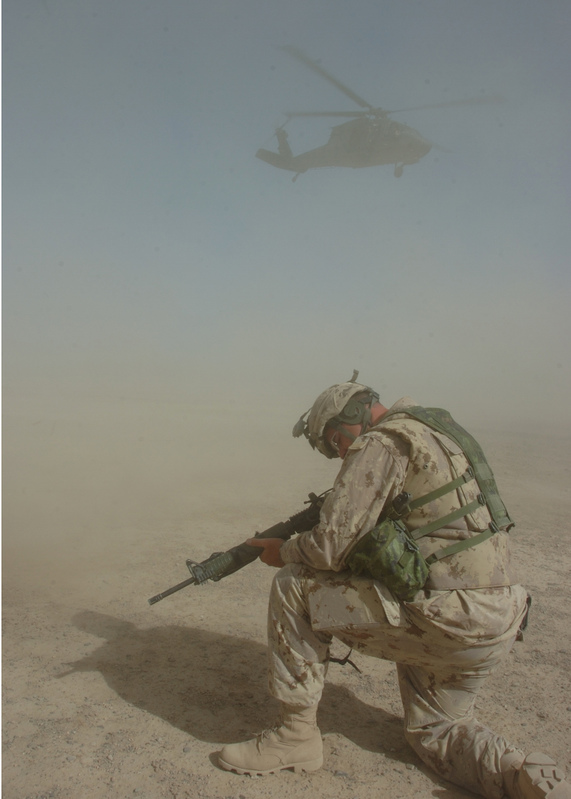
The USA must leave Iraq as soon as possible, whether they want to or not. The war has already cost each household about $20,000. From the graph above, it’s obvious families cannot afford this war.

Why anyone would want to vote for McCain — who wants to stay in Iraq for as long as it takes — is beyond me.

Obama may also be unable to soften the economic blow, but at least there is a chance with him.

war on Iraq costs $3 trillion

Let’s say you believe the War on Iraq was justified. And that U.S. security has been improved by the occupation.

How much are you willing to pay to secure your safety?

Stiglitz, former chief economist of the World Bank and winner of the Nobel Prize in Economics, has stated the total costs of the Iraq War on the US economy will be three trillion dollars in a moderate scenario, and possibly more in the most recent published study, published in March 2008. Stiglitz has stated: “The figure we arrive at is more than $3 trillion. Our calculations are based on conservative assumptions. They are conceptually simple, even if occasionally technically complicated. A $3 trillion figure for the total cost strikes us as judicious, and probably errs on the low side. Needless to say, this number represents the cost only to the United States. It does not reflect the enormous cost to the rest of the world, or to Iraq.” …

Wikipedia

Via an excellent 60 Minutes TV investigative report.

related – The cold price of hot blood – Salon

I’m not a goofy enough peacenik to believe that the USA should have done nothing after 9-11. Sadam Hussein was a modest threat. I’m not 100% against the invasion, even.

But it should have been a one-time military strike. Disabling the Iraqui airforce. Removing Sadam from power.

Perhaps 3-4wks tops. A fixed budget.

… However, the real reason for the Iraq invasion was for the USA oil industry to gain more control over the second largest proven reserves in the World. That hasn’t really worked out for them.