
 A fantastic high altitude hike in Peru. Wow! To see all annotated photos, jump to the permanent webpage in Rick’s photo archive.
Category: hiking
photos – Qoyllur Rit’i festival, Peru, 2005
 The most amazing festival I have ever seen. In the high mountains of Peru. To see all annotated photos, jump to the permanent webpage in Rick’s photo archive.
photos – hiking to Revash, northern Peru
 We hiked to little visited pre-Inca cliff tombs.
To see all annotated photos, jump to the permanent webpage in Rick’s photo archive.
travelogue – Climb Misti for Me – Peru
I returned to Peru with two goals:
1. to hike the remaining major treks
2. to visit the great archeological sites
For my hiking website, Peru is perfect. Arguably the best hiking terrain in the world but yet to be developed. It is the kind of place where people need to research — or they can get in serious trouble. …
For the complete travelogue & photos jump to the permanent webpage in Rick’s photo archive.
» climbing the Misti volcano
» hiking Colca Canyon
» Arequipa
travelogue – Chachapoyas – Peru
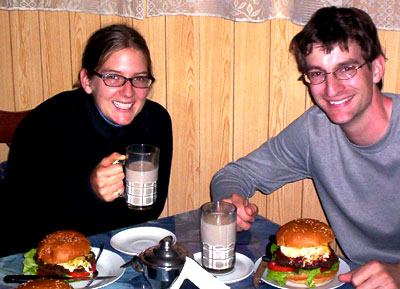
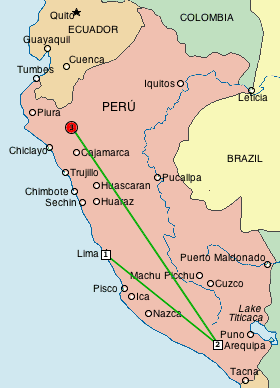 Unexpectedly & at short notice, my buddy Grant from Edmonton found time to return to Peru to surprise his girlfriend Chantelle who is working 2-years in Chachapoyas, a lovely but distant northern Peruvian Provincial capital.
We travelled 23 hours by bus & collective taxi from Lima (not as the condor flies, not the direct route shown on the map!)
Map generated by LonelyPlanet.com free personal travel website service.
A delay when our luxury Volvo sleeper came to a washout. The bus ahead ripped its rear bumper in half! Our driver pre-emptively removed our bumper using rocks & the few tools he had on hand.
Which has worse roads? Himalayas or Andes? I am guessing the Andes because they get more rain.
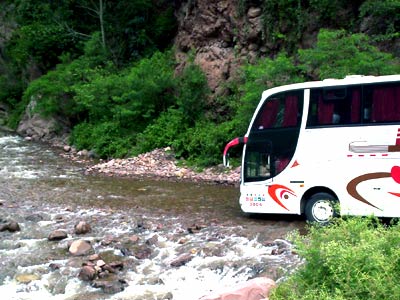
Passengers unloaded, our bus made the crossing with no damage. A relatively uneventful journey for a trans-Andean crossing, actually the lowest pass in Peru.
Chachapoyas (pop. 25,000) is home to a few expats & sees only a trickle of tourists. If you know the town as Chacha, you are a real insider.
But this is a bustling town of many government offices. Business-attired beurocrats keep the good restaurants hopping. It is far more cosmopolitan than I expected. Girls can show midrif!
I just arrived in town. Fadel found me. He runs the largest English language school and is quick to hit on any native English speaker who finds his way here.
Carmen was faster. Despite having no common language, I was invited to the disco within 3 minutes of her spotting me. I’m thinking she is a gringo hunter who dreams to leave Peru for a richer land.
Chantelle gave us a tour of the sewer project her water organization is building here. A Canadian NGO is paying for about a third of the cost.
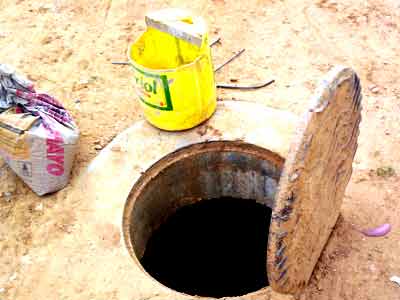
I was impressed. It is very difficult to get anything done in Peru, never mind an undertaking this complex. Local people, many of them squatters, do the unskilled labour as their contribution. Paid labour starts at US$7 a day.
Grant took me up to the dairy, an operation started a year ago, which is partly supported by a Spanish NGO. Fresh milk goes daily to children at 42 local schools.
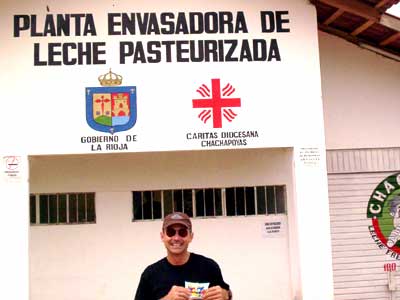 ex-milkman appraising the milk
Gringos can get only UHT boxed milk here. Or unpasteurized fresh milk. And no Diet Coke! This is the boonies.
On the other hand, Chacha is the first town with a market offering fruit, fish & produce from the Amazon.
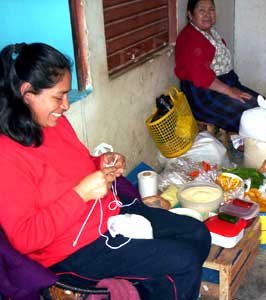
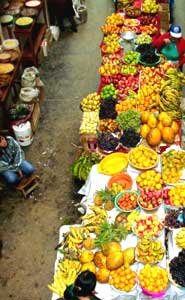
This is Flor, seemingly one of the many hundreds of ladies sitting patiently in the central market, hocking a few seasonal items. Turns out Flor is a wonder woman work-a-holic putting her 16-year-old son through engineering prep school in Lima.
Flor invited us for a meal. She bought property 3 years ago for about US$150. It has increased in value by 6 times since. She plans to build a house soon of hand-made adobe mud bricks.
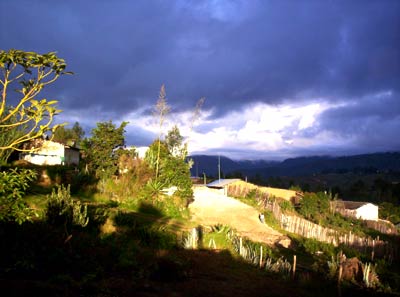 vista from Flor’s property
Peru is desceptive. Tourist all have the wrong impression on arrival. Hovels on the outside can be very comfortable homes within.
Restaurants you assume to be unhygienic, without customers for weeks at a time, are extended family kitchens busy all day providing reasonable grub.
Good Catholic campesinos like Flor should have a dozen children. She has only 2.
Urbanization & education of women = birth control.
Chacha was an eye-opener for me.
Finally, my first earthquake — 5:11 AM April 29th, 2005. (I had slept through a bigger tremor once in Trinidad.) This one felt like a train passing by the hostel.
I insisted to join Grant in the long journey north because I had to see Kuelep, the second best ancient city after Machu Picchu.

For 11 days last year, Grant & I trekked Huayhuash, likely the best high alpine tramp in the world. It was good to be back on the trail with him.
We hiked to Kuelep, 4 hours straight up, 2 hours down. A challenging day.
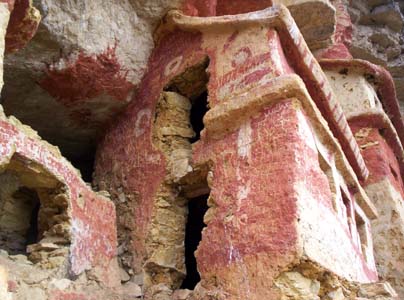
On a Sunday, 4 of us including Luz, a career woman, still unmarried at age 31, recently moved to the Provinces from Lima, hired a car to take us to the seldom seen cliff tombs of Revash. It was an excellent long day. We were the only visitors.
Gracias Chantelle. Gracias Grant.
Hasta la vista,
Ricardo
photos – hiking to Kuelap, northern Peru
 A big hike to what many call the next Machu Picchu.
To see all annotated photos, jump to the permanent webpage in Rick’s photo archive.
photos – climbing Misti, Peru
 My solo ascent of Misti, 5822m, one of the most popular volcano climbs in the world.
To see all annotated photos, jump to the permanent webpage in Rick’s photo archive.
photos – hiking Colca Canyon, Peru
 Hiking the deepest canyons on Earth.
To see all annotated photos, jump to the permanent webpage in Rick’s photo archive.
photos – Arequipa, Peru
 Santa Catalina Monastery, was the highlight of Arequipa, my favourite big city in Peru.
To see all annotated photos, jump to the permanent webpage in Rick’s photo archive.
travelogue – Towers of Paine – Chile
The main reason I travelled to South America was attending the marvels of a thousand Patagonian sights and sounds.
Actually, it was to hike Fitz Roy (Argentina) & Paine(Chile).
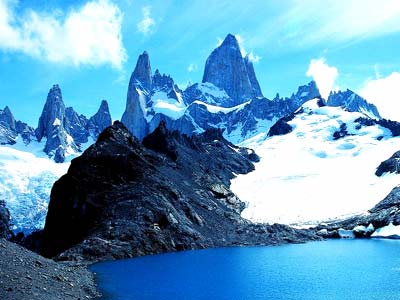
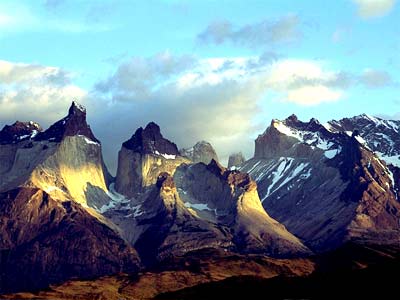 Both are stunning postcards. But which is the better hike?
To get to southern Patagonia we took a 20+ hour bus ride through scrubby, barren Patagonian steppes. I sipped red wine, dozed, listened to music & read — as I had the last two 20+ hour bus rides.
First stop, though, was the Moreno glacier, perhaps the most visited & photographed in the world.
I camped so as to have the fabulous glacier to myself once the buses departed.
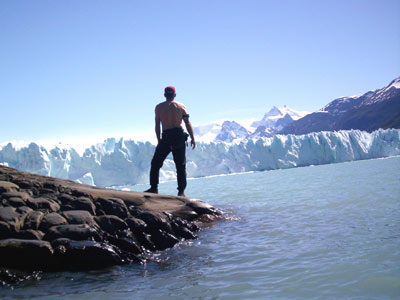 the hunky Moreno glacier.
Next a happy rendezvous with Stacey and Bevan, a cool couple from Vancouver. We had hiked Alpamayo together months before. The three of us were psyched to finish our hiking adventures together before going home — as all good Canadians do— for Christmas.
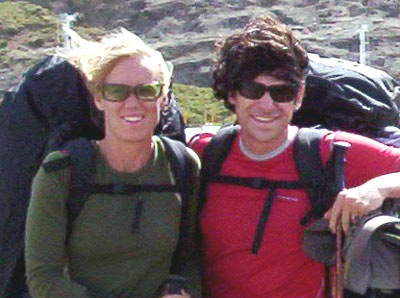
We went first to Fitz Roy named for Captain Fitzroy of the Beagle. He and Darwin were likely the first Europeans to see the massif.
I feel a kinship with Fitzroy. Despite sharing a dinner table with Darwin for 5 years, he managed to come up with diametrically opposite positions on almost every issue.
While Darwin is a regular guest on Oprah, Fitzroy’s scientific theories have languished! (As has my own modest discovery that sea creatures once lived in the high mountains. It’s true! I can show you the fossilized shells.)
I had high hopes for Fitz Roy as it is far less visited than Paine and more famous with mountain climbers. The book Enduring Patagonia, by Crouch, details the history. I was particularly interested in the tale of the best first ascent in Patagonia, the Super Couloir on Fitz Roy, 1965. The Argentine climber Comesana said his fitness, at the time, was unimproveable.
Even more impressive is The Tower (Cerro Torre), most often climbed by theCompressor route, named for the 150 pound compressor hauled up by Maestri in 1970. This desecrated the mountain with 350 bolts, one of the great controversies in mountaineering. The compressor is still up there near the summit.
(Cheap chortle: one of the top climbers in history is named Athol Whimp. Talk about a boy named Sue!)
Also of note is the smaller Egger tower, sometimes named one of the 7 real summits — the most difficult peaks to climb on the 7 continents.
Unfortunately we had to endure Patagonia — in 3 days we did not see the tops of any of the famous peaks. The weather at Fitz Roy is horrific, even by Patagonian standards of horror. It sits on the largest ice shield anywhere in the world outside Antarctica. Near constant storms rage.
Horizontal rain and gale force winds. Snow at higher altitudes.
I love high wind, though, at night. The sound through the trees is wonderful. Wind is alive, like fire.
Wind batted my tent like a cat playing with a mouse.
We bailed on the Fitz Roy hike a day early. It did not look like the weather would clear. Ever.
Oh well, as Crouch says, It’s not Patagonia unless you hang on the cross for a while.
I was reading Naipaul too & recalled his advice on how to face disappointment, Take it on the Chin. And move on.
On to the Towers of Paine.
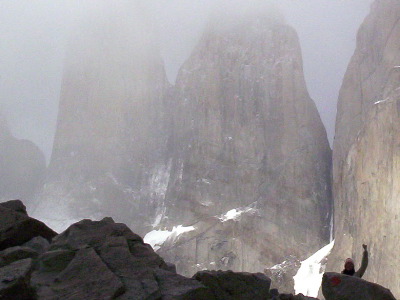
Super touristy, Paine is, regardless, the highlight for many who tramp South America.
Spectacular and uniquely chiselled peaks, granite towers, stunted & twisted trees, colourful flowers including orchids, huge undeveloped glacial lakes, brilliant glaciers — WOW! — What’s not to love?
Animal life is plentiful: llama-like guanaco, ostrich-like rhea, Andean fox, condors, flamingos, water fowl, hares, the endangered huemul deer. We saw all these. People hiking with us even saw a puma, not uncommon.
We did the 100km+ circuit of the Paine massif; no rush, plenty of time for side trips, in 9 days. Wonderful.
Unlike Fitz Roy, on Paine we had, for the most part, remarkably good weather. On the notoriously stormy Glacier Grey, you could light a match when we arrived at the Pass.
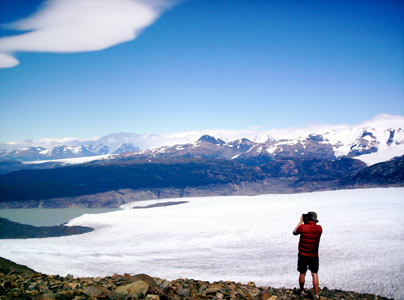 Bevan at Glacier Grey
Anemomaniacs be warned, our most vivid memories of Paine are of the wind which often blasts 170km / hour. Several hikers were thrown to the ground. My glasses were whipped off my face and blown 10m. Two pack covers blew off: one recovered by a group a half hour behind; the other never seen again, flying like a balloon out of sight.
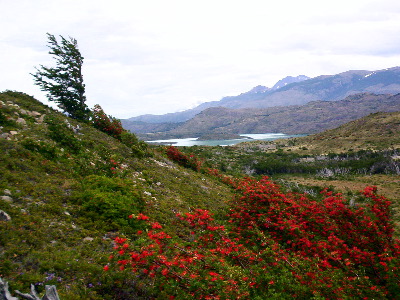
One night we sheltered in one of the expensive Refugiosas winds I estimated at 140km / hour tried to blow in the windows.
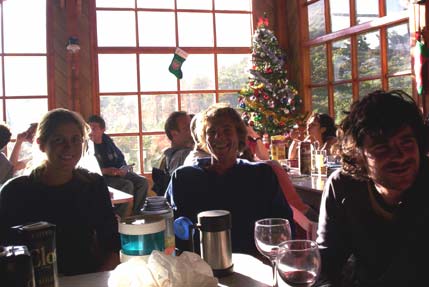
At last light (11PM!) Bevan went to check on their tent — it was close to Maytagging away down the valley. All the pegs had pulled out but the weight of 2 packs was justenough. Other friends had their rental tent flattened.
We saw waterfalls blowing UP.
And never before had we seen the wind pick up sheets of water and splash it on to the shore, drenching us at one point
After Paine, the remaining days of my trip were a let down. I moped at the southern extreme of the continent. I did not reach the barbarian coasts of the uttermost part of the world, but I could see it from Punta Arenas.
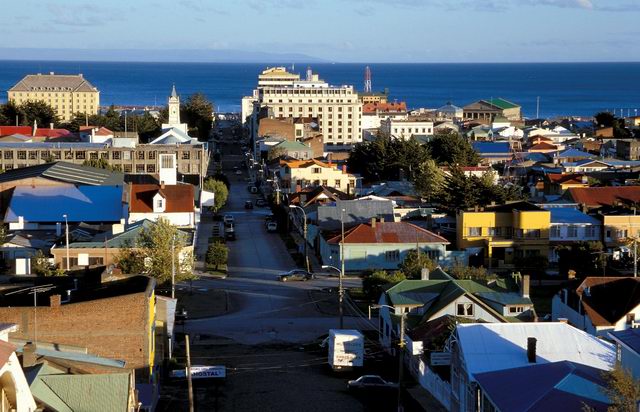 Punta Arenas. Tierra del Fuego in the distance.
I daren’t cross the water to Fireland, forewarned that fearsome, naked giants live there, tending constant flames to stay warm, even in their canoes. They would devour me sure as shooting.
That’s it.
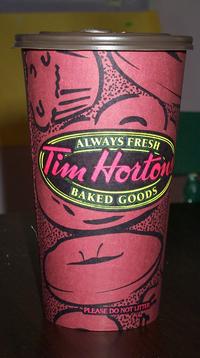 I am happy to go home to the best country in the world. Dreaming of a raisin bagel &double double at Tim Horton’s.
Pleased to stop torturing people with my Spanish.
I have a staggering genius for not learning languages. That is not the problem, though — perhaps I just got off the boat yesterday instead of months ago — the problem is my heartbreaking willingness to try to speak Spanish.
I am weary of filling in unnecessary bus roster & hostel registration forms. The amusement of using the nom de plume Richard Cranium is wearing thin. Occupation:grave robber. I invented new passport numbers each time.
When I was last in South America the blanks asked:Religion?. But this trip I was denied the chance to respond: lapsed pagan.
When I wandered into a high security Chilean naval base, I used my New Zealand driver’s licence as ID before being escorted out past red-faced security guards.
What part of the States are you from? The Canadian part. This no longer amuses anyone.
I will miss the plentiful time for reading, one of the great joys of travel. A few holiday recommendations:
• Kim, Kipling (classic)
• DaVinci Code, Brown (page turner)
• Life of Pi, Martel (original, intense)
• True History of the Kelly Gang, Carey (well wrote)
• Sea Wolf, London (classic)
• My Imaginary Country, Isabelle Allende (on Chile)
 Next?
Next?
I was gifted a guide book to Molvania, a land untouched by modern dentistry.
Or — last minute berths to Antarctica by ship were going for US$1200 all inclusive 10 days.
hmmmmmm
Rick
 Rick McCharles
