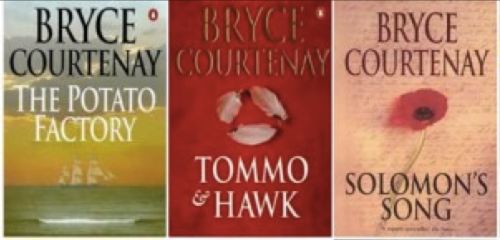
The Potato Factory (1995)
Tommo & Hawk (1997)
Solomon’s Song (1999)
Quite good.
“This is the story of two families – branches of the Solomons – transported to an alien land, both of whom eventually grow rich and powerful but who, through three generations, never for one moment relinquish their hatred for each other.
It is also the story of our country from the beginning until we came of age as a nation. …
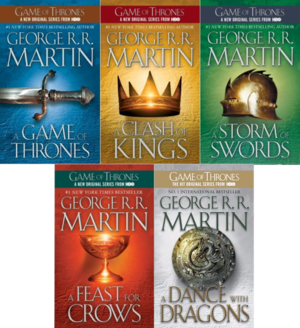
Game of Thrones season 4 … is adapted primarily from the second half of A Storm of Swords, along with elements of A Feast for Crows and A Dance with Dragons, all novels from the A Song of Ice and Fire series by George R. R. Martin. …
The review aggregator website Metacritic gave season 4 a score of 94 out of 100 based on 29 reviews, signifying “universal acclaim”. According to the other aggregator website, Rotten Tomatoes, all episodes aired thus far obtained 91% or more positive reviews. …
I’d agree.
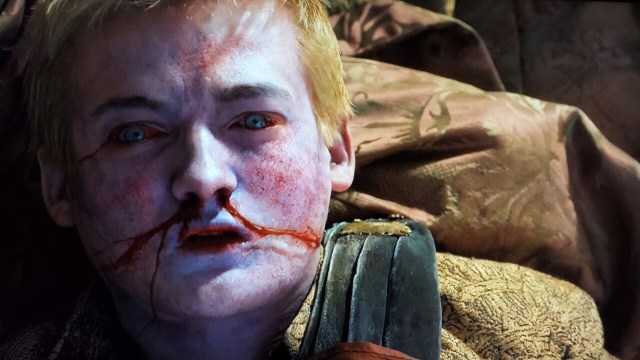
Season 4 was easily the best season so far. And the TV series is better than the books.
Arya Stark, Sandor “The Hound” Clegane, Diana Rigg as Olenna Tyrell, Peter Dinklage as “the Imp”, Tyrion Lannister …
The Potato Factory is a 1995 fictionalised historical novel by Bryce Courtenay which was made into a television miniseries in Australia in 2000. The book is the first in a three-part series, followed by
Tommo & Hawk and
Solomon’s Song.
The Potato Factory has been the subject of some controversy regarding its historical accuracy and its portrayal of Jewish characters.
The book is based on Ikey Solomon, the so-called “Prince of Fences”, and the basis of the Fagin character in the Charles Dickens novel Oliver Twist. …
The story starts in London in the early 19th century. Mary and Ikey start working together as business partners. It follows them as they are separately sent to Tasmania, a penal colony at the time. …
Many have heard of Bryce Courtenay’s more famous book and movie – The Power of One. He wrote that at age-55, his first book.
Having finished the “Game of Thrones” series of books, several people recommended Robin Hobb‘s Farseer Trilogy as a follow-up.
The Farseer Trilogy follows the life of FitzChivalry Farseer (Fitz), a trained assassin, in a kingdom called The Six Duchies while his uncle, Prince Verity, attempts to wage war on the Red-Ship Raiders from The OutIslands who are attacking the shores of the kingdom by turning the people of the Six Duchies into Forged ones; still alive, but without any emotion or soul.
I downloaded book 1 Assassin’s Apprentice.
It’s good. Subtle. Slow moving compared with Game of Thrones, however. I recommend it.
On the other hand, I didn’t enjoy the book enough to continue on to book 2.
… a world in which decades of technological advances have been suppressed in an effort to prevent disruptive change. …
Particle physicist Jon Grady is ecstatic when his team achieves what they’ve been working toward for years: a device that can reflect gravity.
Their research will revolutionize the field of physics—the crowning achievement of a career. Grady expects widespread acclaim for his entire team. The Nobel Prize. Instead, his lab is locked down by a shadowy organization whose mission is to prevent at all costs the social upheaval sudden technological advances bring. This Bureau of Technology Control uses the advanced technologies they have harvested over the decades to fulfill their mission. …
“Influx” isn’t different, deep down, from the “suppressed new invention” plot used by Robert Heinlein, Ursula K. Le Guin, Poul Anderson and many others going back to H.G. Wells himself. …
The highlight for me were scenes where people can alter their own gravity fields, with very interesting effect. It would make a great film.
An Artificial Intelligence is directed to kill the heroes of the book. But the AI is conflicted. The computer does both. Tries to kill. And tries to save, both at the same time. 🙂
Daniel Suarez is a darling of the Tech / Geek crowd.
Daniel Suarez (born December 21, 1964) is an American information technology consultant turned author. He initially published under the pseudonym Leinad Zeraus (his name spelled backwards).
His career as an author began with a pair of techno-thriller novels. The first one, Daemon, originally was self-published under his own company Verdugo Press in late 2006. It was later picked up by the major publishing house Dutton and re-released on January 8, 2009. His follow-up book Freedom TM was released on January 7, 2010.
… Kill Decision, was released on July 19, 2012. His latest book, Influx, was released on February 20, 2014 …
The Daemon (2 book series) is brilliant. Kill Decision and Influx are not nearly as brillian. But they are still good.
I recommend Influx. And will continue to buy his books into the future.
The brilliant minds at Screen Junkies have made one of their signature “Honest Trailers” in anticipation of Game of Thrones’ fourth season, which premieres on HBO this Sunday, and this one doesn’t disappoint. “It’s the abusive show you keep watching, no matter how many times it hurts you,” …
The trailer covers the first three seasons and skewers everything from Westerosi nomenclature (“Travel to Westeros, a place where everything is the [thing] of [nouns]”) to, perhaps inevitably, its tendency to offer naked ladies as eye candy while old men with beards deliver monologues. It’s more or less safe for work, despite all this, but those who haven’t caught up with the show should beware: Spoilers abound.
___ Meanwhile, I’m about half way through reading – A Feast for Crows … meh
A Feast for Crows is the fourth of seven planned novels in the epic fantasy series A Song of Ice and Fire by American author George R. R. Martin. …
In comparison with the previous novels in the series, A Feast for Crows received more negative reviews. … many critics felt that this novel consisted of characters that people were less interested in.
Agreed.
I had very little interest in:
The Iron Islands:
• The Prophet, The Drowned Man: Aeron “Damphair” Greyjoy, and the rest.
• The Kraken’s Daughter: Princess Asha Greyjoy, daughter of Late King Balon of the Iron Islands
• The Iron Captain, The Reaver: Prince Victarion Greyjoy, Captain of the Iron fleet
In Dorne:
• The Captain of Guards: Areo Hotah, Captain of the Guards to Prince Doran Martell of Dorne
• The Soiled Knight: Ser Arys Oakheart of the Kingsguard
• The Queenmaker, The Princess in the Tower: Arianne Martell, daughter of Prince Doran and heir to Dorne
… there was also a sense in A Feast of Crows that Martin had lost his way. The characters whose stories he did tell wandered back and forth across a landscape devastated by war and
oncoming winter, but didn’t seem to be headed anywhere in particular. …
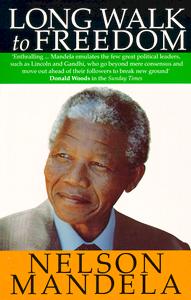
Long Walk to Freedom is an autobiographical work written by South African President Nelson Mandela, and published in 1995 …
The book profiles his early life, coming of age, education and 27 years in prison. Under the apartheid government, Mandela was regarded as a terrorist and jailed on the infamous Robben Island for his role as a leader of the then-outlawed ANC. He has since achieved international recognition for his leadership as president in rebuilding the country’s once segregated society. The last chapters of the book describe his political ascension, and his belief that the struggle continues …
His childhood name was Rolihlahla, which is loosely translated as “pulling the branch of a tree”, or a euphemism for “troublemaker“.
Indeed, many of the most winning anecdotes are stories of how the now sainted man bungled, cheated or lied.
Mandela oversaw the formation of a Truth and Reconciliation Commission to investigate crimes committed under apartheid by both the government and the ANC, appointing Desmond Tutu as its chair. To prevent the creation of martyrs, the Commission granted individual amnesties in exchange for testimony of crimes committed during the apartheid era. Dedicated in February 1996, it held two years of hearings detailing rapes, torture, bombings, and assassinations, before issuing its final report in October 1998. …
Though Mandela was influenced by his older contemporary, Gandhi, he did not subscribe to Gandhi’s non-violence. Nelson felt that non-violence worked in India because the British government was reasonable. But that it would not work in South Africa government.
Mandela said that he actually didn’t know Gregory very well. But did state:
“He was one of the most refined warders. Well-informed and courteous with everybody. Soft spoken. Very good observations. I developed a lot of respect for him.”