Detective Inspector John Rebus

When visiting Scotland I got into Rebus. Happily, Warren is a bit of a fan, too, collecting those that have been televised or turned into movies.

Detective Inspector John Rebus is the protagonist in the Inspector Rebus series of detective novels by the Scottish writer Ian Rankin, ten of which have so far been televised as Rebus. The novels are mostly set in and around Edinburgh. …

Rebus can be said to belong to a long tradition of paternal Scottish hard men. A natural leader whose gruff exterior and fierce will to succeed in his field belies a benevolent nature. …

In the Rebus television adaptations he was played by John Hannah in the first two series, but in the later series the role was taken over by Ken Stott to much acclaim. …

Hannah is a terrific actor, but I’d say Stott is much truer to the Rebus of the novels.

Stott as Rebus

Leave a comment if you’ve an opinion on the two actors.

libraries are dinosaurs

I love libraries. And spend a lot of time in them, everywhere I travel.

But as government monopolies, most are slow to innovate. In all you can spot outdated technologies and nonsensical policies.

The painfully slow introduction of digital media is the most conspicuous example. Librarians like to pretend they offer digital video and books … but to actually access those files can be a nightmare.

Libraries will be somewhat defunct, you see, once digital media is ubiquitous.

I’m pleasantly surprised to report that Signal Hill Library in Calgary, recently re-opened after renovations, has been vastly improved. It’s bright, welcoming and the electronic media access has been upgraded considerably.

in defense of Ayn Rand

“There are two novels that can change a bookish fourteen-year old’s life: The Lord of the Rings and Atlas Shrugged.

One is a childish fantasy that often engenders a lifelong obsession with its unbelievable heroes, leading to an emotionally stunted, socially crippled adulthood, unable to deal with the real world.

The other, of course, involves orcs.”

– Attributed to Paul Krugman.

Atlas Shrugged had that effect on me.

… explores a dystopian United States where leading innovators, ranging from industrialists to artists, refuse to be exploited by society.

The protagonist, Dagny Taggart, sees society collapse around her as the government increasingly asserts control over all industry (including Taggart Transcontinental, the once mighty transcontinental railroad for which she serves as the Vice President of Operations), while society’s most productive citizens, led by the mysterious John Galt, progressively disappear. …

I’ve given Atlas Shrugged to a number of teens. It’s an important book …

Kids need to learn that all men are not created equal, rather that all men should have equal opportunity.

Kids need to learn that we should promote and encourage greatness.

Kids need to learn that authority organizations can ruin their lives ... OK, they already know that.

Now I find myself defending Ayn Rand alongside fans as odious as Glenn Beck and Rush Limbaugh. That does hurt.

The new Ayn Rand movie adaptation Atlas Shrugged Part 1 got nuked and ridiculed on the Slate Culture Gabfest audiocast.

Click PLAY or watch the trailer on YouTube.

I’m going to see it. Unfortunately the producer of the Ayn Rand adaptation said:

… that he is reconsidering his plans to make Parts 2 and 3 because of scathing reviews and flagging box office returns for the film.

“Critics, you won,” …

I hope he joins Gault and makes the two sequels.

disappointed by Greg Mortenson

If you saw the 60 Minutes piece (VIDEO) on author Greg Mortenson, you’ll be saddened and disappointed too.

… Krakauer, and others, say that Mortenson has embellished some of the details of his story to make them sound more dramatic and impressive. That some of the things he claims happened to him in his books are, at best, stretches of the truth, and at worst, outright fabrications.

There are even some indications that the funds that are raised by CAI are not being spent properly and that the organization lacks transparency in how it operates. …

I’m not at all convinced by Greg’s response to the charge as published by Outside – Greg Mortenson Speaks

Greg Mortenson is finished. What a setback to a great cause.

(via The Adventure Blog)

funny Borders Books sign

… We’ve gotta hand it to the employee at a doomed Borders store who still has a sense of humor about the company they work for going down the drain.

Consumerist reader Sam says he snapped this sign at a store which will be closing in Chicago, telling customers where they can now go to find a bathroom.

Borders filed for Chapter 11 bankruptcy protection in mid-February, after struggling for years to compete against Amazon.com and Barnes & Noble, which have cornered the digital and physical book store markets, respectively. As a result, they have been in the process of closing 30% of their stores. …

Consumerist – Closing Borders Store Tells Customers Where To Find A Restroom

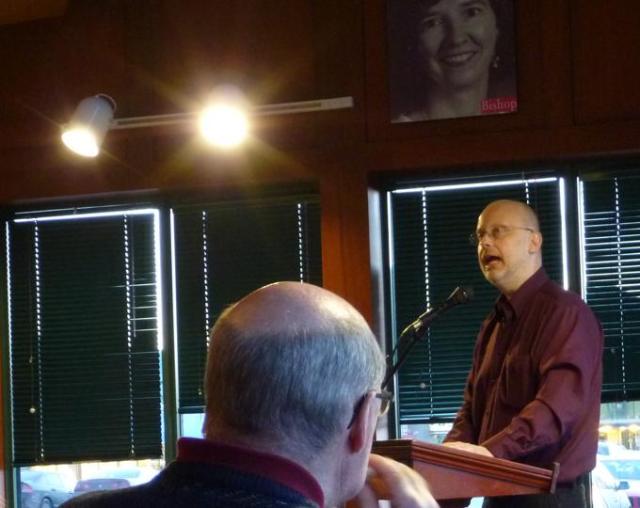
author Robert Sawyer in Saskatoon

Warren stopped by at Robert’s reading at McNally Robinson Booksellers, a preview of the April 5th launch of his latest Sci-fi novel, Wonder.

This is exactly the thing bookstores need to do more of if they are going to survive competing against online book sellers.

The LIVE draw gets people into the store, buying high mark-up coffee and (hopefully) a high mark-up copy of an autographed Robert Sawyer book.

reactions to Borders bankruptcy

Economist:

… We can spare a little thought for Borders.

It has a particular relevance for American small towns and suburbs that isn’t apparent in urban centres.

In the latter, the chain bookstores are the impersonal monoliths that destroyed small independents by undercutting them on prices. But elsewhere, the arrival of a Borders would mean that a town was finally getting a bookstore, rather than a rack of paperbacks and Sudoku books at the supermarket.

(Similarly, while Starbucks might have hurt local coffeeshops in, for example, New York, in rural America it has achieved its stated goal of creating a “third space”.) …

Beyond Borders

L.A. Times – Carolyn Kellogg responds:

It’s an interesting argument, but the only example the Economist provides is a counter: In Austin, Texas, longstanding indie BookPeople successfully prevented a Borders from moving in nearby.

It’s nice to think that Borders provided bookstoreless towns with their first bookstores, creating new community space around books — but I’m not entirely sure that it’s true. …

Borders should die. … But I really don’t think the online experience is anywhere near as good. Yet.

Borders Books bankrupt

I used to drive a milk cart, pulled by a horse.

Those were the good old days.

I used to enjoy lounging around in book stores like Borders, browsing the travel section, browsing magazines. Enjoying a coffee. (… Libraries didn’t allow coffee, back in the good old days.)

Borders is selling at least 200 of their 500 Superstores. The company is going the way of the milk cart.

There should be some pretty sweet bargains … right?

We should swoop down on the corpse. … right?

… At the Borders Group Inc. store on Broadway near Wall Street, box sets of Stieg Larsson’s best- selling “Millennium” trilogy, including the “The Girl With the Dragon Tattoo,” sat on a table near the door last week on sale for $69.39 — a liquidation markdown of 30 percent.

The set costs half as much on Amazon.com Inc.’s website, where it was listed for $34.58 — with free shipping. Amazon’s Kindle e-book editions were even less, priced at $27.97. At Wal- Mart Stores Inc.’s website, the three books sold for $34.96. …

Businessweek

Even in death, Borders can’t compete.

Last week I took my Mom into a Borders to look at the Kindle. … But the e-reader display wasn’t set up. Nobody on staff would have been able to explain it, in any case.

Borders deserves to die.

Why didn’t they rebrand to become an entertainment / food / drink venue, with high mark-up product on the side. That could have worked. We’d go there for book readings, poetry readings, public meetings, etc. … Something like an Apple store.

Hey, isn’t Borders the big, bad company that killed the neighbourhood bookstore in the film You’ve Got Mail (1998)

Live by the sword, die by the sword.

Some of the local bookstores will survive, I predict. Happy that big box Borders is gone from their city.

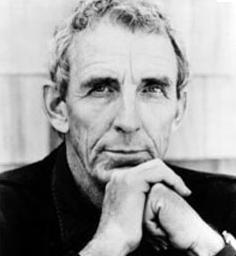
The Tree Where Man Was Born

by Peter Matthiessen (1972)

A perfect moment. …

Sitting in the outdoor hot tub looking out over Pismo Beach. Listening to classic Matthiessen as an audio book.

Africa in the 1960s

On the great East African plain it is the human who feels himself the intruder. Here, and perhaps only here, the world is that of the animals. It is they who belong, as humans do not. In the more sensitive traveler this evokes a feeling of being privileged to observe ancient forms, settings and behavior that have survived intact from pre-history.

“Matthiessen has the language to express this feeling of awe…Matthiessen also goes into the relationships between humans past and present in East Africa’s great fauna with many a flash of insight into the instincts each has bred in the other…This is the Africa book par excellence.”

(Saturday Review)


Amazon

Here’s where Matthiessen first met famed field biologist George Schaller, the man he’d join in the Himalayan adventures documented in The Snow Leopard, one of my very favourite books.

Both Schaller and Matthiessen are still alive. In fact Matthiessen in 2008, at age 81, received his second National Book Award for Shadow Country, an 890-page revision of a trilogy of novels he released in the 1990s. (41hrs audio)