 Hiking the deepest canyons on Earth.
To see all annotated photos, jump to the permanent webpage in Rick’s photo archive. 

Hiking the deepest canyons on Earth.
To see all annotated photos, jump to the permanent webpage in Rick’s photo archive.
 Santa Catalina Monastery, was the highlight of Arequipa, my favourite big city in Peru.
To see all annotated photos, jump to the permanent webpage in Rick’s photo archive.
The main reason I travelled to South America was attending the marvels of a thousand Patagonian sights and sounds.
Actually, it was to hike Fitz Roy (Argentina) & Paine(Chile).
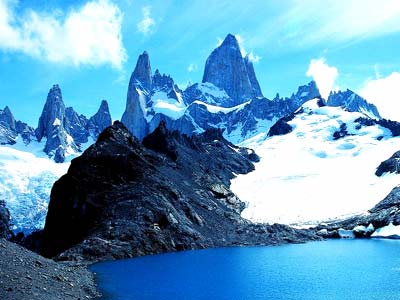
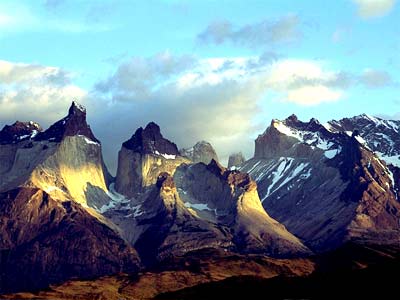 Both are stunning postcards. But which is the better hike?
To get to southern Patagonia we took a 20+ hour bus ride through scrubby, barren Patagonian steppes. I sipped red wine, dozed, listened to music & read — as I had the last two 20+ hour bus rides.
First stop, though, was the Moreno glacier, perhaps the most visited & photographed in the world.
I camped so as to have the fabulous glacier to myself once the buses departed.
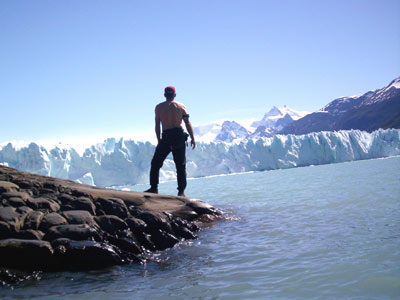 the hunky Moreno glacier.
Next a happy rendezvous with Stacey and Bevan, a cool couple from Vancouver. We had hiked Alpamayo together months before. The three of us were psyched to finish our hiking adventures together before going home — as all good Canadians do— for Christmas.
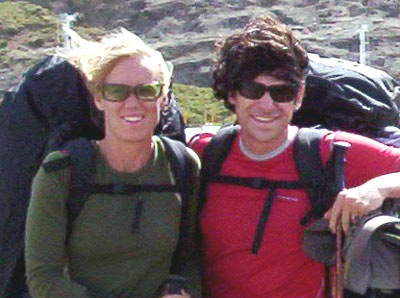
We went first to Fitz Roy named for Captain Fitzroy of the Beagle. He and Darwin were likely the first Europeans to see the massif.
I feel a kinship with Fitzroy. Despite sharing a dinner table with Darwin for 5 years, he managed to come up with diametrically opposite positions on almost every issue.
While Darwin is a regular guest on Oprah, Fitzroy’s scientific theories have languished! (As has my own modest discovery that sea creatures once lived in the high mountains. It’s true! I can show you the fossilized shells.)
I had high hopes for Fitz Roy as it is far less visited than Paine and more famous with mountain climbers. The book Enduring Patagonia, by Crouch, details the history. I was particularly interested in the tale of the best first ascent in Patagonia, the Super Couloir on Fitz Roy, 1965. The Argentine climber Comesana said his fitness, at the time, was unimproveable.
Even more impressive is The Tower (Cerro Torre), most often climbed by theCompressor route, named for the 150 pound compressor hauled up by Maestri in 1970. This desecrated the mountain with 350 bolts, one of the great controversies in mountaineering. The compressor is still up there near the summit.
(Cheap chortle: one of the top climbers in history is named Athol Whimp. Talk about a boy named Sue!)
Also of note is the smaller Egger tower, sometimes named one of the 7 real summits — the most difficult peaks to climb on the 7 continents.
Unfortunately we had to endure Patagonia — in 3 days we did not see the tops of any of the famous peaks. The weather at Fitz Roy is horrific, even by Patagonian standards of horror. It sits on the largest ice shield anywhere in the world outside Antarctica. Near constant storms rage.
Horizontal rain and gale force winds. Snow at higher altitudes.
I love high wind, though, at night. The sound through the trees is wonderful. Wind is alive, like fire.
Wind batted my tent like a cat playing with a mouse.
We bailed on the Fitz Roy hike a day early. It did not look like the weather would clear. Ever.
Oh well, as Crouch says, It’s not Patagonia unless you hang on the cross for a while.
I was reading Naipaul too & recalled his advice on how to face disappointment, Take it on the Chin. And move on.
On to the Towers of Paine.
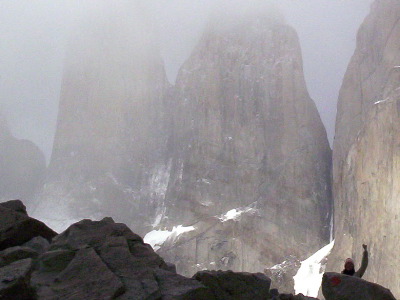
Super touristy, Paine is, regardless, the highlight for many who tramp South America.
Spectacular and uniquely chiselled peaks, granite towers, stunted & twisted trees, colourful flowers including orchids, huge undeveloped glacial lakes, brilliant glaciers — WOW! — What’s not to love?
Animal life is plentiful: llama-like guanaco, ostrich-like rhea, Andean fox, condors, flamingos, water fowl, hares, the endangered huemul deer. We saw all these. People hiking with us even saw a puma, not uncommon.
We did the 100km+ circuit of the Paine massif; no rush, plenty of time for side trips, in 9 days. Wonderful.
Unlike Fitz Roy, on Paine we had, for the most part, remarkably good weather. On the notoriously stormy Glacier Grey, you could light a match when we arrived at the Pass.
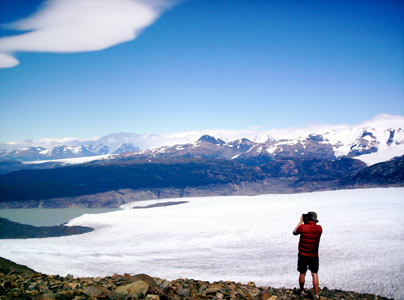 Bevan at Glacier Grey
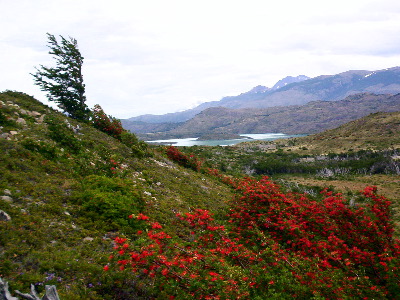
Anemomaniacs be warned, our most vivid memories of Paine are of the wind which often blasts 170km / hour. Several hikers were thrown to the ground. My glasses were whipped off my face and blown 10m. Two pack covers blew off: one recovered by a group a half hour behind; the other never seen again, flying like a balloon out of sight.
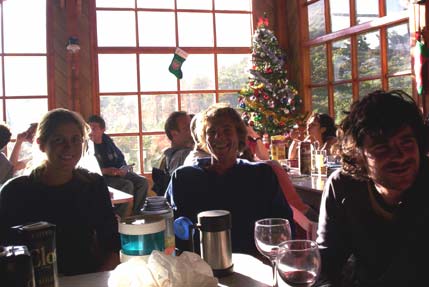
One night we sheltered in one of the expensive Refugiosas winds I estimated at 140km / hour tried to blow in the windows.
At last light (11PM!) Bevan went to check on their tent — it was close to Maytagging away down the valley. All the pegs had pulled out but the weight of 2 packs was justenough. Other friends had their rental tent flattened.
We saw waterfalls blowing UP.
And never before had we seen the wind pick up sheets of water and splash it on to the shore, drenching us at one point
After Paine, the remaining days of my trip were a let down. I moped at the southern extreme of the continent. I did not reach the barbarian coasts of the uttermost part of the world, but I could see it from Punta Arenas.
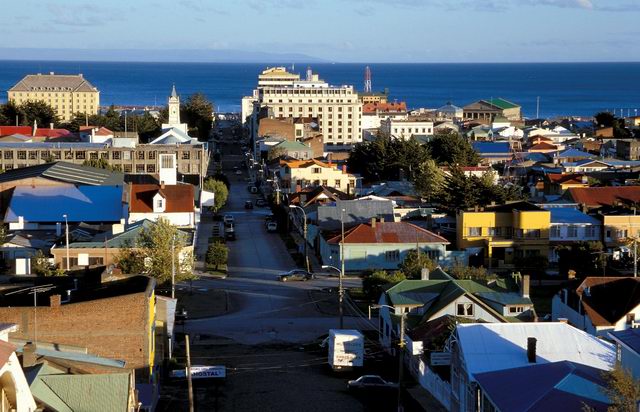 Punta Arenas. Tierra del Fuego in the distance.
I daren’t cross the water to Fireland, forewarned that fearsome, naked giants live there, tending constant flames to stay warm, even in their canoes. They would devour me sure as shooting.
That’s it.
 I am happy to go home to the best country in the world. Dreaming of a raisin bagel &double double at Tim Horton’s.
Pleased to stop torturing people with my Spanish.
I have a staggering genius for not learning languages. That is not the problem, though — perhaps I just got off the boat yesterday instead of months ago — the problem is my heartbreaking willingness to try to speak Spanish.
I am weary of filling in unnecessary bus roster & hostel registration forms. The amusement of using the nom de plume Richard Cranium is wearing thin. Occupation:grave robber. I invented new passport numbers each time.
When I was last in South America the blanks asked:Religion?. But this trip I was denied the chance to respond: lapsed pagan.
When I wandered into a high security Chilean naval base, I used my New Zealand driver’s licence as ID before being escorted out past red-faced security guards.
What part of the States are you from? The Canadian part. This no longer amuses anyone.
I will miss the plentiful time for reading, one of the great joys of travel. A few holiday recommendations:
• Kim, Kipling (classic)
• DaVinci Code, Brown (page turner)
• Life of Pi, Martel (original, intense)
• True History of the Kelly Gang, Carey (well wrote)
• Sea Wolf, London (classic)
• My Imaginary Country, Isabelle Allende (on Chile)
 Next?
Next?
I was gifted a guide book to Molvania, a land untouched by modern dentistry.
Or — last minute berths to Antarctica by ship were going for US$1200 all inclusive 10 days.
hmmmmmm
Rick
 One of the best hikes in the world, without question. I spent 9 days hiking the Paine Circuit — and would happily have stayed longer. Visit Torres del Paine National Park as soon as you can.
To see over 100 annotated photos, jump to the permanent webpage in Rick’s photo archive.
 One of the surprise highlight hikes in Patagonia was Cerro Castillo. Very few trekkers find this remote gem off the great Southern Highway.
To see the annotated photos, jump to the permanent webpage in Rick’s photo archive.
 Certainly the most visited glacier in the world is Moreno just outside the tourist mecca of El Calafate. Many travel to Patagonia mainly to see this world wonder.
To see the annotated photos, jump to the permanent webpage in Rick’s photo archive.
 Go to Bolivia?
Everyone else was.
Beneath my radar, I had never heard good things about Bolivia. It is the prototype South American disaster: corrupt, turbulent history, over 190 leaders in 180 years, breakdowns, roadblocks, strikes. Mucho problemas!
Yet Stephan from Vancouver (yet another engineer) and I crossed the border to Copacabana, Bolivia — a classic hangout for travellers.

Bolivia looked good to us!
On the standard Island of the Sun tour I mostly ignored the ruins and dreamed about the mountains in the distance. The weather was perfect even though this was supposed to be the start of the rainy season.
Stephan returned to Peru to do the Inca Trail. I climbed on a local bus with my huge luggage, the only gringo trying to reach the tiny mountain town of Sorata.
I ended up in La Paz instead.
If you are planning your next family vacation to La Paz — reconsider.
I expected to like La Paz as most do:
But I did not thrive. It was very difficult to get anythingdone there. Accommodation & food were disappointing.
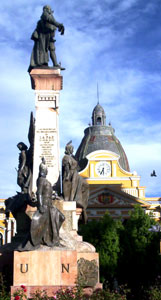 My hotel was last modernized in the 1950s. But I loved the location beside central Murillo Plaza & theRoyal Palace (known as the Burned Palace for historical reasons).
The statue is President Villarroel, dragged from the Palace and hung on this spot in 1946. Coincidentally, much the same thing happened to President Murillo in 1810.
Ancient history? Plaza Murillo was riddled with bullets a year ago. (Oct. 2003) The then President Lozada fled to Florida rather than face the mob.
So is La Paz safe?
Surprisingly, yes. It is one of the safest large cities in South America. Dunno why. Perhaps because there are more armed personnel here than any city I can recall aside Mexico City.
 The most frequent crime in La Paz is theft of ladies bowler hats, worth on average US$40.
The wonderfully colourful indigenous costumes some say were imposed on natives by the King of Spain in the 1700s. They are charming. Bolivia has the highest percentage native population of any South American country.
Actually, I was twice approached by awkward scam artist / pickpockets. My usual tactic of walking into busy traffic dissuaded them.
I note 2 interesting things in La Paz, though:
1) Shoeshine boys are everywhere, dressed as bandits! Ski masks protect the identity of the young men and their families. It is lowly work of last resort.
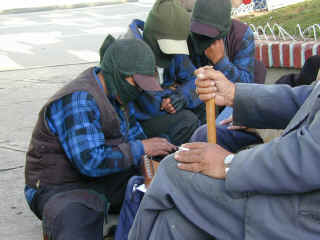
2) No need to own a phone. Everywhere are people in uniform leashed to mobile phones. Local calls are US$.15 / minute.
Like La Paz, hiking in Bolivia has great potential, but is surprisingly undeveloped. Access to trailheads is problematic. Bandits are a concern. In the end I did none of the major treks.
But for climbers, Bolivia is a paradise. No restrictions. No permits required. No fees. Screw the Himalaya, come to Bolivia!
The Royal Range (Cordillera Real) near La Paz offers 6 peaks over 6000m.
 photo source unknown
The most popular mountaineering peak is Huayna Potasi— though it is no cinch due to altitude. The last 200m is a steep scramble above 19,000ft. Roped together, keeping the line taut, you have very little control over the pace of ascent. I was exhausted for two days after.
Climbing Potasi was a wonderful experience though. Perfect weather! I saw the grandest shooting star of my life up close through the thin air. (My climbing amigos were so tired & focused they barely acknowledged it.) Climbing a mountain at night by full moon was unique. This photo shows the knifetop summit ridge.
Annotated climbing photos with Into-Thin-Air-likedetail.
Many climb Potasi first in preparation for peaks of 6300 – 6500m, very doable for the average Edmund once acclimatized.
Not me. I prefer carbogganing & hiking. I will be back to Bolivia to do the major mountain routes. (May – June are probably the best months in the central Andes if you want to join me.)
 Most every backpacker in Bolivia bikes the world’s most dangerous road. Something like a 3000m descent from high peak to steamy jungle in one go.
It reminded me of Going to the Sun highway in Montana. (Bikes not allowed there, of course.)
The title of most dangerous was designated by the Inter-American Development Bank. Can you dispute the claim? An average of 26 vehicles a year were disappearing over the brink.

The bank helped fund (US$120 million) a safe road on theopposite side of the valley. The new road was paved with good intentions.
But the day I biked the new road was closed yet again for repair. All traffic took the dangerous road. In fact, we learned that buses & trucks always take the old road with the cyclists. The new bridges were under built — they cannot support heavy vehicles. That is Bolivia for you.
It was good fun. The torrential rainstorm on the way down cut the dust until the complimentary beer at the bottom.
Rainy season had finally arrived in the Central Andes.
Time to head for sunny northern Chile via the fabulous 3-day salt lake jeep trek.


I travelled by train to Uyuni, in remote SW Bolivia with Jenni from Finland. She’s a gamer having just toured North America by Greyhound from sea to shining sea.
Kid, the next time I say lets go some place like Bolivia, lets go some place like Bolivia!
Paul Newman
Our train had been robbed by 2 Americanos. But a posse from Uyuni tracked down Butch & Sundance in 1908. Cornered & wounded, Butch shot his partner and then himself rather than surrender. (That’s not how the movie ended, you may recall.)
Che Guevara died too in Bolivia in a rash attempt toliberate the country from a U.S. backed (one of the George Bushes, I think) military dictator.
El Puro’s end was sad. Age 38, emaciated, sick, defeated; shot on a schoolroom floor by a lowly CIA-trained sergeant bolstered to the task with beer.
Che is dead as Elvis. But his icon lives on, a vague symbol anti-capitalism, pro-revolution. An ex-girlfriend says Che would be mortified to have become a consumer product. But I bought the t-shirt.
Rather than read the much edited Motorcycle Diaries, I recommend Chasing Che (2000) by journalist Patrick Symmes. He retraced Che’s early footsteps giving a more accurate & entertaining account.
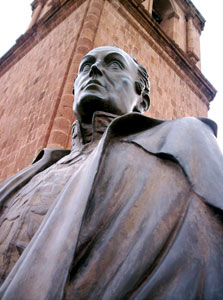 Bolivia is named for Simon Bolivar, one of the few hombres who deserves a statue.
There have been three great fools in history: Jesus, Don Quiote and I.
An idealist who could get the job done — he liberated Venezuela, Panama, Peru, Ecuador, Colombia & Bolivia — but none the less died broke & abandoned. Bolivar dreamed of unifying Spanish America into a single country.
Why is North America so advanced, Bolivia & South America so slow to develop?
Bolivar knows.
Last Bolivian stop — gorgeous Laguna Verde on the border. See you in Patagonia!
Ricardo
 I did not particularly enjoy my first high altitude climb with full mountaineering gear. It was a success — but very uncomfortable.
This is one of the easiest 6000+m (almost 20,000ft) summits in the world.
To see the annotated photos, jump to the permanent webpage in Rick’s photo archive.
 Our major trek to Alpamayo Base Camp & beyond. This is one of the best hikes in South America.
To see Bevan’s annotated photos, jump to the permanent webpage in Rick’s photo archive.
Mariano Fernandez (with the lime green pack cover) photos of the same trek.
 Everyone enjoys the lovely Mediterranean ambiance of Lake Titicaca. I took the standard tourist trip — though I wish I had camped there, as well.
To see the annotated photos, jump to the permanent webpage in Rick’s photo archive.
 Rick McCharles