idea – a Wiki novel

Has this been done?

Has an author posted a novel online. Then encouraged readers to “improve” it as they do a Wikipedia article?

It would be a HIT online.

====

Related – Wikipedia kills Encarta — and Microsoft pronounces it dead
microsoft_encarta_dead_small

It could not compete against an open source, free competitor.

Microsoft initiated Encarta by purchasing non-exclusive rights to the Funk & Wagnalls Encyclopedia, incorporating it into its first edition in 1993. …

In the late 1990s, Microsoft bought Collier’s Encyclopedia and New Merit Scholar’s Encyclopedia from Macmillan and incorporated them into Encarta. Thus the current Microsoft Encarta can be considered the successor of the Funk and Wagnalls, Collier, and New Merit Scholar encyclopedias. None of these formerly successful encyclopedias remained in print for long after being merged into Encarta. …

Wikipedia – Encarta

new Robert Sawyer book – Wake

My brother feels his friend Robert J. Sawyer could win another Nebula or Hugo for his latest release, the first in a three part series: Wake, Watch, Wonder.

The WWW trilogy.

This book is accessible even to young readers. The main character is age-15.

But the issues addressed are fascinating: the infrastructure of the World Wide Web, part of the web becoming aware, primates gaining intelligence. Pandemic out of China as well as the battle between bloggers in China and their repressive government.

When I read a book and find myself saying, “Why didn’t I think of this?”, I know it’s a brilliant plot.

Caitlin Decter is young, pretty, feisty, a genius at math—and blind. Still, she can surf the net with the best of them, following its complex paths clearly in her mind. But Caitlin’s brain long ago co-opted her primary visual cortex to help her navigate online. So when she receives an implant to restore her sight, instead of seeing reality, the landscape of the World Wide Web explodes into her consciousness, spreading out all around her in a riot of colors and shapes. While exploring this amazing realm, she discovers something—some other—lurking in the background. And it’s getting more and more intelligent with each passing day…

Amazon – Wake

wake-cover

Sawyer takes up where Michael Crichton, who died in 2008, left off. Making the cutting edge issues of real science interesting to the general public.

The main difference is that while Crichton’s books always end in catastrophe, Sawyer’s look at both the positive and negative side of new technologies.

This one is highly recommended. As are all of Sawyer’s books.

Twitter Eats World: Global Visitors Shoot Up To 19 Million

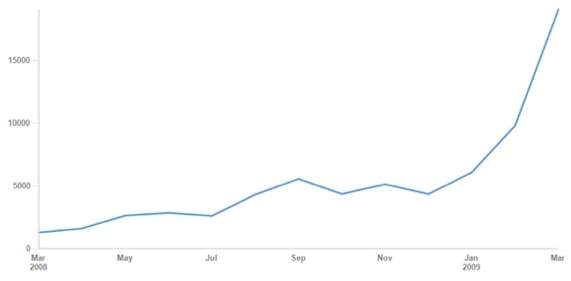
Twitter’s march towards world domination continues apace. This morning comScore released its global numbers for March, 2009. Worldwide visitors to Twitter.com increased 95 percent in the month of March from 9.8 million to 19.1 million, according to its estimates. This compares to 9.3 million visitors in the U.S. alone. …

If Twitter can keep this rate of growth up, it should cross 50 million visitors by summer.

TechCrunch – Twitter Eats World: Global Visitors Shoot Up To 19 Million

twitter-trends

Twitter is cryptic and useless for most people.

Avoid it if you can. (Though you might want to grab a twitter name now, while there are still many availlable, just in case.)

I have:

  • https://twitter.com/besthike
  • http://twitter.com/GymCoaching
  • http://twitter.com/McCharles
  • Actually, once you follow 50 or more people, it can be interesting. I’m starting to like Twitter despite its many failings.

    I have not started using any of the Twitter clients, as yet. But I’m leaning towards trying Seesmic Desktop.

    Will the Internet Replace Universities?

    Newspapers are dropping like flies.

    Are Universities next?

    … Universities were also subject to a lot of fevered speculation back then. In 1997 the legendary management consultant Peter Drucker said, “Thirty years from now, the big university campuses will be relics…. Such totally uncontrollable expenditures, without any visible improvement in either the content or the quality of education, means that the system is rapidly becoming untenable.” Twelve years later, universities are bursting with customers, bigger, and (until recently) richer than ever before.

    Was Drucker wrong?

    My own guess is that the existing Universities will continue to evolve into the future. In one form or another.

    But that the cost of tuition will force future students into less expensive online Universities.

    … Quick, name the largest private university in the U.S. The answer is the University of Phoenix, founded in 1976, where 95% of faculty are part-time and the large majority of teaching happens completely online.

    It could happen that more education-providing corporations (one hesitates to call them “universities”) could develop better ways to provide online classroom educations to a large number of students who are interested in the first purpose listed above but are unwilling to pay for the second. If that model catches on, it will cause dramatic upheaval in the economy of traditional universities. …

    Blogs / Cosmic Variance – Will the Internet Replace Universities?

    upx_logo_print

    The University of Phoenix (UPX) is a for-profit educational institution that specializes in adult education. The largest private university in North America, it has an enrollment of more than 345,300 students …

    94% Of Users Don’t Like Facebook Redesign

    TechCrunch – Facebook Poll: 94% Of Users Don’t Like Redesign

    volte

    I love it.

    And, luckily for me, Facebook CEO Mark Zuckerberg isn’t listening to the haters. Because he doesn’t have to, he’s told employees.

    Scoble agrees with him.

    The new Facebook is now a logical, clean, easy-to-filter, river of news. The old Facebook a confusing jumble of random features.

    (Everyone needs to remove the posts of those friends they don’t actually want to hear about, of course. That couldn’t be easier — simply click on the small X on the right hand side of any of their posts.)

    making the internet more readable

    I’ve just added this free bookmarklet to my browsers.

    … Readability is a browser bookmarklet (sort of like a bookmark on steroids). You can install Readability by visiting the Readability setup page:

    http://lab.arc90.com/experiments/readability/

    Readability works with most major modern browsers and has been tested on many news sites and blogs. It isn’t 100% effective but works surprisingly well. …

    lab.arc90.com – Experiments – Readability

    new Safari 42x faster than IE 7

    As my default browser, I’m just about to switch from Opera to the beta version of Safari 4 on Mac.

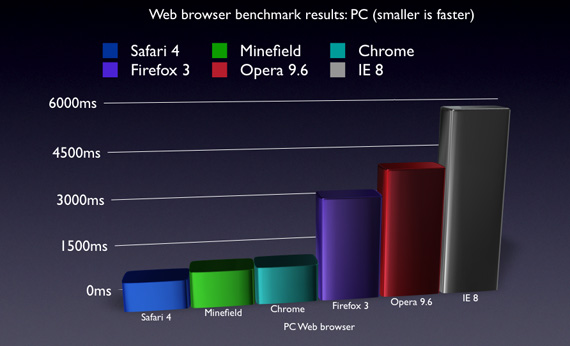
    It’s fast. (smaller is faster)

    pc_benchmarks1

    The main thing this graph shows is that Internet Explorer is for idiots. It’s horribly slow.

    Opera is good. But has some annoying features that cannot be modified.

    In future, I will keep Firefox and Safari open at the same time, switching back and forth. Safari now offers full screen zoom like Firefox. That’s the main feature I need, aside from speed.

    Google Chrome is not yet available for Mac.

    Cnet – Safari 4 benchmarked: 42x faster than IE 7, 3.5x faster than Firefox 3

    Arstechnica – Hands on: Safari 4 beta fast, mixes polish, rough UI edges

    how YouTube is changing the world

    Rockin’s recommendation on Facebook:

    … It’s the best thing I’ve seen on how social media in general, and YouTube in particular, are profoundly changing the world. It’s almost an hour long but totally captivating. Anyone interested in Web 2.0 must watch this. …

    It is terrific.

    Michael Wesch will understand if you start watching it, then quit whenever you wish. Very few YouTube videos are watched from start to finish.

    The best part is the first 20min IMHO.

    Presentation at the Library of Congress, June 23rd 2008. This was tons of fun to present. I decided to forgo the PowerPoint and instead worked with students to prepare over 40 minutes of video for the 55 minute presentation.

    An Anthropological Introduction to YouTube
    by Michael Wesch
    and the Digital Ethnography Working Group

    MediatedCulture.net

    Facebook not a Safe Haven

    The bad Facebook press of the past week was overblown. Mostly by journalists that don’t use it.

    TechCrunch posted the best reality check:

    Facebook just turned 5 years old. But a week that should have been filled with reflection and good times was instead marred by a series of breaking news reports detailing sex scandals, phishing, and other malicious activity on the world’s largest social network. …

    Wake Up Call: Facebook Isn’t A Safe Haven

    facebook

    Most young people where I live use Facebook every day. And cannot live without the site.

    The good far outweighs the risks.

    Stephen Colbert remix

    The Colbert Report is the best comedy show on television. And my favourite TV show of all time.

    Colbert is a “well-intentioned, poorly informed, high-status idiot”, a caricature of televised political pundits like right-wing idiot Bill O’Reilly.

    Colbert debated Lawrence Lessig, “a founding board member of Creative Commons, a board member of the Software Freedom Law Center and a former board member of the Electronic Frontier Foundation. He is best known as a proponent of reduced legal restrictions on copyright, trademark and radio frequency spectrum, particularly in technology applications.”

    Needless to say, Colbert pretended to be outraged against anything “free” on the net, especially illegal downloading.

    Here’s one clip from Colbert’s ongoing coverage of the internet.

    Stephen Colbert makes a remix featuring himself on some “jaw dropping, ear popping fresh” beats so others won’t 🙂