The perfect book for Rick McCharles?
An author friend strongly recommended Scream And Run Naked – Lessons from a Neurotic’s Journey to Nepal by Alison Arnold.
It’s on the top of my “to read” list.


The perfect book for Rick McCharles?
An author friend strongly recommended Scream And Run Naked – Lessons from a Neurotic’s Journey to Nepal by Alison Arnold.
It’s on the top of my “to read” list.
BBC is my favourite photo site.
Check their excellent 3-minute audio slideshow of an Indian religious festival held only every 12 years. The world’s tallest monolith statue is annointed with tumeric, water, milk and flowers:
BBC photos – Audio slideshow: Spectacular Jain festival
{High speed internet connection recommended.)
The Jains are the ultimate proponents of non-violence.

A couple of weeks Quit, the bubbling vat of my India experiences is starting to congeal.
“Cheap and Best!” is the highest praise possible from any street tout. They always display a “great and misplaced enthusiasm” for whatever product or service the tourist is hurrying past.
Cheap and Best? India is ridiculously inexpensive and offers much. There must be more World Heritage Sites here than in any other country.
My first visit to India was the big city touristic fast lane; Varanasi, Agra (Taj Mahal), Jaipur, Udaipur, Bombay. I was quite critical of India that trip, though I loved it and wanted to return as soon as possible.
This time I visited many smaller places. Check-out this random list of some of my favourite spots including (population):
– Pushkar (13,000)
– Dharamsala (19,000)
– Rishikesh (82,000)
– Kodaicanal (31,000)
– Varkhala Beach (41,000)
– Darjeeling (83,000)
– Hampi (930)
– Sevagram (10,000?)
– Jaisalmer (46,000)
– Mt. Abu (18,000)
– Bharatpur bird sanctuary (millions of birds)
I thought China was noisy but India is much worse, reaching ear-damaging volumes. The Muslim call to prayer is amplified 5 times a day. (Actually, this one I like. “Allah, Akbar. Prayer is better than sleep.”) Christians and Hindus blare their speakers in religious competition. Simultaneously, vehicles and shops play Hindi film songs at “diabolical volumes” (Dervla Murphy)
This cacophony is punctuated by the many air horns found now on all manner of vehicles, even putt-putt Vespa motor-scooters.
Every citizen I talked to blamed most of India’s problems on over-population. I think the main problem is cultural. There are many regions in other countries just as crowded, just as poor, which are organized, happy, neat and tidy. (Northern Myanmar, for example, from where I write. I haven’t caught a whiff of stale urine, India’s national odour, since I got to this country.)
Nowhere else in the world but India will you find such conspicuous inefficiency, ignorance, and injustice. The reason is simple, said Gita Meha, “conservatism, massive passivity, opaqueness, apathy, and nearly sanctified prejudices“.
India just doesn’t seem to adapt to changing times. 50 years ago you should throw all your trash on the street — it was quickly eaten by roaming cows.
Now we have plastic.
50 years ago you could defecate and urinate just about anywhere. It would be “smulched” into the soil.
Now we have concrete.
Governments seem almost powerless in India. Not even Sonya Gandhi, with her vast wealth of political experience as Rajiv Gandhi’s widow, offers any hope.
Corruption seems to be a source of perverse National pride. Many told me, “India is the most corrupt country on Earth.” Actually, I read they ranked 8th worst on the Transparency International ranking. (Perhaps the committee was bought-off.)
Certainly much has improved even since I was here before. Trains and buses now depart close to schedule. Newspapers are excellent. The Elite of India are rising quickly to 1st world standard.
So am I being too critical of India?
Perhaps I just need more hyperbole to balance the vitriol. (Ah, but the villain is always more interesting than the hero in any picture.)
No, I’m not being over-critical. India needs more teachers, leaders, constructive critics — not fewer. As Gandhi said, “All criticism is not intolerance“.
This is an ancient culture, but a baby nation. Much was left undone over the past 50 years.
HIGHLIGHTS
 I was blown away by the Kailasa Hindu rock temple at Elora. It’s been acclaimed as one of the “most audacious feats of architecture ever conceived“. Carving stone from the top down, artisans cut out a complex twice the size of the Parthenon in Athens. That being difficult enough, the precision and detail of this monolith is also fabulous.
I visited the most fantastic Jain temple complex at Shatrunjaya. This is a hilltop strewn with over 800 gleaming white immaculate temples.
Gorgeous. Jain temples are always first class, usually constructed of fine marble.
I liked a lot of the stone carving, especially the erotic images. Indian Gods, like movie stars, must be respectably chubby. Goddesses are voluptuous, consorts Hefneresque. Those ancient carvers must have enjoyed their work.
The Rat Temple near Bikaner is unique. Rats are holy here. Like all Hindu temples, bare feet are demanded. I stood patiently until one of the thousands of rats finally scampered over my feet (very auspicious!) before I scampered out myself. Actually, the rats look small and sickly despite the mountains of food offerings they get.

For me the biggest attraction to India this time was the Jaisalmer Fort. Of all the amazing forts in fort-studded Rajasthan, this is everyone’s favourite.
“Straight out of the ‘Tales of the Arabian Nights’ … captivating, romantic, and unspoiled … no one who makes the effort to get to this sandy outpost departs disappointed.”

Another favourite was Daulatabad Fort. Very “Indiana Jones” with defences including crocodiles, poisonous snakes, rock-hewn spiral passageways, fire traps, boiling oil. A 6 km escape tunnel leads to the plains below.
Certainly impregnable, this fort was never taken by force. (The gate guards were bribed.)
The Sultan of Delhi liked the fort so much that he marched the entire population of Delhi 1100 km to make it his new capital. His unhappy subjects dropped like flies in their new home. He finally marched them back again 17 years later.
Being a jock philistine, the Arts are a low priority for me on these trips. But I did manage to stumble on to some amazing acts.
I saw a frantic 12-year-old girl tabla prodigy. The tabla is like a bizarre double bongo which can produce wild sounds. Indians play jazzy rhythms unknown to me. But I like them.
Of course I saw sitar players several times. (Once on a hotel roof overlooking the Taj Mahal. Magic.) But the best of all was an old fellow playing an inverted clay pot, drumming with his hands, special rings on his fingers. This gives a unique percussive sound.
I enjoyed the Kathakali dance performed in Kerala. Dynamic, dramatic, with unbelievably detailed make-up and masks. The dancers put something in their eyes to make them large and red, expressive eye movements being the highlight of Kathakali.
The next day we had a charismatic boat captain described by Anna from Finland as “one of most beautiful human beings she had ever seen“.
Turned-out he was a Kathokali dancer. He ran that ship as he danced.
In Delhi I dropped in to a place called the “Crafts Museum“, not expecting much. I was the only one there. It turned out to be the funkiest, hippest folk art gallery I’ve ever seen. Craft work from all over India, but displayed in tasteful and interesting ways. I loved everything.
I had wanted for a long time to visit the Golden Temple of the Sikhs in Amritsar. It is glorious! I stayed in the pilgrim complex too, for free (donation).

This is what all religions should be doing.
Every Sikh I’ve met has been courteous, educated and affluent. These people are so industrious they’ve made their state the richest in India.
I was very lucky to meet Gopi and Chitra. Gopi was born in India and educated in Canada and the U.S. He married Chitra who was born in Edmonton. They now live in Pondicherry with their 6-year-old daughter.
I spent a good deal of time with them, meeting both sets of parents. (Chitra’s parents live in Vancouver but come over for a few months each year.) Chitra & Gopi are certainly an Indian couple, but with western sensibilities and understanding. They answered all of my questions about Indian society in 1999.
The family “keeps” a 12-year-old untouchable girl as a baby-sitter and companion for their daughter. This is quite common for progressive families. The “servant” does odd chores, as well, in exchange for room, board, and a little spending money. It seemed to work well. The two were best of friends.

Every time you turn a corner in India there is something to make you grin:
Everything is done in the most labour intensive way possible. For example, men carry milk from the plains up to Mt. Abu every morning. A really heavy load. A very steep 5 hour climb. Yet there is a perfect road up. The milk could be driven.
Crazy things still happen in India every day. Pick up any paper and you are likely to read:
To die in Varanassi is immediate release from the cycle of rebirth and a direct ticket to Heaven. Pilgrims drown themselves or their children in the holy Ganges, swimming out tied to empty clay pots. (Actually the British put a stop to that in the early 1800s.)
The diseased and aged make their way here, many begging. Usually I can smile, greet them, and walk on, leaving them to work out their own salvation.
But for the first time I was really shaken. A young woman. Wasted. Obviously dying. AIDS? I walked past, but haunted.
What to do? Mother Teressa’s hospice for the Dying Destitute is a few metres away. Yet she chooses to beg in the street.
In the morning I returned, still unsure. Of all the beggars working the cremation ghat, she was the only one still left wrapped-up in her dirty sheet. I waited 5 minutes but could detect no sign of breathing.
At a loss, still, I walked away. I hope she finds release.
I returned along the river ghats looking for sweepers. India is filthy because these people are despised and under-paid. Each untouchable I could find, I patted on the back, thanked, and then offered a cash tip (disguised in a candy wrapper not to draw too much attention).
Each and every one stared back at me blankly — “This is a madman.” — then took the cash.
 Siva devotee
From Charles March Blackride:
Subject: McCharles
I beg your forgiveness if I am overstepping my slight acquaintanceship with your Mr. McCharles, but having just scanned his most recent email from India, I’m somewhat disturbed. His letters are getting longer, more frequent and, dare I suggest, possibly manic-depressive. McCharles would appear to be on course to declaring as one of the very mystics he rightly ridicules. Perhaps one of you who understands him better than I should alert him that he is Kurtz.
My apologies, once more, if this electronic mail is an over-reaction.
Sincerely yours,
Charles
“Spiritual tourists” like me are certain we will discover secrets here in a country where we can’t even find the train station. This is the land of saints and sages. Six million sadhus can’t be wrong.
None of us are dissuaded when we learn that the Indian sex manual (Kama Sutra) was written by a celibate.
The XX Century is done. Y2K looms. India tramps are hearing much talk of “Kaliyug“, the “age of darkness“, the “end time“.
This helps fuel the “enlightenment industry“. (Gita Mehta) Buzzwords attract tourists like flies — “tantric“, “karma“, “dharma“, “nirvana“. No worry they are so over and mis-used they’ve come to mean anything and nothing.
India is a place where people will embrace spiritual novelty. Any self-proclaimed prophet can quickly attract credulous devotees. The most enthusiastic are promoted to the inner circle.
India, Japan, and the U.S. boast the lions share of religious con-men, but they’re found world-wide.
An Indonesian prophet Petrus Ratu required his followers to wear their underwear on their heads. He was last seen in 1996 on his way to prison — with his underwear on his head.
Indian astrologers can veto weddings, corporate mergers, and wars. Gandhi said it all:
“I know nothing of the science of astrology and I consider it a science, if it is a science, of doubtful value, to be severely left alone.”
I’m embarrassed how many pathetic dupes are fleeced of $20 – $30 U.S. by street fortune-tellers. (I was savvy enough to limit my loss to $20 Canadian.)
I travelled with Harry; educated, articulate, sun-burnt, “square” — a prototype Brit. He started out to get his palm read and finished hugging the seer. Both naked.
Harry couldn’t explain how this happened except to emphasize that it was never threatening or coercive. They separated on excellent terms, the palm-reader looking forward to meeting Harry’s wife.
Channelling? Rebirthing? Angeology? Put up a poster and westerners will appear. (10 minutes early to get a good seat.)
I was considering a Gandhi-inspired fast until a Colorado “rolfer” advised a 10 day “cleansing“; drinking salt water, “chomper” pills, electric “zapper” (to kill parasites), twice daily enemas. “Long black oily strings are still coming out day 10.”
A group of travelers nodded approval. One packed-up and headed to Goa to sign-up.
I told “Rolf” I had decided, instead, on a “gorge“. I hurried to the bakery.
I climbed Mt. Abu to investigate their “World Spiritual University” (excellent!) and “Forest of Honey” administrative headquarters which oversees 4500 branches worldwide.

(One point of similarity — MLM companies always include a prophet, usually the corporate founder. The BKs deify a Calcutta diamond merchant who had bizarre visions.)
I descended the mountain feeling warm and fuzzy, memories of happy, smiling people all dressed in white. Like Heaven.
I dropped by Krishna’s hometown to check-out Hare Krishnas India headquarters. The place was surprisingly run-down.
 Though the blue-skinned God is understandably respected for satisfying 900,000 milkmaids one night — at his ashram: no sex, intoxicants, meat, or gambling.
There’s a daily requirement of at least 16 rounds of the Hare Krishna mantra.
Entering the temple I was immediately hit-on to “adopt a cow“. When I innocently asked, “Why not a goat?”, I was nearly throttled by a sputtering, enraged little fellow. This was profane mockery. Krishna is the “sacred cow-herd“.
I fled (my usual exit from Hindu temples) but ran directly into a shouting match between two shaven, orange-robed devotees.
Bad karma. They should be singing and dancing ecstatic with Krishna.
Thinking I’d just caught ISKCon on a bad day, I tripped to their gorgeous new temple / recruitment centre in Delhi. Conch shell horns sounded, curtains swept open, all fell in prostration to Krishna. It was an impressive show.
At the gift shop I couldn’t find a copy of “the book“, “Monkey on a Stick“, a damning expose of ISKCon U.S.A.
But the “park” between was a stinking cesspool. This is India. A slum latrine between two spiritual palaces.
 Lotus Temple, Delhi
Other innovations: no priesthood, donations accepted only from Baha’i, gossip discouraged. Courtesy, modesty, and decency are expectations.
I had a few concerns; the cult of personality around the Persian founders, they are a bit inflexible on alcohol and drugs, and (inconsistently) only men can serve at the embryonic world government, the “House of Justice” at Mt. Carmel, Israel.
The Baha’i have no hang-ups with sex, so long as its monogamous, wedded, and not over-frequent. Homosexuality is an aberration that, thankfully, is treatable.
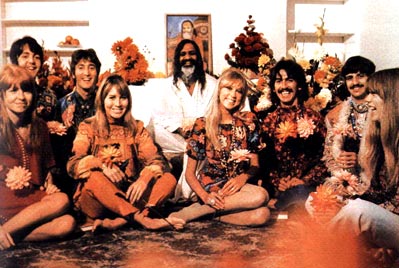 Beatles
“Shanti“, man. The Holy Ganges still flows clean as it emerges from the hills. Quiet, relaxing. A perfect space to write that novel, play bongos, or watch your hair grow.
Rishikesh is “The Yoga Capital of the World“.
Yoga? I know nothing of the science of Yoga. But it seems to me they obfuscate a practice (stretching and light conditioning) done safely and effectively by 7-year-olds.
Practitioners would highlight the mental discipline, a total lifestyle. This is true for serious yogis as it is for dancers and martial artists. But I just can’t stand mute when someone extols the “topsy-turvy manoeuvre” as religious experience.
“It’s a headstand! We teach it to 6-year-olds!”
Still, students in Rishikesh were all mellow-happy. I should make time to try yoga. (Should I choose Bhakti, Hatha, Laya, Kundalini, or Raja yoga?)
Rishikesh is replete with dozens of massive ashrams, housing untold thousands of Hindu pilgrims. Yet there was no place for me.
One gatekeep looked like a sadhu, but acted more soldier than sage. (Ex-military in the British tradition, as it turned-out.)
Later he warmed to me, after I concurred that most backpackers are complaining cheap-skates. Suddenly a great Ganges-view corner room became available. I camped on my balcony looking over to the cremation ghat.
 God?
God?Einstein believed in God. Feynmann found only “a mysterious universe without any purpose“.
Particle physicists have a better chance to answer the question than philosophers. They seek the G.U.T. (Grand Unified Theory) which will explain “everything“.
Many a genius concluded that God exists. Saint Vinoba was asked, “Do you feel as sure of God as you do of the lamp in front of you?”
“I am sure, quite sure, of God. But as for the lamp …”
Gandhi heard what he assumed to be the voice of God tell him to undertake a 21 day fast. Gandhi did not lie. Was it a schizophrenic episode?
Psychologist Antony Starr noted that unprovable beliefs shared by a few are delusion, but those shared by millions are religions.
Scientific rationalists should not believe in God. Nor should they fall in love, or feel fear watching a horror movie.
The Dalai Lama (officially an “atheist“, but the most religious atheist I can imagine) pointed out that we are born into this world not needing religion, only affection.
The historical Buddha told his followers clearly that there is no God. After his death they rushed to fill the void with … The Buddha.
Gandhi said that all religions are different leaves on the same tree.
But what is the tree?
Joseph Campbell called the myths and religions of man, the “masks of God“.
But what lies under the mask?
Even the most devout atheist will agree that E=mc2. Matter is energy. The atheist might even go along if you call that energy “God“. It’s just a word.
The debate really starts when you claim that God is sentient, creates or destroys, intercedes on Earth.
This is difficult to defend as “it rains on the just and the unjust“. Bad things happen to good people. None of the religious rationalizations, I’ve heard, convince me.
Yet I don’t have the conviction to deny that your God exists. Some microbe in my small intestine might deny that I exist. It would be mistaken.
Obviously a God might “be” which we can’t yet perceive. Perhaps God is unaware of our existence too. (Could you call him “God” then?)
Microbe that I am, I still can’t condone any God which calls you to hurt yourself or others. I get suspicious if your religion:
Me? I’ve been studying monkeys.
We and the apes evolved from a common ancestor. Thence we came — tribal bands of pesky hunter-gatherers.
Life was short and brutish for primitive man. (We sired 20 offspring in order that 2 survive to adulthood.) Life was precarious. Drought, flood, disease, invasion. A dangerous world of evil forces.
The only defense was to “call upon powers which were a match for these adversaries or to propitiate the malevolent forces themselves“. (Roger Housden)
Superstitions, rites, rituals for protection evolved in every clan. The “evil eye” was feared the world over.
The first deity of which we know is the “fertility goddess“; “Earth Mother“, “Maha Devi“.
The miracle of life. The profound sense of wonder at the magic of birth was akin the awe of the mountains, thunder storms, the sea.
Often She was represented by a clay figurine. I know because a friend once made and gave me such a fertility goddess — a fine gift. (Mine hasn’t worked yet, Mary.)
You must know that a female supreme deity can’t last long in a male-dominated species like ours. She was usurped by male warriors like Zeus, Thor, Indra.
But for me the original God is female. And She is energy.

I should go back to Tibet, search out Shambala, consult the “Spiritual Masters” of the Theosophists who have been monitoring the progress of mankind.
 I was mad to have missed the chance to ask Satya Sai Baba, near Bangalore. Two Texas Indians married at his ashram assured me he’s a true fakir.
Sai Baba is the #1 guru of all time, a “man of miracles” who can materialize Swiss watches, heal the sick, and once turned into a sea serpent in front of hundreds of witnesses.
Sai Baba out-draws everyone but the Pope. He fed a million people for a week at his 70th birthday party.
A founder of the Hard Rock Cafe knows he’s for real. He donated $54 million. “Love All. Serve All.”
PS
I’m Quitting India. I’m gone down the Irrawaddy to hunt down Kurtz.

Matter manifested into life. Life evolved “mind” (a consciousness of our existence). Next is the transition to a kind of Superman, with supramental understanding that all life is part of the same “Energy“.


 This new Eden attracted idealists from all over the world. Even Saskatoon! I moved in immediately.
I was impressed with the courage of trying to build Paradise, an experiment material and spiritual. Anyone can meditate in a cave. Auroville took guts. Plato would be proud.
Since it opened in 1968, Auroville has struggled. Settlers were starving in 1976. Utopia is a work-in-progress.
After the Mother left her body in 1973, an acrimonious power struggle was inevitable between the ashram (which controlled the money) and the increasingly pragmatic Aurovillians.
In 1988 the Indian government finally transferred power to a committee representing all interest groups. Progress is slow. All talk no action. Too much democracy?
Evolution was faster with Mother as benevolent dictator.
(As a neo-Confucius wandering state-to-state looking for a potentate to install my ideal government, I’d be happy to take over. Aurovillians would fly right, or be drinking the special Cool-aid.)
Auroville is clean and green. Mongoose run bold as house cats.
All life’s necessities are available; ayurvedic medicine, reflexology, pranic healing. You can get your lymphs drained.
Library, computer lab, health food. It’s a cashless society, everything done on account. I liked the “Free Store” — used clothing and toys dropped-off and picked-up as needed.
Jazz on Sunday nights. Theatre Sports Fridays.
My guesthouse provided bikes and motor-scooters so I could explore the communities and get to the beach.
Aurobindo’s ashram itself (in town) was disappointing, but Frenchified Pondicherry was a treat! Wide, clean boulevards, Hotel de Ville, red-capped Gendarmes. The Tricolour flies the Consulate.
 Gandhi’s Ashram, Sevagram
Gandhi was a normal boy, a little rebellious. He stole money, smoked, ate meat — then repented, submitting a written confession to his father.
Some years later he became the impossible, a truthful man. He said he had “no regrets about any word spoken or written“. A lawyer for 20 years, he never lied. How about that?
A week at Gandhi’s, I was overwhelmed by his story, by the self-sacrifice and altruism he inspired. I was brought to tears dozens of times as I visited his many memorials across India.
Gandhi’s commitment to truth made me consider my own “weakness for dogmatic and exaggerated statements“. (Herzog) I’d like to claim a comic style a la Hunter S. Thompson or P.J. O’Rourke; that I’m sacrificing the boring, literal truth on the higher alter of humour. The Mahatma would not approve, I know.
Then I considered my use of unattributed quotations. These scribblings are mostly anecdotes I’ve liberated from books and fellow travellers. Precious little is divinely inspired. A friend (kindly) suggested I wasn’t a plagiarist but, rather, a “jewel thief“. (Becket?)
Osho International (Bhagwan Shree Rajneesh)
Remember Osho, the “sex guru“? His scandalous Oregon Rajneeshpuram ashram? His fleet of Rolls Royces?
The “man” charged Osho with immigration fraud, fined him $400K, and deported him back to Pune, India in 1985.
My guidebook urged me come see “hundreds of disaffected maroon-clad yuppies being individuals together“. I couldn’t resist.
Before admittance to the ashram you must pass an (intriguing) HIV negative test. Inside the leafy, immaculate compound there is no hint you’re in India. Pretty people, some sitting close, cow-eyed. Others lead blind-folded partners in a trust game. Unseen speakers pipe new-age music. Classes are offered in Chinese, Sufi dance, calligraphy, koan study, archery, and “zennis” (zen tennis).
Osho’s the rogue guru who could be counted on to do or say anything. Still his most popular practice involves laughing, crying, or being “a watcher on the hill” (sitting) for 3 hours / day. “This is the most important breakthrough since the Buddha 25 centuries ago.”
Osho was his own worst enemy. His most astute business move was to leave his body in 1990. With no more fear of scandal, the ashram is booming. It’s the #1 Club MEDitation in the world.
Osho’s market has always been rich Westerners. The kind who believe James Redfield (“Celestine Prophesy“) to be a spiritual genius. They load up with “new” (carefully re-edited) Osho videos and books before flying home to New York or Milan. Audio tapes of his silent communion with devotees sold briskly.
Everyone I spoke with who spent time there left disappointed. But I thought it looked fun and harmless.
I’m in a mellow place. Dharamsala is still surprisingly undeveloped; pot-holed, muddy roads, littered hillsides. The Dalai Lama had lunch in a local eatery with Tenzin Palma (American nun who spent 12 years in a cave retreat) — nobody pestered them.
 Gere’s here. And Goldie Hawn. The Dalai Lama is teaching an advanced tantric initiation.
Can you believe this? A charity golf fund-raiser. Pounding golf balls for merit off a makeshift mountainside driving range. (The Dalai Lama has a terrible slice, rushes his swing.)
We marked the 40th anniversary of the Tibetan uprising. Recently, 6 hunger-strikers were force-fed after 49 days. One, 60-year-old Thupten Ngodup, then set himself ablaze. Their (ignored) demands were:
For the first time I’m staying at a Buddhist retreat. A founder, Lama Yeshe, died in 1984. But he’s still here in his new incarnation, a Spanish teenage monk. Smoking, alcohol, sex, theft, and lying are forbidden — this is truth.
Each evening Westerners get together for meditation and a “teaching“. The theme, appropriately, is “delusion“. But our teachers, mostly American nuns, babble free of any confines.
There is far too much emphasis on the teacher-student relationship, a throwback to the times of oral transmission of wisdom. Those with spiritual accomplishment and experience are assumed to be educators.
I quickly tired of long debates on whether a Buddhist should rescue a fly trapped in a web. But I did feel compassion for the sincere, muddled seekers caught up in the complexities of ancient text and ritual. They are an intelligent, thoughtful group, but unenlightened as the rest of us.
The Western mind has difficulty melding with Buddhism. The Dalai Lama is constantly advising not to change religion. He’s seen the damage far too many times, especially when Westerners put on Buddhist robes.
Yet there is something excellent in Buddhism. Eastern Buddhist are radiant, serene, full of fun and laughter.
Buddhist masters are capable of incredible physical and mental feats. One Rimpoche refugee was assigned brutal Himalayan road construction. He worked joyously, unaware of the cold, mentally transforming a frozen quarry into a “pure realm“.
I tried to reduce Buddhist philosophy to a few USEFUL elemental CONCEPTS & TECHNIQUES.
Life is IMPERMANENT; birth, aging, disease, death. You are travelling by train, 3rd Class, or perhaps 1st Class A.C. The only thing certain is that your train will crash. You just don’t know when. So enjoy the ride.
I’ve always denied death, but Buddhists find it liberating. The Dalai Lama rehearses his death moment every day (to get it right when the time comes). He’s always talking of living and dying in peace.
The founder of Tibetan Buddhism meditated in a charnel ground. Buddhists make instruments of human bones, bowls of skulls.
DETACHMENT. No clinging or despising. Renounce the world and accept it back each day as a one-time-only gift.
SUFFERING is part of life’s cycle. Should we ignore it? Call on the Gods to intervene? Can we be “happy” when others are suffering?
The Buddha said we should not rely on external saviours. Instead, cultivate our own “Buddha-nature” (call it “Christ-spirit” if you prefer) — LOVE(be happy when others are happy) and COMPASSION(be sad when others are sad).
When the Dalai Lama first visited the States in 1977 he noted that Americans only show affection for their dogs and cats.
A useful concept is KARMA — accumulate “merit” (like a bank account) through good action and thought. MOTIVATION is critical. Karma makes more sense to me than sin-all-week, repent-on-Sunday Christianity.
Buddhists believe meditation is essential. I find it difficult and frustrating, the posture uncomfortable. Neither meditation nor prayer have ever done much for me.
I liked the chanting we did at Gandhi’s. I’m thinking I’d like my own spoken mantra of favourite quotations set to a musical score. Regular quiet time. Gandhi, the most practical Holy man you’ll ever find, suggested to sit in a chair or stand if that helps concentration.
VISUALIZATION is the next step. Buddhists are filled with calm when they see the Buddha. Sunlight sparkling off the lake might do it for me.
The Buddha, a reformer, said we must not believe in tradition simply because it is written in religious texts. Do not blindly accept authority of teachers. Keep testing and reinventing. When you find something that agrees with reason, conducive to the good of one and all, accept and abide by it.
I can disregard reincarnation, enlightenment, Buddhahood. It’s enough to aspire to be a little more generous, patient, persistent. Less susceptible to that “sudden, temporary madness“, anger.
Truth?
That greater seeker, Gandhi, always disclaimed, “In my search for truth I have disregarded many ideas and learned many new things.”
Me too.
Nietzsche argued that there are no truths. Heisenberg proved it — “Nothing is certain“.
Be assured at least this travelogue is truthful. Even my golfing with the Dalai Lama. We golfed and chanted.
Actually we just chanted. I don’t think His Holiness is a golfer.
Continuing my experiments with truth,
– Shri Swami McBhagwan
Perhaps I’ll follow the Beatles to Rishikesh. (Though George fell out with Maharishi Mahesh Yogi after the giggling guru fondled Mia Farrow.)
Where is Alanis? I haven’t bumped into her yet.
Naipaul called him a “fool-parody” of Gandhi.
I found him magnificent.

Gandhi chose the little known Vinoba, who’s “purity of motive was unquestionable”, as the first jail-goer in 1940, ahead of Nehru. Vinoba understood that he was to fast to the death on reaching prison. Fortunately Gandhi’s message to “hold off on that for now” reached there in time.
Bapu was “fascinated and overjoyed” by Vinoba and his work. He invariably sent visitors (including me) the 5 km. to Paunaur ashram where Vinoba toiled independently but parallel with his mentor.
Vinoba was a communicator, a simplifier, a translator of Gandhian thought. Though he had not one whit of Gandhi’s humour or charisma, he could convince anyone. Bandits laid down their weapons at his feet and repented.
Vinoba was unbelievably single-minded. His mother suggested he translate the Gita from Sanskrit to his native tongue. He sat down at 5 AM Oct. 7, 1930 and worked until Feb. 6, 1931.
He learned Arabic in order to study the Koran. In fact, he studied all the great religious texts, many in the original, memorizing much, eventually learning 30 languages.
Vinoba noted that Gandhi was “not a very learned man”, too busy to study properly.
Vinoba was a scientist, trusting personal experience. He wanted a minimal diet, finding he could work on as little as 1200 calories / day. He experimented with sleep, variously 2 to 10 hours, eventually settling on 8 / night.
He experimented with, then adopted, regular periods of voluntary silence (as did Gandhi) one day / week. He reported “a remarkable experience of peace”.
He couldn’t see logic in polluting rivers with cremation ashes so, starting with his father, they were buried.
Vinoba loved Gandhi and was utterly devoted. “Bapu (father) was our philosopher’s stone, making heroes out of clay.” That in him Gandhi converted a“savage” to one with “a craze for service”.
“I do not deal in opinions but only in thoughts, in which there can be give and take.”
Vinoba never criticized Gandhi, but often questioned his ideas. He tested Gandhi. “Had he been found wanting, I would not have stayed.” Indeed, when in doubt, Gandhi consulted Vinoba who was “untainted by politics”.
Vinoba took Gandhi’s programme to the next level.“Though we are small men we can stand on the shoulders of giants like the Buddha and Gandhi and perhaps see a little farther.”
Once India was an independent democracy, Vinoba could see no need of non-violent resistance. Instead? “Non-violent Assistance.” The fighter goes to no-mans-land, offers help, willing to die if necessary. He expanded the concept of the Peace Army; one “soldier” for every 5000 population, ready to intervene in case of disturbance.
Vinoba walked 13 years, over 36,000 miles, accepting over 4.4 million acres of land. Admittedly he left behind many problems when he walked on the next day, but the utter simplicity, the scope of this achievement overwhelms me.
Today he would be scheduling appointments with Gates and Turner.
From Vinoba’s we trekked over to the nearby National Leprosy centre. I felt blessed to meet and watch the patients at work. Never have I known such meek, thankful people.
Gandhi destigmatized this disease. The famed poet Parchure was at an advanced stage, considering suicide. Gandhi invited him in, nursing and cleaning his wounds personally.
An army of Indian leprosy social workers then rose up. Rural India of that day was “backwardness, poverty, exploitation, superstition”, “disease all rampant and horrible”, the Director told us over lunch.
Today leprosy is diagnosed early and “cured”(arrested) in an average of 6 months. The children appeared quite normal, to me. They all return home after treatment.
After Gandhi’s death, Vinoba was much involved in the “Centre of Science for Villages”, improving the technologies of village self-sufficiency. They research bee-keeping, compost, solar power, cottage crafts, and the like. There’s even a toilet museum!
Out here in the middle of nowhere you’ll find the modern Kasturba Gandhi hospital and medical school. It’s amazing what has bloomed around these 2 ashrams.
Vinoba was much influenced by his pious mother. Once a “sturdy” beggar came to the door. He got an equal portion of the prepared dinner. When Vinoba protested, she asked, “Who are we to judge who is worthy and who is unworthy? I must regard every person who knocks as God.”
He was never able to convincingly refute that idea.
Gandhi once advised him to “use a magnifying glass to inspect other people’s good qualities and your own faults”. But, later, Vinoba decided to pay no attention to faults in others or in himself. “Good is God.”
“Live affectionately together” was his message. At his ashram he added a 12th vow, “Speak ill of no other person”.
Vinoba’s ashram was modeled on Gandhi’s, a benevolent dictatorship. But Vinoba came to feel this was a weakness. “Problems started as soon as Bapu closed his eyes.”
Vinoba withdrew his guidance, asking his Sadhaks to do what “collectively and unanimously decide, putting aside those proposals, for now, on which there is no agreement.” The 31 inmates, today, mostly women, still decision-make this way.
Vinoba wrote. He wanted to pass on what he had gathered, “Whether it proves to be true knowledge, or some kind of ignorance which I have mistaken for knowledge.” His final book draft he referred to as“Half-formed Mutterings”. But someone published it as “A Nosegay of Thoughts”.
Friendship was important to Vinoba. Gandhi had taught that all are equal, no one should be “special”, not even spouse and children.
But Vinoba recited the names of 1000 friends and colleagues, like the 1000 Names of God, as a prayer each day, just to bring them to mind.
I like that.
If, then, enough people evolve to adopt voluntary simplicity that — coupled with the efficiencies of a competitive market place — would provide plenty enough for all. And a surplus to start cleaning-up the planet.
ZPG is essential. That can come with education.
Social activism is essential. We need more Vinobas, not more government welfare.
Philanthropy is essential. Gandhi counted generousmerchant princes among his closest friends. Actually I trust Bill Gates to invest more wise than tax and spend governments.
Dreaming on.
Alpatma McCharles
4:30 AM! Wake-up
4:45 “Prayer”
5:15 Study
6:30 “Bread Labour”
7:30 Breakfast
8:00 Kitchen work
8:30 (free)
11:00 Lunch
11:30 (rest)
2:00 pm (spinning thread)
2:30 Study
5:00 Dinner
6:00 “Prayer”
6:30 Study
7:30 (devotional & national music / discussion)
9:00 Bed
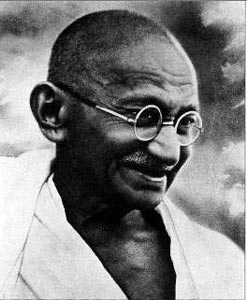 Gandhi said, My life is my message. The study of Gandhian thought here is active learning.
Rambhau is fit & energized, kindly & wise. During morningbread labour (the dirtiest jobs he can find) he joyfully outworks the backpackers.
As a fire-brand at age 18, he told his family he would go to the revolutionary, Gandhi. Father threatened suicide. Rambhau asked that he do it quickly so that he could perform the last rites. Rambhau would not return home.
Rambhau has not travelled. He’s not seen the mountains where old Hindus should go. Echoing Gandhi, he said, My Himalayas are here.
Rambhau is inspiring and grand. But there is a grander. Grander than the God of Michelangelo. Stooped, big-bearded, bushy-eyed. The ancient’s mobility is limited but, in excellent English, he told that he was still completely self-sufficient. He joined in 1945.
Another of Gandhi’s Freedom Fighters, age 75, was visiting. He did go to the Himalayas, completing the sacred Narmada river pilgrimage as a sadhu. For over 450 days he never touched money. Best experience of his life. He was still elated.
I suggested to his son that father had earned a good rest. I’m afraid not, he said. Now he will be a caged tiger.
In 1916 Gandhi was to speak to a noisy crowd who did not yet know him. He stood on a table.
These words had a magic effect. Three in the audience that night became disciples. One was Desai — Gandhi’s personal secretary for life.
Who was Gandhi that he could so inspire these impressive people? I only knew him as Ben Kingsley.
In the West we vaguely associate the Mahatma (“great soul”) with:
Who was Gandhi?
Nehru said his greatest gift was fearlessness. Indeed, that is the Gita’s first divine quality of theMan of Steadfast Wisdom, Gandhi’s favourite scripture which we recited daily at the ashram:
Though Gandhi’s fearlessness was to fear nothing and frighten no one, I find it scary. A Buddhist detachment.
Death is not such a disaster. It comes sooner or later.
Some are ready to die, but can’t bear to have their loved ones taken away. Others can’t part with property. Others fear the bad opinion of the world.
Gandhi met the King of England as a half-naked fakir(Churchill), wearing a peasant’s dhoti. Like Christ he defied the greatest Empire, alone.
When asked if he felt under-dressed for Buckingham Palace, he replied, The King was wearing enough for the both of us.
In the West we mainly know Gandhi for freeing India. Actually, this was his darkest hour, Partitionhis greatest defeat. Perhaps 500,000 dead, 10 million displaced. While they celebrated Independence in Delhi, Gandhi was comforting the despairing in East Bengal. He declined to speak to the BBC — They must forget I know how to speak English.
Gandhi was a warrior, as driven to conquer as any Alexander.
My mission is to convert every Indian, every Englishman, and finally the world to non-violence.
I’ve been a fighter for over 50 years. But I found weapons more powerful than guns and tanks — truth and non-violence”
Does this sound like a passive resister?
He was no martyr, but a man of action. He wanted results. Like any general, he picked his battles.
He fought for South African Indians but not for the Blacks. (Mandella has forgiven him.) Through the deliverance of India, I seek to deliver the so-called weaker races of the Earth.
He fought for untouchables, but downplayed other caste injustice. If untouchability goes, the caste system goes.
Gandhi loved confrontation. Loved to win over his opponent with courtesy, kindness, and the power of his personality.
Gandhi was no peace-nik. He was warlike, and was called to task for it by one of his greatest admirers,The Poet Tagore, who felt that hunger strikes and burning of British cloth were not conversion but coercion, a lesser violence.
Gandhi and war:
Gandhi loved to call himself a Hindu. But wasn’t he a heretic? He abandoned the temple by age 16. He knew no idol. He railed against untouchability and Hindu treatment of women. In fact, he denounced almost all of what we would call Hinduism assuperstition.
Humanitarianism. That was Gandhi’s God, though he called it Rama.
I will give you a talisman. Recall the face of the poorest and most helpless man whom you may have seen and ask yourself if the step you contemplate is going to be of any use to him.
This talisman is key to understanding Gandhi. This is the premise. Everything else falls into place.
One disciple kept 2 photos on his wall; Gandhi (my master) and a poor peasant (my master’s master).
Gandhi’s fight to free India was only a means to an end. Under colonial exploiters it was impossible to fight poverty, prevent disease, end suffering. Even before self-rule had been won, his focus had shifted to Advancement of All.
For Gandhi, work was worship. To work until not a single citizen was deprived of the necessities of life.
His last (unheeded) directive to the Congress Party was to disband; to pledge to make every village self-sufficient; that all workers form a service army to promote:
Remember his march to Dandi? To pick-up natural sea salt which the British were trying to tax. That was perfect.

The “inmates” vow to live by Gandhi’s 11 Commandments:
When a court asked Gandhi his occupation he replied, Farmer and weaver.
Non-stealing is much more than Thou shall not steal. Gandhi felt that keeping a secret was stealing; accepting anything you don’t really need is thieving; even a desire could be theft.
Non-possession is voluntary poverty, and more. Being content with the minimum possible, and being a trustee of those few items, not the owner. Gandhi admired sadhus who seek truth with no possessions. The rest of us need critically examine our possessions and try to reduce them.
Bread Labour is a curious Russian notion that people should WORK for their breakfast. Manual labour. Farm work is best.
We ate excellent food; seasonal, home-grown, unseasoned (except for a little salt and sugar).Ideally the sun should be our only cook.
They use solar cookers and a cow manure biogas stove. Gandhi advocated we drink 2 pounds! of milk every day, (no wonder cow protection is so important) boiled, though he knew that not to be completely safe.
Everyone washes their own dishes, scouring with ash.
I won’t dwell on Gandhi’s failed experiments, his mistakes — but I’ll note a few briefly.
He had some mistaken ideas of holistic medicine — using mudpacks, for example, to treat all manner of illness.
Gandhi did not advocate contraception. Big mistake. Reincarnated today (after a quick headcount) he would reverse that stand, as well as his opposition to inoculation.
He was too puritanical, though as forgiving as demanding. Too enamoured of the religious traditions of renunciation, prayer as confession of unworthiness, fasting, and penance.
Chastity as a straight and narrow road to enlightenment is over-rated at best, anguishing and damaging at worst. I’m surprised it persists with so many seekers.
Most infamously, in the last years, Gandhi tested his self-control (hoping to gain power) by asking young women to lay down with him at night. Other people slept nearby, doors were open. But perhaps this was his Himalayan blunder.
Notwithstanding his few and unimportant faults, Gandhi will prove to be our greatest prophet. The warrior brave enough to embrace his enemy. When I say Gandhi, I see King, Mandella, the Dalai Lama, Aung San Suu Kyi.
Non-violence is increasingly the only option. Would India and Pakistan be playing cricket if both had not tested nuclear weapons?
(Now that an Islamic nation has the bomb, it’s time to revisit the hasty British withdrawal from India and the Middle East; the role of Indian-hating Churchill in the dynamic.)
Ultimately Gandhi declared that Truth is God. A leader who puts truth first is credible — essential if conflicts are to be resolved with words. The alternative is arms.
Perhaps those two are together now. Gandhi said if he was ever fortunate enough to talk with the Lord Buddha he wouldn’t hesitate to ask him why he did not teach the gospel of WORK instead of contemplation.
Gandhi embraced the Christian work ethic. (I’ve come to believe this is wrong. Many workaholics are misled. Good work is good. Bad work is bad, or at least a waste of time.)
It will take some decades (as it did with Christ and Siddhartha) to forget he was human. Now is not the time.
Vinoba was asked what Gandhi would think of how India was progressing.
Men like Gandhi transcend time. He is known as the father of the nation. We are all his children. For the moment, we are behaving as children.
In his lifetime we worked with confidence, but not self-confidence. We worked with confidence in Gandhi.
Vinoba said we should not be dismayed. The forces of peace in the world have never been as strong. It took great vision to make this statement during the Cold War.
 Gandhi and grandson Kanaa
This is Hampi — lost City of Victory, one of 3 astonishing abandoned cities in India.

It’s that old plot; boy (Rama) marries girl (Sita), demon kidnaps girl, boy and monkey (Hanuman) rescue girl, boy denounces girl as soiled goods, girl swears to have kept her virtue, boy and girl reunited in Heaven.
In Hampi, Hanuman is the most cherished God. Monkeys are sacred, a Holy Terror, actually. There’smonkey menace.
These sneaks loot kitchens, snatch daypacks from tourists, steal candy from children. In the cool Hill Station of Kodaicanal, monkeys violate the Hostel dorms every morning. They’ve learned how to open backpacks.
One Hampi monkey I saw swiped a hand mirror — he paused every once in a while to admire himself.
Locals despair of monkeys, but I love them. Fighting, playing, mounting. So human. And such pleasing posture.
The Hampi ruins are great. But my best fun was scrambling the boulders. I trooped after the monkeys at dusk when they retire to the highest hill, actually the highest heap of boulders. In many ways we have devolved. The most inept baby monkey is more agile than a skilled gymnast. Even after several attempts I failed to summit that hill.
I guess it wanted a bolder boulderer.

A friend wrote to ask if I was getting anaesthetizedto these sights, something he had experienced on his long trip to Europe. Yes. The euphoria seemed to wear off after about 4 months. I still love to travel. But I’m no longer giddy.
I did enjoy Pongol (Thanksgiving), though. We ate sweet rice pudding. Farmers washed and then tarted-up the Holy Cows in day-Glo polka dots. At the Maharaja’s palace in Mysore, confused cattle were made to jump over sacred fires. Other cities conduct incompetent versions of The Running of the Bulls. I don’t recall how many casualties. Newspapers love to cite the death counts, but I’ve stopped jotting down the figures.
In South India there are no unhappy travellers — at least not during the temperate winter months.
Most colourful are the hordes (men, boys, young daughters) dressed entirely in black, on pilgrimage to a mountain temple in Kerala. There dwells the peevish child God, Lord Ayappan, an incarnation of Vishnu.
Twenty years ago Ayappan was a minor deity visited only by a hardy handful willing to walk 6 miles barefoot up his mountain.
Today millions take a vow to leave home for 41 days, sleep on bare floors, abstain from sex, meat, and eggs. They are devotees of Hanuman too, and make pilgrimage to his special shrines like Hampi.
No one knows why Ayappan suddenly became so popular. Another mystery of Hinduism.
Roshan, a lady lawyer from Karnataka, explained that Ayappan does not suffer women of menstruating age. One pregnant woman (not mensturating) thought to accompany her husband. The boy God was not amused. A resthouse roof collapsed killing her and spouse.
It’s wisdom as old as India that menstruating women are unclean. Children learn the laws of pollution on their mother’s knee. Many temples prohibit women in their monthly flow. This, like untouchability, like apartheid, is institutionalized inequality.
Caste discrimination is slowly disappearing. But Roshan told that affluent Indian homes include a room used exclusively by women at that time of the month. It is yet quite common.)
It would seem the Ayappan pilgrimage is fraught with risk. Newspapers daily report the number of pilgrims killed in road accidents, mainly pilgrim bus crashes.
Let me climb way out on another limb to declare — South Indian drivers are the most reckless in the world.
Skilled as knife throwers (James Cameroun), they race madly to no purpose. Even the never squeamish Lonely Planet guide advises, take the train … or walk!
The biggest and loudest vehicle has right of way. It was only a few years ago that I finally realized that almost no one wears glasses. No vision test is required. Many are driving blind, relying on the protection of dashboard Gods & movie stars.
The government puts up speed breakers (bumps) and erects barricades. But they serve mainly to infuriate. Drivers make up for lost time.
One of my biggest frustrations here are taxis. I envision a special circle of Hell where hacks cruise calling out only to each other, Taxi? Tuk-tuk? Where you go?, in an ever thickening haze of exhaust.
Oh, NO!, Master. 50 DOLLAR, no 50 rupee!
I’ve counselled many, enthusiastically, to seek honest employment.
I travelled with Robert, an Austrian wurstmeister, now living in South Africa. He inspired — kind and patient with hacks, touts, and beggars.
For the tourist, beggars are a disturbing, sometimes heart-rending dilemma. Some travellers follow the lead of locals who can distinguish between professional beggars and the truly impoverished of the neighbourhood.
Others, the majority, myself included, give nothing to anyone who asks on the street. This is the safer, simpler strategy. You don’t risk luring more into the trade.
I can see no upside to beggary.
What should be a short-term, last-ditch contingency — is usually not.

Historically, Buddhist monasteries provided food and sanctuary. No more. Today the destitute squat beside the river, cook under the bridge, sleep wrapped like a corpse beside the highway. Children are left to play all day at the Railway station.
Mother Teressa has been questioned, but never her mission. What other organizations care for thepoorest of the poor, no questions asked, no demands made?
In my experience, all children are willing to hound, even if they get something from only 1 in 5000 tourists. School pen? Bon-bon? One rupee?
A beggar boy (Lazarus?) accompanied me patiently for 25 minutes, chanting his mantra in Bengali, until finally driven off by locals threatening to beat him.
Street urchins are the most wrenching. (Kids just won’t listen to reason.) Beggars are rarely threatening, though one time I was swarmed by a group of boys. I moved out into rush hour traffic forsafety. I assumed they were pick-pockets, but a professor who happened by assured me they were just curious cricket lads.
The congenitally malformed are mostly fated to beg. Tim Ward was entreated by an armless boy restrained on a leash by a blind woman beggar. He cut the leash.
I heard the story of a tourist who could not get an air ticket to Dharmsala where the Dalai Lama was to be speaking. Eventually he was offered a seat on a charter. Arriving for the flight he found he was the only non-leper. A colony had booked the plane. It was the start of high season.
Tourist beggars are those who have somehow learned a little English. On Sudder Street in Calcutta there is a Feeding of the Poor every Sunday morning. The beggars, mostly women with babies, who work that pavement the rest of the week, do not appear. Charity is beneath them.
Indian beggars are the most inventive. Normal, skinny, flexible! boys suddenly appear with weirdly twisted or splayed limbs. Little girls learn to roll back their eyes, then put something in to make them green and cloudy.
I don’t blame the beggars. There but for the grace of Shiva, go I. Parasites will appear wherever the misled offer something for nothing. The result? Degraded self-esteem, self-pity, a welfare mentality.
Gandhi said, If your heart goes out to a beggar, offer him work not alms.
As for me, I try to steel myself to look each in the eye, smile, shake my head, no. I’ve heard that beggars, like all salespeople, don’t mind being refused (it’s a numbers game) but they resent being ignored.
Everyone agrees that someone should be feeding, housing, and providing medical attention. Most travellers feel they have not given, nor volunteered enough. There is no shortage of reputable charities.
Yet these alternatives do not seem to be attractive enough to pull beggars off the street. It’s economics. A subsistence salary in Madras is $120 / month though the average is only $60/month. A beggar needs only collect $2 / day to match that. Numbers would indicate that begging is one of the more profitable street jobs.
The most successful beggars I’ve come across are the adorable Chicklet girls in Mexico. They move restaurant-to-restaurant offering a tiny box of 2 Chicklets for whatever the tourist chooses to pay. I was told they earn more than police officers there. Why go to school?
I feel more compassion for the non-begging poor. More respect for the man I saw licking clean the used banana-leaf plates out of the trash than for the cripple I surprised enjoying a smoke and chai with the boys at the tea shop.
Indian peoples are very industrious. Most are too proud to beg. You will never find a Sikh beggar — it’s a tenet of their faith to care for their own.
When the Dalai Lama gave a bag of food to each pilgrim, I offered mine to a severely handicapped woman who sold crafts on the curb. She was one of the few who didn’t cry out to foreigners every time they passed. I was careful to offer it when no one else was looking; she careful to hide it away — so as not to get robbed when I turned the corner.
There is no end of do-good charity gone wrong.
James Cameroun made a documentary on the plight of indentured farmers. Dowry debt impoverishes millions. He chose a typical family enslaved to blood-sucking moneylenders. No chance to ever pay back the principle.
The filming complete, the producers paid off the loan then rewarded the incredulous peasant with 100 Pounds Sterling. He immediately set-up shop — as a moneylender.
I travelled with Carole from Spain. Last year she fulfilled a 30 year old promise to return to India as a volunteer. She chose an orphanage out of the Madras phonebook.
Carole is in construction. She renovated, cleaned, painted the buildings & planned an addition — a medical ward.
At home she raised funds and corresponded to be sure work was progressing as she had directed.
Arriving back this year, all of her donated money had gone missing. The children eating plain rice 3 times / day.
She was heartsick but didn’t blow the whistle for fear of having the orphanage closed, the kids turned-out.
In the meantime she was struggling over what to do about another orphanage; a European manager, reportedly, a child molester.
So many problems.
What’s to be done?
Where to start?
I wish Gandhi were here. In England he said, India has problems that would baffle any statesman. But they do not baffle me.
The best investment, I think, is Basic Education of women. Not Tagore, but simple nutrition, hygiene, family planning.
I read a book twice; “May You Be The Mother Of A Hundred Sons”, by Elizabeth Bumiller.
Women work hard and suffer much. Food, water, animal feed, care of the children. They get no rest.
Heavy manual labour too. Convict work; breaking river boulders to stone, stone to gravel, sifting sand, carrying loads up to the road. This is done by women who are paid half a man’s wage.
Despite all, India is progressing. By some accounts, 200 million are middle class. Some are optimistic about the future.
I dropped-in to SEWA (Self-Employed Women’s Association), a success story since 1972.
This trip I’ve been happier, more patient, by taking an educator’s outlook. (Though teaching India is like enlightening a beach, one grain of sand at a time.)
I aspire to be a good role model.
But this country is distressing. It is said thatwhatever weaknesses you have, India will find them.
Too often I’ve lapsed as did Zen Buddhist Peter Matthieson. In his revered book The Snow Leopardhe recounts how a Tibetan dog chased him up on to a roof. He urinated on the beast.
He lamented, that aching gap between what I know and what I am.
A teacher told me that the government has recently decided to fund free education for girls for 2 years longer than for boys. Reverse discrimination? Certainly. But I took this as excellent news.
PPS – Email from Ray Heiderich
I enjoy your accounts of your trip. Interesting stuff. Could use. Some more. Two word. Sentences, though.
PPPS
Back in Canada I got a letter from Carole in Spain. The European paedophile orphanage manager was ejected from India.
PPPPS
Peter Long wrote to note out that Europe is far, far bigger, geographically, than India.
Oops, I sit corrected.
Though I arrived Christmas eve, it was a bit of a let down. I wished I were there.
Goa is OK. But it takes more than the usual tropical attractions (pounding surf, white sand, bikinis) to grip me for more than a day or two.
Goa is special, though, for sea food. Tika shark coconut curry. Kingfish masala with ice cold Kingfisher beer.
Up to now I’d been avoiding the Indian hooch. I dread cashew Feni, coconut Toddy, and other local intoxicants. I’m gun-shy since I poisoned myself and Keith Russell (who, admittedly, imbibed more of the lethal stuff than I) with tainted Sri Lankan Arak. Many here die or are blinded from wood-alcohol-enhanced country liquor.
South Indian food is rightly famous. You eat with your fingers (right hand only!) to FEEL your meal, as well as taste and smell. Spicy, sometimes very spicy, yogurt cools the burn.
Dining South should be superb (vegetarian, healthful, tasty), but it is often a disappointment. Most quickly get bored of rice, mushy vegetables, and dhal (lentil gravy). The best Indian food is to be got outside India.
I’m happy with a few favourites; Uttapam (spicy pancake with onion & tomato), lassi (yoghurt drink), and what we might call masala tea (milky, sweet, spiced with cardamom).
Weird, though, is the restaurant service. As we moved south it became increasingly prompt, courteous, and efficient. The mythical Curry in a Hurry — it is reality!
You see, in the North you expect employees whoachieve the absolute minimum through the expenditure of the most conspicuous activity. (James Cameron)
A sweeper’s job is to sweep, not necessarily move sweepings from the floor to the bin. It’s enough to go vigourously through the motions.
In the North you have no confidence that your food order will ever arrive.
Even if you lurk until the server is standing idle, rush forward and demand tea. He will stand slack, smile sheepishly, shuffle side-to-side, perhaps glance at the roof. It would be improper not to have you wait.
Christmas day I visited Old Goa, the Portuguese city which once rivalled Lisbon in magnificence.
All that remains are imposing cathedrals and beautiful churches, some of the largest in Asia.
It’s the same feeling I get eating a peanut butter and banana sandwich — comfort food for me (but abhorrent to many others).
Are you Christian?, I’m often asked. I mumble some non-answer like, I was raised in a Christian culture …
Missionaries (including my Grandmother Grace and, I think, my Great Aunt Ida Graham) have done some wonderful work here; hospitals, orphanages, training centres.
But I’m loathe to associate myself with Christian religious violence, Papal misdeeds, the Inquisition(more horrific here than anywhere else).
I have, too, distaste for Western paternalism in these many charitable Christian institutions.
In Kalimpong I toured Dr. Graham’s Home, a Christian school founded 1900 to educate children of tea-workers. Graham, a Scottish minister, is a name prominent in my family tree.
I wondered if, but for a few generations, I might have been a heathen-hating pulpit-pounder? Endlessly reiterating the same tired message to a bored audience?
… Nah. That doesn’t sound like me.
 India’s greatest missionary, Francis Xavier, arrived 1544 finding fertile soil amongst the untouchable castes. Hindus have 330 million Gods and Demons. There was certainly room for one more.
Christians soon divided into competing sects and sub-sects. Complicating the usual religious turf-staking, many Indian Christians remained loyal to their hereditary castes. Even today some caste Christians won’t allow untouchables into their homes.
Christianity is much in the news. Hindu extremists have been burning churches in protest of Christian proselytising.
A great blessing here, actually, is the scarcity of Church recruiters. You must be born a Hindu — that’s that. And anyone can call themselves a Buddhist, as I’ve frequently seen. (There may be a requirement to buy the Dalai Lama’s book, I’m not sure.)
I even visited the Jewish enclave in Cochin. Only 80 orthodox souls remain, those who haven’t immigrated to Israel. Don’t be surprised that there are 3 castes of these Malabar Jews, not allowed to inter-marry.
I attempted a tour of the famous Hindu temples of the South. Indeed, I persisted longer than anyone else I met, before temple fatigue and disillusion brought me low.
Hinduism is baffling.
Even poor saint Francis Xavier, buried in Goa, died incomprehensive. How could Hindus worship a stone penis as God when the one true religion knows that God is corporal in wafer and wine?
FX wrote home, There is a class of men here called Brahman (priests). They are the mainstay of heathenism, and have charge of the temples devoted to their idols …. They do not know what it is to tell the truth but forever plot to lie subtly and deceive their poor ignorant followers.
The priesthood of India does seem corrupt to this wandering fellow. I’ve yet to see or hear about a kindly one.
At the famous rock fort temple at Trichy I went looking for the authorities to rescue a confused, injured owl. I could find no one to help though there were hundreds of racketeers and baksheesh-demanders of every ilk.
The most popular temple for tourists is in Madurai.Riotously baroque … towers covered top to bottom in a breathless profusion of multicoloured images of gods, goddesses, animals, and mythic figures. (LP Guidebook)
It’s a Hindu comic book come to life visited by 10,000 every day.
 shrine at Madurai
The temple Art Gallery — laugh or cry? Of all the dilapidated, cob-webbed, rubble-strewn museum disasters I’ve traipsed, this was the worst. Where were the attendants? Disdainful, palm-outstretched, baksheesh hounding.
Without specifically naming Madurai, Roger Housden (Travels through Sacred India, 1996), wrote, at one of the great temples of the south … each scale of the administrative hierarchy pays a dividend to the level above … At the bottom of the pile are the beggars.
I’m over-stating again. No one else was as critical or judgmental. I was fault finding when I, an outsider, should have been appreciating the festive buzz. The pilgrims don’t seem to mind.
Actually, the priests lately have fallen on hard times. In ancient days (the 1940s!) the well-fed Maharaja would be weighed against gold, silver, or pearls. The booty distributed amongst his Brahmen.
I was VIP (exciting mobs, shaking hands, signing autographs) at a remote Hindu village festival. My chance to meet a real priest, one pious man. But no priest was present. This event was organized only by village volunteers from all castes.
Puzzling.
Hindus have no Pope, no central authority. At each temple the hereditary priests are left to their own devices.
It’s unfair to compare Hindu temples with Christian churches.
The word temple is inaccurate. More correct is shrine— simply a roof over the inner sanctum of the resident Gods, represented, usually, by statues; dyed, garlanded, oiled, blunted by the caresses of affectionate devotees.
Only the inner sanctum (where Non-Hindus are not allowed) is sacred. The rest of the temple can be a construction yard and a parking lot. And usually is.
Some say that Hinduism is a simpletonism, a foreign construct to try to explain the hodgepodge. Indians would more often use the word Dharma, describing religious practice and their whole way of thinking. The two cannot be dissected as we try to do in the West.
I visited some lovely, quiet, sanitized temples — those converted to museums. Westerners appreciate them. But to Hindus they are dead.
I’m sure this story made the News — Father Graham, an Australian missionary working with lepers since 1965, burned to death along with his two young sons. Over 100 miscreants poured petrol on the vehicle in which they slept, then set it ablaze.
Is Sonia implicated?
 Sonia Gandhi (of the Nehru dynasty, unrelated to the Mahatma), leader of the opposition Congress Party, is the media anointed ruler-in-waiting — and, born in Italy, she is Christian.
Hindu nationalist BJP is in power. Most believe that the current spate of anti-Christian violence is politically motivated; an anti-Sonia campaign.
She, I, and perhaps 50,000 more alit the holy hill of Trimula, the busiest pilgrimage site in the world, eclipsing Jerusalem, Rome, and Mecca.
Politicians love to be photographed here. A viewing of Vishnu guarantees that any wish will be granted.
Non-Hindus like myself and Sonia must sign a guestbook.
She refused.
Her detractors made the most of this awkward moment. (Sonia doesn’t have the moral credibility to declare herself Hindu, Muslim, Parsi, Buddhist, Sikh, and Jain — the way the Mahatma did.)
Trimula is a marvellous place. A world wonder. A centre of excellence NOT developed by foreigners. In fact, it is ignored by Westerners.
Fleets of buses, armies of pilgrims. Simple housing, services, meals are all provided free.
Trimula is organized; discouraging beggars, touts, and litter. I even saw one of the 6000 temple employees painting over red betel spit stains on the street!
As many as 100,000 people queue for up to 12 hours for a fleeting darshan with the God. Most believe it auspicious to surrender hair to Lord Venkateswara — men, women, and children descend bald, and radiant.

 Rick McCharles