
Category: travelogues

travelogue – Gandhi – India
Gandhi’s “Village of Service” ashram is in Sevagram, the very heart of India. We were greeted warmly by Rambhau. Smiling, he handed us the daily schedule:
4:30 AM! Wake-up
4:45 “Prayer”
5:15 Study
6:30 “Bread Labour”
7:30 Breakfast
8:00 Kitchen work
8:30 (free)
11:00 Lunch
11:30 (rest)
2:00 pm (spinning thread)
2:30 Study
5:00 Dinner
6:00 “Prayer”
6:30 Study
7:30 (devotional & national music / discussion)
9:00 Bed
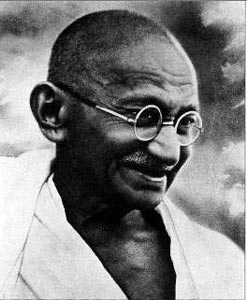 Gandhi said, My life is my message. The study of Gandhian thought here is active learning.
Rambhau is fit & energized, kindly & wise. During morningbread labour (the dirtiest jobs he can find) he joyfully outworks the backpackers.
As a fire-brand at age 18, he told his family he would go to the revolutionary, Gandhi. Father threatened suicide. Rambhau asked that he do it quickly so that he could perform the last rites. Rambhau would not return home.
He’s been at the ashram since — over 50 years.
Rambhau has not travelled. He’s not seen the mountains where old Hindus should go. Echoing Gandhi, he said, My Himalayas are here.
Rambhau is inspiring and grand. But there is a grander. Grander than the God of Michelangelo. Stooped, big-bearded, bushy-eyed. The ancient’s mobility is limited but, in excellent English, he told that he was still completely self-sufficient. He joined in 1945.
Another of Gandhi’s Freedom Fighters, age 75, was visiting. He did go to the Himalayas, completing the sacred Narmada river pilgrimage as a sadhu. For over 450 days he never touched money. Best experience of his life. He was still elated.
I suggested to his son that father had earned a good rest. I’m afraid not, he said. Now he will be a caged tiger.
In 1916 Gandhi was to speak to a noisy crowd who did not yet know him. He stood on a table.
I will not address you as long as I hear the voice of even a single person, nor will I leave this hall as long as a single person is left to hear me. Know that I am obstinate.
These words had a magic effect. Three in the audience that night became disciples. One was Desai — Gandhi’s personal secretary for life.
Who was Gandhi that he could so inspire these impressive people? I only knew him as Ben Kingsley.
In the West we vaguely associate the Mahatma (“great soul”) with:
- winning Indian Independence
- passive resistance
- acceptance of poverty
- return to the simplicity of India’s rural economy
Each of these is wrong.
Who was Gandhi?
Nehru said his greatest gift was fearlessness. Indeed, that is the Gita’s first divine quality of theMan of Steadfast Wisdom, Gandhi’s favourite scripture which we recited daily at the ashram:
… jealous of none, who is without egotism, who is selfless, who treats alike hot and cold, happiness and misery, who is ever forgiving, who is always contented, who’s resolutions are firm, who is versed in action and yet remains unaffected by it, who treats friend and foe alike, who loves silence and solitude, who has a disciplined reason
Multi-denominational prayers are chanted in Sanskrit, Hindi, Urdu (Islam), and English (Lord’s Prayer). A blind man accompanies on home-made sitar.
Though Gandhi’s fearlessness was to fear nothing and frighten no one, I find it scary. A Buddhist detachment.
Death is not such a disaster. It comes sooner or later.
Some are ready to die, but can’t bear to have their loved ones taken away. Others can’t part with property. Others fear the bad opinion of the world.
Gandhi met the King of England as a half-naked fakir(Churchill), wearing a peasant’s dhoti. Like Christ he defied the greatest Empire, alone.
When asked if he felt under-dressed for Buckingham Palace, he replied, The King was wearing enough for the both of us.
In the West we mainly know Gandhi for freeing India. Actually, this was his darkest hour, Partitionhis greatest defeat. Perhaps 500,000 dead, 10 million displaced. While they celebrated Independence in Delhi, Gandhi was comforting the despairing in East Bengal. He declined to speak to the BBC — They must forget I know how to speak English.
Gandhi was a warrior, as driven to conquer as any Alexander.
My mission is to convert every Indian, every Englishman, and finally the world to non-violence.
I’ve been a fighter for over 50 years. But I found weapons more powerful than guns and tanks — truth and non-violence”
Does this sound like a passive resister?
He was no martyr, but a man of action. He wanted results. Like any general, he picked his battles.
He fought for South African Indians but not for the Blacks. (Mandella has forgiven him.) Through the deliverance of India, I seek to deliver the so-called weaker races of the Earth.
He fought for untouchables, but downplayed other caste injustice. If untouchability goes, the caste system goes.
Gandhi loved confrontation. Loved to win over his opponent with courtesy, kindness, and the power of his personality.
Gandhi was no peace-nik. He was warlike, and was called to task for it by one of his greatest admirers,The Poet Tagore, who felt that hunger strikes and burning of British cloth were not conversion but coercion, a lesser violence.
Gandhi and war:
Some are ready to die, but can’t bear to have their loved ones taken away. Others can’t part with property. Others fear the bad opinion of the world.
My mission is to convert every Indian, every Englishman, and finally the world to non-violence.
I’ve been a fighter for over 50 years. But I found weapons more powerful than guns and tanks — truth and non-violence”
Does this sound like a passive resister?
- Zulu war — NON-VIOLENT support of British. Ambulance core.
- WW 1 — VIOLENT support of the British. Tried to enlist Indian soldiers.
- WW 2 — NON-VIOLENT moral (conditional) support of British.
- 1947 — VIOLENT support. Told Nehru, You can’t escape sending the army to Kashmir.
Where there is only a choice between cowardice and violence, I would advise violence.
Gandhi slipped at the end. Compassion got the better of him. If he did not reluctantly agree to Partition, his comrades would be ruined.
Gandhi loved to call himself a Hindu. But wasn’t he a heretic? He abandoned the temple by age 16. He knew no idol. He railed against untouchability and Hindu treatment of women. In fact, he denounced almost all of what we would call Hinduism assuperstition.
Humanitarianism. That was Gandhi’s God, though he called it Rama.
I will give you a talisman. Recall the face of the poorest and most helpless man whom you may have seen and ask yourself if the step you contemplate is going to be of any use to him.
This talisman is key to understanding Gandhi. This is the premise. Everything else falls into place.
One disciple kept 2 photos on his wall; Gandhi (my master) and a poor peasant (my master’s master).
Gandhi’s fight to free India was only a means to an end. Under colonial exploiters it was impossible to fight poverty, prevent disease, end suffering. Even before self-rule had been won, his focus had shifted to Advancement of All.
For Gandhi, work was worship. To work until not a single citizen was deprived of the necessities of life.
His last (unheeded) directive to the Congress Party was to disband; to pledge to make every village self-sufficient; that all workers form a service army to promote:
- Khadi (hand-spun clothing)
- basic education
- women’s welfare
- removing untouchability
- Hindu-Muslim unity
- “Peace Army”
Gandhi had great timing, a marvellous gift for symbolic action. He kept it simple. The audience was illiterate; the dumb millions. He identified with and united these disparate people beyond what seemed possible.
Remember his march to Dandi? To pick-up natural sea salt which the British were trying to tax. That was perfect.

I want world attention in this battle of right vs. might.
His ashram is a living museum almost unchanged since his death. It was Gandhi’s experiment in training Satyagrahas (seekers after the steadfast truth), sometimes called Sadhaks (servants of society).
The “inmates” vow to live by Gandhi’s 11 Commandments:
- Truth
- Non-violence
- Chastity
- Non-possession
- Non-stealing
- Bread Labour
- Control of Palate
- Fearlessness
- Equality of religions
- Self-sufficiency (use local products only)
- Removal of untouchability
Sadhaks seek spiritual fulfilment through social service, without living beyond the means of the poor.
When a court asked Gandhi his occupation he replied, Farmer and weaver.
Non-stealing is much more than Thou shall not steal. Gandhi felt that keeping a secret was stealing; accepting anything you don’t really need is thieving; even a desire could be theft.
Non-possession is voluntary poverty, and more. Being content with the minimum possible, and being a trustee of those few items, not the owner. Gandhi admired sadhus who seek truth with no possessions. The rest of us need critically examine our possessions and try to reduce them.
Bread Labour is a curious Russian notion that people should WORK for their breakfast. Manual labour. Farm work is best.
We ate excellent food; seasonal, home-grown, unseasoned (except for a little salt and sugar).Ideally the sun should be our only cook.
They use solar cookers and a cow manure biogas stove. Gandhi advocated we drink 2 pounds! of milk every day, (no wonder cow protection is so important) boiled, though he knew that not to be completely safe.
Everyone washes their own dishes, scouring with ash.
I won’t dwell on Gandhi’s failed experiments, his mistakes — but I’ll note a few briefly.
He had some mistaken ideas of holistic medicine — using mudpacks, for example, to treat all manner of illness.
Gandhi did not advocate contraception. Big mistake. Reincarnated today (after a quick headcount) he would reverse that stand, as well as his opposition to inoculation.
He was too puritanical, though as forgiving as demanding. Too enamoured of the religious traditions of renunciation, prayer as confession of unworthiness, fasting, and penance.
Chastity as a straight and narrow road to enlightenment is over-rated at best, anguishing and damaging at worst. I’m surprised it persists with so many seekers.
Most infamously, in the last years, Gandhi tested his self-control (hoping to gain power) by asking young women to lay down with him at night. Other people slept nearby, doors were open. But perhaps this was his Himalayan blunder.
Notwithstanding his few and unimportant faults, Gandhi will prove to be our greatest prophet. The warrior brave enough to embrace his enemy. When I say Gandhi, I see King, Mandella, the Dalai Lama, Aung San Suu Kyi.
Non-violence is increasingly the only option. Would India and Pakistan be playing cricket if both had not tested nuclear weapons?
(Now that an Islamic nation has the bomb, it’s time to revisit the hasty British withdrawal from India and the Middle East; the role of Indian-hating Churchill in the dynamic.)
Ultimately Gandhi declared that Truth is God. A leader who puts truth first is credible — essential if conflicts are to be resolved with words. The alternative is arms.
I regard Gandhi as the only truly great figure of our age…. Generations to come will scarce believe that a one such as this was ever flesh and blood walked the Earth.
– Einstein
It would surprise me if Gandhi is not soon worshipped as a God — an incarnation of Vishnu, along with the Buddha.
Perhaps those two are together now. Gandhi said if he was ever fortunate enough to talk with the Lord Buddha he wouldn’t hesitate to ask him why he did not teach the gospel of WORK instead of contemplation.
Gandhi embraced the Christian work ethic. (I’ve come to believe this is wrong. Many workaholics are misled. Good work is good. Bad work is bad, or at least a waste of time.)
It will take some decades (as it did with Christ and Siddhartha) to forget he was human. Now is not the time.
Vinoba was asked what Gandhi would think of how India was progressing.
Men like Gandhi transcend time. He is known as the father of the nation. We are all his children. For the moment, we are behaving as children.
In his lifetime we worked with confidence, but not self-confidence. We worked with confidence in Gandhi.
Vinoba said we should not be dismayed. The forces of peace in the world have never been as strong. It took great vision to make this statement during the Cold War.
Men like Gandhi transcend time. He is known as the father of the nation. We are all his children. For the moment, we are behaving as children.
In his lifetime we worked with confidence, but not self-confidence. We worked with confidence in Gandhi.
Vinoba said we should not be dismayed. The forces of peace in the world have never been as strong. It took great vision to make this statement during the Cold War.
 Gandhi and grandson Kanaa
travelogue – that aching gap – south India
I couldn’t stop grinning. The terrain strange, wild, beautiful. Giant granite boulders heaped inexplicably among green plantations and meandering rivers.
This is Hampi — lost City of Victory, one of 3 astonishing abandoned cities in India.

Hampi is land of the Monkey Kingdom in The Ramayana, an epic of greater than Biblical importance to Hindus.
It’s that old plot; boy (Rama) marries girl (Sita), demon kidnaps girl, boy and monkey (Hanuman) rescue girl, boy denounces girl as soiled goods, girl swears to have kept her virtue, boy and girl reunited in Heaven.
In Hampi, Hanuman is the most cherished God. Monkeys are sacred, a Holy Terror, actually. There’smonkey menace.
These sneaks loot kitchens, snatch daypacks from tourists, steal candy from children. In the cool Hill Station of Kodaicanal, monkeys violate the Hostel dorms every morning. They’ve learned how to open backpacks.
One Hampi monkey I saw swiped a hand mirror — he paused every once in a while to admire himself.
Locals despair of monkeys, but I love them. Fighting, playing, mounting. So human. And such pleasing posture.
The Hampi ruins are great. But my best fun was scrambling the boulders. I trooped after the monkeys at dusk when they retire to the highest hill, actually the highest heap of boulders. In many ways we have devolved. The most inept baby monkey is more agile than a skilled gymnast. Even after several attempts I failed to summit that hill.
I guess it wanted a bolder boulderer.

Though I spent New Years in Hampi, it was a bit of a let-down. I wished I was there.
A friend wrote to ask if I was getting anaesthetizedto these sights, something he had experienced on his long trip to Europe. Yes. The euphoria seemed to wear off after about 4 months. I still love to travel. But I’m no longer giddy.
I did enjoy Pongol (Thanksgiving), though. We ate sweet rice pudding. Farmers washed and then tarted-up the Holy Cows in day-Glo polka dots. At the Maharaja’s palace in Mysore, confused cattle were made to jump over sacred fires. Other cities conduct incompetent versions of The Running of the Bulls. I don’t recall how many casualties. Newspapers love to cite the death counts, but I’ve stopped jotting down the figures.
In South India there are no unhappy travellers — at least not during the temperate winter months.
Most colourful are the hordes (men, boys, young daughters) dressed entirely in black, on pilgrimage to a mountain temple in Kerala. There dwells the peevish child God, Lord Ayappan, an incarnation of Vishnu.
Twenty years ago Ayappan was a minor deity visited only by a hardy handful willing to walk 6 miles barefoot up his mountain.
Today millions take a vow to leave home for 41 days, sleep on bare floors, abstain from sex, meat, and eggs. They are devotees of Hanuman too, and make pilgrimage to his special shrines like Hampi.
No one knows why Ayappan suddenly became so popular. Another mystery of Hinduism.
Roshan, a lady lawyer from Karnataka, explained that Ayappan does not suffer women of menstruating age. One pregnant woman (not mensturating) thought to accompany her husband. The boy God was not amused. A resthouse roof collapsed killing her and spouse.
It’s wisdom as old as India that menstruating women are unclean. Children learn the laws of pollution on their mother’s knee. Many temples prohibit women in their monthly flow. This, like untouchability, like apartheid, is institutionalized inequality.
Caste discrimination is slowly disappearing. But Roshan told that affluent Indian homes include a room used exclusively by women at that time of the month. It is yet quite common.)
It would seem the Ayappan pilgrimage is fraught with risk. Newspapers daily report the number of pilgrims killed in road accidents, mainly pilgrim bus crashes.
Let me climb way out on another limb to declare — South Indian drivers are the most reckless in the world.
Skilled as knife throwers (James Cameroun), they race madly to no purpose. Even the never squeamish Lonely Planet guide advises, take the train … or walk!
The biggest and loudest vehicle has right of way. It was only a few years ago that I finally realized that almost no one wears glasses. No vision test is required. Many are driving blind, relying on the protection of dashboard Gods & movie stars.
The government puts up speed breakers (bumps) and erects barricades. But they serve mainly to infuriate. Drivers make up for lost time.
One of my biggest frustrations here are taxis. I envision a special circle of Hell where hacks cruise calling out only to each other, Taxi? Tuk-tuk? Where you go?, in an ever thickening haze of exhaust.
Oh, NO!, Master. 50 DOLLAR, no 50 rupee!
I’ve counselled many, enthusiastically, to seek honest employment.
I travelled with Robert, an Austrian wurstmeister, now living in South Africa. He inspired — kind and patient with hacks, touts, and beggars.
For the tourist, beggars are a disturbing, sometimes heart-rending dilemma. Some travellers follow the lead of locals who can distinguish between professional beggars and the truly impoverished of the neighbourhood.
Others, the majority, myself included, give nothing to anyone who asks on the street. This is the safer, simpler strategy. You don’t risk luring more into the trade.
I can see no upside to beggary.
What should be a short-term, last-ditch contingency — is usually not.
I’ve counselled many, enthusiastically, to seek honest employment.

Begging is sanctified by Hinduism, Buddhism, Islam, and alms for the poor Christianity. Millions sit out in the sun all day in postures of supplication, as pitifully as possible.
Historically, Buddhist monasteries provided food and sanctuary. No more. Today the destitute squat beside the river, cook under the bridge, sleep wrapped like a corpse beside the highway. Children are left to play all day at the Railway station.
Mother Teressa has been questioned, but never her mission. What other organizations care for thepoorest of the poor, no questions asked, no demands made?
In my experience, all children are willing to hound, even if they get something from only 1 in 5000 tourists. School pen? Bon-bon? One rupee?
A beggar boy (Lazarus?) accompanied me patiently for 25 minutes, chanting his mantra in Bengali, until finally driven off by locals threatening to beat him.
Street urchins are the most wrenching. (Kids just won’t listen to reason.) Beggars are rarely threatening, though one time I was swarmed by a group of boys. I moved out into rush hour traffic forsafety. I assumed they were pick-pockets, but a professor who happened by assured me they were just curious cricket lads.
The congenitally malformed are mostly fated to beg. Tim Ward was entreated by an armless boy restrained on a leash by a blind woman beggar. He cut the leash.
I heard the story of a tourist who could not get an air ticket to Dharmsala where the Dalai Lama was to be speaking. Eventually he was offered a seat on a charter. Arriving for the flight he found he was the only non-leper. A colony had booked the plane. It was the start of high season.
Tourist beggars are those who have somehow learned a little English. On Sudder Street in Calcutta there is a Feeding of the Poor every Sunday morning. The beggars, mostly women with babies, who work that pavement the rest of the week, do not appear. Charity is beneath them.
Indian beggars are the most inventive. Normal, skinny, flexible! boys suddenly appear with weirdly twisted or splayed limbs. Little girls learn to roll back their eyes, then put something in to make them green and cloudy.
I don’t blame the beggars. There but for the grace of Shiva, go I. Parasites will appear wherever the misled offer something for nothing. The result? Degraded self-esteem, self-pity, a welfare mentality.
Gandhi said, If your heart goes out to a beggar, offer him work not alms.
As for me, I try to steel myself to look each in the eye, smile, shake my head, no. I’ve heard that beggars, like all salespeople, don’t mind being refused (it’s a numbers game) but they resent being ignored.
Everyone agrees that someone should be feeding, housing, and providing medical attention. Most travellers feel they have not given, nor volunteered enough. There is no shortage of reputable charities.
Yet these alternatives do not seem to be attractive enough to pull beggars off the street. It’s economics. A subsistence salary in Madras is $120 / month though the average is only $60/month. A beggar needs only collect $2 / day to match that. Numbers would indicate that begging is one of the more profitable street jobs.
The most successful beggars I’ve come across are the adorable Chicklet girls in Mexico. They move restaurant-to-restaurant offering a tiny box of 2 Chicklets for whatever the tourist chooses to pay. I was told they earn more than police officers there. Why go to school?
I feel more compassion for the non-begging poor. More respect for the man I saw licking clean the used banana-leaf plates out of the trash than for the cripple I surprised enjoying a smoke and chai with the boys at the tea shop.
Indian peoples are very industrious. Most are too proud to beg. You will never find a Sikh beggar — it’s a tenet of their faith to care for their own.
When the Dalai Lama gave a bag of food to each pilgrim, I offered mine to a severely handicapped woman who sold crafts on the curb. She was one of the few who didn’t cry out to foreigners every time they passed. I was careful to offer it when no one else was looking; she careful to hide it away — so as not to get robbed when I turned the corner.
There is no end of do-good charity gone wrong.
James Cameroun made a documentary on the plight of indentured farmers. Dowry debt impoverishes millions. He chose a typical family enslaved to blood-sucking moneylenders. No chance to ever pay back the principle.
The filming complete, the producers paid off the loan then rewarded the incredulous peasant with 100 Pounds Sterling. He immediately set-up shop — as a moneylender.
I travelled with Carole from Spain. Last year she fulfilled a 30 year old promise to return to India as a volunteer. She chose an orphanage out of the Madras phonebook.
Carole is in construction. She renovated, cleaned, painted the buildings & planned an addition — a medical ward.
At home she raised funds and corresponded to be sure work was progressing as she had directed.
Arriving back this year, all of her donated money had gone missing. The children eating plain rice 3 times / day.
She was heartsick but didn’t blow the whistle for fear of having the orphanage closed, the kids turned-out.
In the meantime she was struggling over what to do about another orphanage; a European manager, reportedly, a child molester.
So many problems.
What’s to be done?
Where to start?
I wish Gandhi were here. In England he said, India has problems that would baffle any statesman. But they do not baffle me.
The best investment, I think, is Basic Education of women. Not Tagore, but simple nutrition, hygiene, family planning.
I read a book twice; “May You Be The Mother Of A Hundred Sons”, by Elizabeth Bumiller.
Women work hard and suffer much. Food, water, animal feed, care of the children. They get no rest.
Heavy manual labour too. Convict work; breaking river boulders to stone, stone to gravel, sifting sand, carrying loads up to the road. This is done by women who are paid half a man’s wage.
Despite all, India is progressing. By some accounts, 200 million are middle class. Some are optimistic about the future.
I dropped-in to SEWA (Self-Employed Women’s Association), a success story since 1972.
This trip I’ve been happier, more patient, by taking an educator’s outlook. (Though teaching India is like enlightening a beach, one grain of sand at a time.)
I aspire to be a good role model.
But this country is distressing. It is said thatwhatever weaknesses you have, India will find them.
Too often I’ve lapsed as did Zen Buddhist Peter Matthieson. In his revered book The Snow Leopardhe recounts how a Tibetan dog chased him up on to a roof. He urinated on the beast.
He lamented, that aching gap between what I know and what I am.
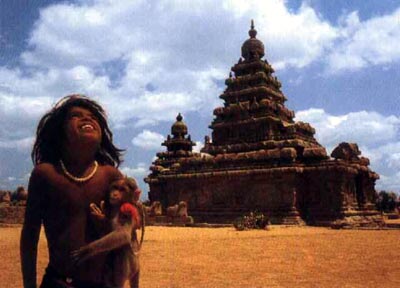
PS
A teacher told me that the government has recently decided to fund free education for girls for 2 years longer than for boys. Reverse discrimination? Certainly. But I took this as excellent news.
PPS – Email from Ray Heiderich
I enjoy your accounts of your trip. Interesting stuff. Could use. Some more. Two word. Sentences, though.
PPPS
Back in Canada I got a letter from Carole in Spain. The European paedophile orphanage manager was ejected from India.
PPPPS
Peter Long wrote to note out that Europe is far, far bigger, geographically, than India.
Oops, I sit corrected.
travelogue – curry in a hurry – south India
Goa. The most storied Christmas party-cum-beach traveller’s scene in backpackerdom. Nirvana for freaks and greying hippies.
Though I arrived Christmas eve, it was a bit of a let down. I wished I were there.
Goa is OK. But it takes more than the usual tropical attractions (pounding surf, white sand, bikinis) to grip me for more than a day or two.
Goa is special, though, for sea food. Tika shark coconut curry. Kingfish masala with ice cold Kingfisher beer.
Up to now I’d been avoiding the Indian hooch. I dread cashew Feni, coconut Toddy, and other local intoxicants. I’m gun-shy since I poisoned myself and Keith Russell (who, admittedly, imbibed more of the lethal stuff than I) with tainted Sri Lankan Arak. Many here die or are blinded from wood-alcohol-enhanced country liquor.
South Indian food is rightly famous. You eat with your fingers (right hand only!) to FEEL your meal, as well as taste and smell. Spicy, sometimes very spicy, yogurt cools the burn.
Dining South should be superb (vegetarian, healthful, tasty), but it is often a disappointment. Most quickly get bored of rice, mushy vegetables, and dhal (lentil gravy). The best Indian food is to be got outside India.
I’m happy with a few favourites; Uttapam (spicy pancake with onion & tomato), lassi (yoghurt drink), and what we might call masala tea (milky, sweet, spiced with cardamom).
Weird, though, is the restaurant service. As we moved south it became increasingly prompt, courteous, and efficient. The mythical Curry in a Hurry — it is reality!
You see, in the North you expect employees whoachieve the absolute minimum through the expenditure of the most conspicuous activity. (James Cameron)
A sweeper’s job is to sweep, not necessarily move sweepings from the floor to the bin. It’s enough to go vigourously through the motions.
In the North you have no confidence that your food order will ever arrive.
Even if you lurk until the server is standing idle, rush forward and demand tea. He will stand slack, smile sheepishly, shuffle side-to-side, perhaps glance at the roof. It would be improper not to have you wait.
Christmas day I visited Old Goa, the Portuguese city which once rivalled Lisbon in magnificence.
All that remains are imposing cathedrals and beautiful churches, some of the largest in Asia.
There is something culturally comforting in Christianity. Spotting a steeple is like spying a dress instead of an Indian sari.
It’s the same feeling I get eating a peanut butter and banana sandwich — comfort food for me (but abhorrent to many others).
Are you Christian?, I’m often asked. I mumble some non-answer like, I was raised in a Christian culture …
Missionaries (including my Grandmother Grace and, I think, my Great Aunt Ida Graham) have done some wonderful work here; hospitals, orphanages, training centres.
But I’m loathe to associate myself with Christian religious violence, Papal misdeeds, the Inquisition(more horrific here than anywhere else).
I have, too, distaste for Western paternalism in these many charitable Christian institutions.
In Kalimpong I toured Dr. Graham’s Home, a Christian school founded 1900 to educate children of tea-workers. Graham, a Scottish minister, is a name prominent in my family tree.
I wondered if, but for a few generations, I might have been a heathen-hating pulpit-pounder? Endlessly reiterating the same tired message to a bored audience?
… Nah. That doesn’t sound like me.
 India’s greatest missionary, Francis Xavier, arrived 1544 finding fertile soil amongst the untouchable castes. Hindus have 330 million Gods and Demons. There was certainly room for one more.
Christians soon divided into competing sects and sub-sects. Complicating the usual religious turf-staking, many Indian Christians remained loyal to their hereditary castes. Even today some caste Christians won’t allow untouchables into their homes.
Christianity is much in the news. Hindu extremists have been burning churches in protest of Christian proselytising.
A great blessing here, actually, is the scarcity of Church recruiters. You must be born a Hindu — that’s that. And anyone can call themselves a Buddhist, as I’ve frequently seen. (There may be a requirement to buy the Dalai Lama’s book, I’m not sure.)
I even visited the Jewish enclave in Cochin. Only 80 orthodox souls remain, those who haven’t immigrated to Israel. Don’t be surprised that there are 3 castes of these Malabar Jews, not allowed to inter-marry.
I attempted a tour of the famous Hindu temples of the South. Indeed, I persisted longer than anyone else I met, before temple fatigue and disillusion brought me low.
Hinduism is baffling.
Even poor saint Francis Xavier, buried in Goa, died incomprehensive. How could Hindus worship a stone penis as God when the one true religion knows that God is corporal in wafer and wine?
FX wrote home, There is a class of men here called Brahman (priests). They are the mainstay of heathenism, and have charge of the temples devoted to their idols …. They do not know what it is to tell the truth but forever plot to lie subtly and deceive their poor ignorant followers.
The priesthood of India does seem corrupt to this wandering fellow. I’ve yet to see or hear about a kindly one.
At the famous rock fort temple at Trichy I went looking for the authorities to rescue a confused, injured owl. I could find no one to help though there were hundreds of racketeers and baksheesh-demanders of every ilk.
The most popular temple for tourists is in Madurai.Riotously baroque … towers covered top to bottom in a breathless profusion of multicoloured images of gods, goddesses, animals, and mythic figures. (LP Guidebook)
It’s a Hindu comic book come to life visited by 10,000 every day.
 shrine at Madurai
Riotous, yes. But to me it was no more than an unholy shopping bazaar. Jesus would exhaust himself upsetting tables.
The temple Art Gallery — laugh or cry? Of all the dilapidated, cob-webbed, rubble-strewn museum disasters I’ve traipsed, this was the worst. Where were the attendants? Disdainful, palm-outstretched, baksheesh hounding.
Without specifically naming Madurai, Roger Housden (Travels through Sacred India, 1996), wrote, at one of the great temples of the south … each scale of the administrative hierarchy pays a dividend to the level above … At the bottom of the pile are the beggars.
I’m over-stating again. No one else was as critical or judgmental. I was fault finding when I, an outsider, should have been appreciating the festive buzz. The pilgrims don’t seem to mind.
Actually, the priests lately have fallen on hard times. In ancient days (the 1940s!) the well-fed Maharaja would be weighed against gold, silver, or pearls. The booty distributed amongst his Brahmen.
I was VIP (exciting mobs, shaking hands, signing autographs) at a remote Hindu village festival. My chance to meet a real priest, one pious man. But no priest was present. This event was organized only by village volunteers from all castes.
Puzzling.
Hindus have no Pope, no central authority. At each temple the hereditary priests are left to their own devices.
It’s unfair to compare Hindu temples with Christian churches.
The word temple is inaccurate. More correct is shrine— simply a roof over the inner sanctum of the resident Gods, represented, usually, by statues; dyed, garlanded, oiled, blunted by the caresses of affectionate devotees.
Only the inner sanctum (where Non-Hindus are not allowed) is sacred. The rest of the temple can be a construction yard and a parking lot. And usually is.
Some say that Hinduism is a simpletonism, a foreign construct to try to explain the hodgepodge. Indians would more often use the word Dharma, describing religious practice and their whole way of thinking. The two cannot be dissected as we try to do in the West.
I visited some lovely, quiet, sanitized temples — those converted to museums. Westerners appreciate them. But to Hindus they are dead.
I’m sure this story made the News — Father Graham, an Australian missionary working with lepers since 1965, burned to death along with his two young sons. Over 100 miscreants poured petrol on the vehicle in which they slept, then set it ablaze.
Is Sonia implicated?
 Sonia Gandhi (of the Nehru dynasty, unrelated to the Mahatma), leader of the opposition Congress Party, is the media anointed ruler-in-waiting — and, born in Italy, she is Christian.
Hindu nationalist BJP is in power. Most believe that the current spate of anti-Christian violence is politically motivated; an anti-Sonia campaign.
She, I, and perhaps 50,000 more alit the holy hill of Trimula, the busiest pilgrimage site in the world, eclipsing Jerusalem, Rome, and Mecca.
Politicians love to be photographed here. A viewing of Vishnu guarantees that any wish will be granted.
Non-Hindus like myself and Sonia must sign a guestbook.
She refused.
Her detractors made the most of this awkward moment. (Sonia doesn’t have the moral credibility to declare herself Hindu, Muslim, Parsi, Buddhist, Sikh, and Jain — the way the Mahatma did.)
Trimula is a marvellous place. A world wonder. A centre of excellence NOT developed by foreigners. In fact, it is ignored by Westerners.
Fleets of buses, armies of pilgrims. Simple housing, services, meals are all provided free.
Trimula is organized; discouraging beggars, touts, and litter. I even saw one of the 6000 temple employees painting over red betel spit stains on the street!
As many as 100,000 people queue for up to 12 hours for a fleeting darshan with the God. Most believe it auspicious to surrender hair to Lord Venkateswara — men, women, and children descend bald, and radiant.

travelogue – the City of Joy – Calcutta
I arrived in the City of Joy. A wonderful day. Nothing was open. No vehicle moved. The beautiful new cable bridge, normally choked, deserted.
Nothing was doing — except cricket. Boys and men played everywhere, the space glorious.
They are mad for cricket here. You from Canada coming? You are seeing the CLASH India-Pakistan?
It is too dangerous for nuclear super-rivals to play on the subcontinent, so they play in Toronto. (Matches are planned soon in India. A disaster looms.)
You can quote me as a physical educator. If there is a more useless physical activity than baseball, it is cricket. I blame the British who inflicted this disease on all their colonies, except snowy Canada.
I strolled empty Calcutta for hours, clueless. Finally I saw the poster:
24 Hour National Strike against Globalization, Privitization, Unemployment, Indiscriminate Computerization, and Murderous Price Rise, etc.
In the Calcutta Telegraph the next day: Bengal Basks in Strike Glory. With blood on its hands, West Bengal stood … boastful of bringing life to a complete halt.
Bengal is a poor region with Marxist local governments. The Strike, protesting national government economic policies, was successful here while mostly ignored in the rest of the country. Everyone seemed pleased that 2 strike-breakers died in roadblock confrontations, and relieved that even more weren’t killed.
Next day Calcutta was back to normal; loud, polluted, ugly. One of the most densely populated cities on Earth.
The City of Joy is no joke. The poor migrate here when life in the floodplains becomes a death sentence.
There are few Westerners, mainly those in transit and a core of NGO volunteers. A vocal few defend the city, It has a soul. It’s the centre of the Arts.
 Sudder Street
I stayed at the Salvation Army in the backpacker ghetto of Sudder Street. Two blocks away is New Market, the biggest in the city. In the mountains of garbage behind was a scene from Hell; dogs, humans, black pigs, and crows, all scavenging. In Calcutta the pigs and crows are thriving, the dogs and humans might be close to death.
I was reminded of a dusty bus stop in Nepal where I watched huge vultures, wings spread for balance, battle dogs and pigs for a buffalo carcass.
 I’ve seen too many pitiful dogs; open-sored, limping 3-legged, squinting hopeful, but suspicious. Even one paraplegic, dragging useless hindquarters across the village meat market. I involuntarily compared these desperately poor Bengalis with pariah dogs. Pups and children appear quite healthy, then quickly deteriorate, a cumulative effect of disease, malnutrition, and bad water.
I’m painting the worst possible picture.
I visited the border of rural Bangladesh; green paddies, lush mango groves, fertile fields. There were no walking skeletons. Most often I’m impressed how happy are the poor, their simple lives. Some of the garbage dump architecture (Alex Frater) appears homely, and breezy. In Sri Lanka the beach shacks of the poor Tamils appealed more than the modern Sinhalese homes.
I didn’t visit the goonda-controlled slums, the bustees of Calcutta or Bombay. I’m reluctant to go with no greater purpose than picturesque poverty. (James Cameron)
I should make clear that the Indian peoples are bodily fastidious. While the streets are rank, teeth and gums are brushed, the body ritually scrubbed. Westerners are always struck by how much clothing is washed. The dhobi-wallahs, washers, are seen by every body of water, all day, every day, enthusiastically slapping the laundry clean on boulders.
Naipaul pointed out that the impoverished wash the most because they have so few clothes. The poorest women are conspicuous — they own just one sari and have no undergarments. Of course they wash and bathe at the same time.
It seems a contradiction that these ritually clean people are so unaware of the filth around them. I’m told that it is caste related. It is unclean even to notice shit underfoot.

Everyday I’m asked, You are liking India?
I always respond, Great! Wonderful people! But it is very dirty, polluted. (I can point in any direction.) Locals always look puzzled at such an unfounded concern.
Most far-travelled backpackers would concur that India is the most rewarding destination.
The Indian peoples are fascinating and fanatic. Friendship assails the stranger. You are besieged with Indian company, all hopeful new pen friends.
I was the lone Westerner in town. A jolly smiling chap introduced himself and his pretty wife. Next morning I had breakfast at their home in the Police Lines — he was the Commissioner. This lovely, traditional Bengali family had come to know a number of Westerners. His last posting was in Nadia, home of ISKCon, the International Society for Krishna Consciousness. Hare Krishna, to you.
I’ve been befriended by English teachers, political activists, free-lance journalists, priests, and a travelling vegetable oil sales rep.
A proud father pushed his 3 year old through a crowded bus so that the Sahib might admire his prodigy’s knowledge of world capitals and political leaders, with just a little prompting. Only in India.
A tiny woman approached me at a bus stand; Roshan, a Parsi (originally from Iran), the first lady lawyer in Karnataka state. Vivacious, articulate, impressive. She had traveled all of India, providing us with a wealth of advice — even the price of tiger prawns on Varkhala beach! I assumed Roshan was that rarity, a single, academic career woman. Actually she had 9 children in 10 years, the youngest 14 and all still in school.
I was reading the autobiography of another Indian barrister, one M.K. Gandhi. Roshan’s life was even more exceptional.
Actually it’s a problem to meet the women of India. Few are forward enough, and speak English well enough, to engage.
I did meet an Islamic dentistry student studying at an Arab-financed university. She was horrified at what I was doing. Roaming India was her worst nightmare.
I travelled first class compartment with a lady journalist, a BBC correspondent from Myanmar. We were both en route to see the Dalai Lama. When I saw her next she had shaved her head and become a nun. (Not on my account, I’m sure.)
Bodhgaya, the most important pilgrimage in Buddhism. This is where Prince Siddhartha meditated beneath a tree until he achieved enlightenment. The moment of all awareness is depicted seated, with the right hand touching the ground, “calling the Earth to witness”.
Bodhgaya is a tiny enclave in the middle of Bihar state, India’s poorest. Dacoits (bandits) still loot pilgrim buses with impunity. These dusty Gangetic plains are where the historic Siddhartha was born, taught, and died (from eating poisonous mushrooms).
Around the ancient Bo tree temple, Buddhists from every sect have built. You can contrast the Thai, Japanese, and Korean monasteries. I stayed in a makeshift dungeon dormitory in the Burmese monastery where I had a fine reunion with backpackers I had met in Tibet.
 The Dalai Lama did not disappoint. Larger than life, energetic, enthusiastic. He charmed the audience. A one-man-show.
He was very humble. In my knowledge and teaching of the Buddha, I might stand slightly taller than the pygmies.
He spoke in Tibetan. We listened to simultaneous translation on FM radio. Of his teachings I have little recollection as most were incomprehensible.
In fact, few of the thousands assembled each day under the huge bamboo supported tents had much idea what he was talking about. Certainly not the simple Tibetans. Perhaps the discourse was intelligible to the book-Buddhists, Westerners who have read every text on the subject.
No one complained. Like me they were happy to be present, listening to his laugh, his mellifluous voice. I read, wrote, and napped. It was tranquil. Even tranquilizing.
One of my few notes: Think of all sentient beings as your Mother.” Christians are only concerned for souls of man while Buddhists revere all living creatures.
His Holiness referred to the friends from the West asdepressed, self-obsessed. He advised we renounce acquisition, heaping-up. No clinging or despising.
Another note: Relinquish self-cherishing and self-grasping. That translation became a bit of run-on-fun.
We spent our evenings at the Bo tree, the most marvellous of all the Buddhist festivals I’ve seen. Thousands circumambulated the temple, smoky and fragrant, lit by tens of thousands of candles. Hundreds practiced the impressive prostration meditation. The murmur of mantras merged with the clamour of candle salesmen, mostly kids reaching through the fence.
The Dalai Lama called for a Prayer Night and a Peace March for the victims of the Iraq bombings. The mischievous ones will somehow escape. Only the powerless will suffer. He was diplomatic in his criticism of the U.S. and England. But he was the only diplomat in town. I felt badly for our American friend Michelle. Perhaps this is why so few Americans backpack.
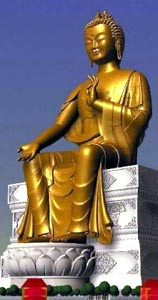 The best story in Bodhgaya is the Maitreya Project, anotherWorld’s Biggest Buddha. This one will be 152 metres high, seated! (The statue of Liberty is 46 metres.) A high-tech Buddha; elevators, assembly halls, telecommunication centre. Earthquake-proof, it must last 1000 years.
Undoubtedly it will be built. There is a lot of money in Buddhism these days. Perhaps Richard Gere, or the high lama Steven Segal, will lead the mega-project fund-raising.
The GREAT IRONY is that the Buddha specifically forbade his followers from making any image. Buddhism is not centred on any Gods but is a a personal philosophy, a code of morality:
1) Right understanding (uninhibited by superstition or delusion)
2) Right thought
3) Right speech
4) Right action
5) Right mode of living (do no harm to living creatures)
6) Right endeavour (self-discipline)
7) Right mindfulness (alert, contemplative)
8) Right concentration
Right.
Your pandit-wanna-be has gone South.
Namaste!
travelogue – Happy Holidays, Wish You Were Here – India
So, you think you can tell,
Heaven from Hell,
Blue skies from pain,
Hot ash from a cool rain,
Can you tell a green field,
from a cold steel jail,
a smile from a veil,
Do you think you can tell?
– with apologies to P.F.
My first Christmas away. Homesick?
I remember being homesick for my cat Cleo when I was about 10 years old.
After high school myself and 3 close friends toured Europe in an orange VW van. That still ranks as my best trip. Age 18 — a most excellent age for travel / discovery. I identified with characters in Michener’sThe Drifters.
Towards the end of our Grand Tour we resolved each to go do our own thing. I was quickly devastated. It seemed so pointless to travel and not have anyone close to share those experiences. I still feel that way at times.
I’m almost never homesick. But I often wish you were here.
These e-mail missives help me a lot. At least I can share an inkling.
For the holidays I thought I might tell you about some of my travel companions, about the kind of people I meet on the road.
I’ve evolved to the point of preferring to travel solo. This is not unusual. The majority of backpackers travel alone or as a couple. It is rare to find groups of 3 or more who can travel together for long.
Many ask, Don’t you get lonely?
Not lonely, as I am rarely alone. It is actually a treat when I get a day completely to myself.
Best I think is to travel solo but to rendezvous with friends en route. (When are you coming to meet me?)
Vikram Seth said that travelers who wander months require an attitude of mind capable of contentment with the present. Perhaps that’s true. But (as you know) budget travel is much easier than most imagine it to be. Almost anyone can handle it.
Of all the cultures I’ve observed, the main one is, of course, the backpacker culture. I’ve traveled with hundreds of different people from all over the world and met many thousands. There are a few I’ve really admired.
I also tend to gravitate towards expats living in these countries as they often know how things work behind the scenes. Always an eye-opener.
Where backpackers gather the talk is of cheap hostels, good restaurants, and places not to be missed. They always have some sort of warning for you. They always speak of the highlight of their trip.
They don’t have much in common — except a claim not to have children back home. There are a few people traveling with their kids, but the consensus is that the low-end travel circuit is not the place for children. Actually the kids thrive, but the parents are wracked with fears about what might go wrong.
The biggest surprise to new backpackers is whom I’ve dubbed the Israeli Army. In countries like India they are the most numerous nationality. Many Israelis travel after their mandatory 3 year military service in such numbers that I often wonder if there is anyone left in Israel.
I trekked with Alon from Tel Aviv who explained that the Army breaks into two main camps — the party types who go directly to Asia, and the nature loverswho head first for South America.
Israelis are notorious for being loud, aggressive, and cheap. Dozens of times I’ve seen some poor shopkeep hounded until he sells an item below cost. Israelis buy 7-day trekking permits for the 21-day Annapurna Circuit Trek and later claim they didn’t realize it would take that long. Networking, they know the cost of items all over the world. (Whenever I want to know the rock bottom price, the cheapest hotel, or the best value restaurant, I ask an Israeli.)
On the other hand, Israelis are often the most adventurous, informative, and fascinating backpacking companions — especially the ones travelling solo who despair of their terrible reputation. The men are world-wise, politically savvy cynics. The Israeli born women are often tough-sexy. Trained killers!
The other big surprise is the scarcity of Americans. It is rare to come across a Yank outside big name tourist destinations. I smiled when I heard of a Trek in Colombia which allowed every nationality EXCEPT Americans. (They make too good kidnap victims.)
I did find a lot of Americans in China. I always introduced them to locals as close friends of Bill Clinton. No one is as easy to embarrass as an American.
Many live up to the stereotype; loud, over-enthusiastic, Amerocentric. Those open-eyed enough to realize how the rest of the world sees them can be very good company. I enjoyed traveling with Julie from Wyoming. She was the first other person who, unprompted, said that she quite liked the Han Chinese people, that she didn’t blame them for the misdeeds of their government and hoped they wouldn’t blame her for the crimes of the USA.
Twice I met up with Dave, a Jesus Christ look-alike from New Jersey. A chronic traveller, his girlfriend had taken off somewhere without him, prefering to go solo. (They had reunited by the second time I bumped into him.)
I’ve travelled with some marvellous, respectful Japanese backpackers. Impressive in that people from that culture have so much difficulty getting intobackpacking and even more difficulty learning English, the lingua franca of travel. The Japanese are the rubes, constantly being taken advantage of, constantly getting ripped-off.
Hiro, who brilliantly hired a taxi to Tibet, disagreed with my assessment. While he felt that it used to be true that most Japanese didn’t know what they were doing, that now they are quite informed, that more women are travelling than men, and that I should understand that many of the Japanese have disgraced their families and forsaken careers to go on the road.
I was somewhat chastened by his rebuttal. And yet over and over again, hundreds of times, I’ve seen Japanese backpackers who look the part — dyed long hair, custom-torn jeans — but afraid to leave their guesthouse. For days.
A high percentage of backpackers are smokers. Bored smokers, I often think. Killing the plentiful down time with cheap smokes. A high percentage of slackpackers don’t get much done in a day. Most guilty of this are those on a strict, low budget.
No doubt the average age of backpackers is increasing. But age is rarely a consideration in travel companions. Destination, language, and budget all factor much higher.
I met a tough German woman, 55, who had been away from home cycling for over 4 years. She was bitter in having been turned back half way into Tibet. She planned to try again on a different highway.
There are more professional couples. I met a chain-smoking Swiss couple who were travelling on-line. Their journal was emailed via a palm-top computer. Photos were mailed home, scanned, and inserted.
Julio from Spain travels one year of every five. Next time he promised to bring his girlfriend who stayed home to run his small business. They will remember him in the tiny Tibetan village of Longmusi — he gave a Salsa dance tape to the disco there.
I always enjoy the company of the educated, understated Brits. I traveled off-and-on with Jess, an exception to the rule, perhaps the most intelligent, opinionated person I ever met. Brilliant and an original thinker, but somehow blinded, I thought, by a failed Catholic upbringing, a rage at the ruling aristocratic Protestant elite. (Is Canada the most classless place on Earth? I don’t give a damn how rich or connected you are.)
In some leap in understanding Jess venerates the poor and Godless. As an example he explained that the only intelligent folk he can find in San Francisco, where he now lives, are the illegal Hispanic (presumably lapsed Catholic) restaurant workers. Jess debunked the Tibetan monasteries we were visiting. I tried to point out the societal benefits of tradition, even religious tradition but he was unequivocal. I pictured him as the kind of dogmatist who thrived during the Cultural Revolution in China, burning the olds and establishing a new order based only on science and reason.
Jess despises the rich and powerful. Mockingly he reminded me that, It is easier for a camel to pass through the eye of a needle than for a rich man to enter the Kingdom of Heaven.
The French, the French, are a curious race — but they always have style. Fashionable dress is de rigeur even in the most remote jungle or mountain top. The women are often chic and beautiful. I’ll always remember one unsettling dorm night when a gorgeous French girl burst in late, drunk, tore off most of her clothes and lolled topless. She was en route to visit her brother who was attempting to be the first person to rollerblade around the world.
I spent some time with Sebastien, an Italian Buddhist who lived several years at the Labrang monastery, now the largest in the world. He had once done the prostration meditation, facing inwards, around the 3.5 km kora. That was 4 days, 10 hours per day. The best aspect he said was the camaraderie with the other pilgrims — that and the tremendous ab. workout.
Over the years he had grown disillusioned with the Tibetans, however. Buddhism is rapidly becoming a business and a career, not a calling. There is a story of a Kathmandu businessman who could not find anyone to buy his used Mercedes — until a Tibetan Rimpoche arrived and paid cash.
High lamas are often wealthy and can even marry.
I’ve met far more Canadians on this trip than ever before. I travelled with Jenny, a pretty Chinese Canadian who had just graduated from Princeton with a degree in Black American Literature. (Toni Morrison is at Princeton.) Jenny is polite, self-deprecating & considerate — just like most Canadians. All over the world we enjoy a terrific, sometimes undeserved reputation. Even self-righteous critics of the Great White North like myself get all patriotic abroad. At first I thought that Jenny didn’t carry a flag. Then I detected 3 very subtle Maple Leafs dyed into the fabric of her pack.
The closest friend I’ve met on this trip is Damian from Switzerland, a gregarious, outdoors enthusiast. We did 2 big treks in Tibet. Someone trying to describe the two of us said that it looked like Steven Spielberg was having breakfast with Keifer Sutherland.
I’ll keep in touch with Damian. But I’ve learned the hard way that it is impossible to stay in contact with past travelling companions. I often give out my own email, but I rarely promise to write.

what do they think of us?
I have a ticket home booked for May ’99 … but I think that is probably too soon to return. I hope to extend the trip as long as health, enthusiasm, and cash hold out.
Thinking of you.
Happy holidays! Wish you were here.
PS
I’m next gone to Bodhgaya, India where I hope to see the Dalai Lama.
travelogue – Annapurna Sanctuary – Nepal
A man brought in a little girl. He said she was four years old. She looked about two. I knew she was dying. Her father asked if we had any medicine. I said we didn’t; he’d have to take her to the hospital. He looked at me as if I’d suggested he take her to the moon.
– Monica Connell
____
This story of old rural Nepal is one I heard many times. Unlike Tibet, every kind of pestilence can flourish in this climate; rats, leeches, bedbugs, roaches. Dysentery was a big killer. TB a plague.
Things have improved immensely since Tenzing and Edmund climbed Everest. Communication, transportation, schooling, health care; all much better due largely to the advent of foreign attention and Trek tourism.
I’d like to report that Nepali cultures, the environment, and tourism exist in a harmonious symbiosis. But I don’t think it’s quite true — yet.
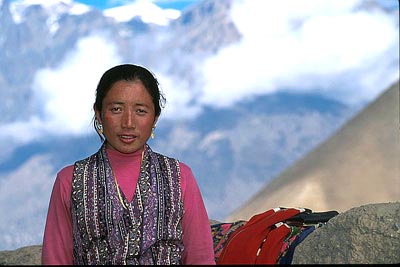
Sustainable tourism? Why not? Nepal is as good an example as anywhere in the developing world.
Trekking here is not a “wilderness” activity. You can’t get away from people, 75% of whom still live in small villages of between 15 – 80 families. The subsistence economy is non-monetary. Villages can grow and trade for almost everything they need.
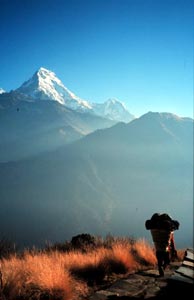 That balance is disturbed in those areas frequented by “rich, lavish, and foolish” Westerners who think it’s fun to walk up and down mountains. (No Sherpa would walk one step further than he must.) And nowhere in the Himalayas is more disturbed than Annapurana, by far the most popular hiking destination. The best hiking in the world, in my opinion.
The Annapurna Circuit is 3 weeks walking up and over the Himalayas to the Tibetan plateau, crossing a monster pass, & back down again to jungle. I did the last half of the Circuit, the Jomson Trek, acclaimed for views of 2 of the highest peaks in the world (Dhaulagiri and Annapurna) and even more famous for the best trekking teahouses anywhere. On Jomson you stroll from one terrific lodge to the next, struggling only whether to order the apple crumble or the baked “Snickers” (reportedly a Scottish invention).
In Tibet we had scornfully poopooed Teahouse Trekking; we pictured 3 week warriors, highwayslittered with unburned toilet paper.
Annapurna is not real hiking. But it is fun.
I started as high, dry, and Tibetan as I could in Kagbeni village; closely packed mud houses, dark tunnels and alleys. Protection from the constant wind.
Kagbeni is Tibet. The same arid luminosity. This is the northernmost point I was allowed to travel; the gateway to Lo Mustang, the last of the Forbidden Kingdoms of the Himalayas, still forbidden. The Tibetan trading caravans pass by Kagbeni as they always have, horses festooned with mirrors and dyed plumed headgear.
Nepal claims 9 of the worlds 14 highest mountains (over 8000 metres) none of which had been climbed in 1950 when Herzog’s expedition arrived here. He had permission to climb either Dhaulagiri or Annapurna. His team, the elite of French climbers, were badly hampered by the best maps of the day — all completely wrong.
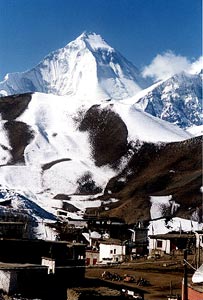 Inspired by Herzog’s journal, I set out first to climb up to the Dhaulagiri Icefall, reportedly a 9 hour sidetrip — if you find the correct route. I wasn’t worried as I carried a tent, food, and all the gear. There was no trail but I ascended as far as humanly possible up to a spectacular waterfall. I couldn’t see Dhaulagiri but had wonderful views of the Annapurna massif 30 km. across the valley.
Up there were only the huge condor-like Lammergeyers, and me, though I’m sure I heard voices and whistling coming from the waterfall at night. (Perhaps I’m becoming an Anamist?)
That balance is disturbed in those areas frequented by “rich, lavish, and foolish” Westerners who think it’s fun to walk up and down mountains. (No Sherpa would walk one step further than he must.) And nowhere in the Himalayas is more disturbed than Annapurana, by far the most popular hiking destination. The best hiking in the world, in my opinion.Inspired by Herzog’s journal, I set out first to climb up to the Dhaulagiri Icefall, reportedly a 9 hour sidetrip — if you find the correct route. I wasn’t worried as I carried a tent, food, and all the gear. There was no trail but I ascended as far as humanly possible up to a spectacular waterfall. I couldn’t see Dhaulagiri but had wonderful views of the Annapurna massif 30 km. across the valley.When I poked my head out of the tent in the morning, a big old Yak was peering back at me. The herd had climbed all the way up just to drink at the waterfall. They love to get high, these beasts.
Dhaulagiri. Would it go?
Bung Ho!
I stashed my pack in the rocks and went to search the impassable cliffs and ravines. I finally found a dry waterfall which formed a perfect ladder/staircase. It ended in an overhang. I resolved reluctantly to turn back. (Perhaps I’d learned some common sense after getting lost in the Andes overnight last trip.)
Descending I spied another possible traverse which couldn’t be seen from below. Precipitous grass slopes, thorny shrubs, several more dry watercourses, a long ridge, several false summits. Finally, eyeball to eyeball with a glacial icefall spilling out massively from beside the Dhaulagiri summit. Beautiful and terrible. This was the glacier which killed 7 U.S. climbers in ’69 (avalanche). In ’73 another U.S. team summited having had supplies air-dropped. (including 2 bottles of wine and a live chicken. Of course the sherpas would not allow the chicken to be killed on the mountain. It was carried down snowblind and frost-bitten.)
Herzog’s team climbed up here, returning to report that the glacier was too dangerous. I concurred with their recommendation, “Let’s have a go at the other fellow.”
However, it took Herzog a month just to find Annapurna 1. That massif has perhaps 50 peaks! This put their expedition very late in the season. Monsoon was coming. Climbing would then be impossible.
I too had to traverse over mountains to reach Annapurna. I was lulled into a false ease on Jomson where you can hike with your hands in your pockets. Now I was into more typical Nepali hiking; high ridge top down to river valley, across amazing permanent (and temporary!) bridges, and back up to ridge top. Exhausting. I had a number of really tough days.
But I was inspired. The Annapurna Sanctuary is one of the most incredible glacier basins in the world, completely surrounded by huge peaks; Hiunchuli, Modi, Fang, Annapurna 1, Glacier Dome, Gangapurna, Annapurna 3.
These mountains are indescribably impressive. I won’t try.
The gate is guarded by everyone’s favourite peak, Machhapuchare (Fishtail). Jimmy Roberts climbed, in 1957, to within 50 metres of the summit but turned back due to the steepness of the final ascent. On his return to Kathmandu he suggested to the Nepalese government that they keep at least this one peak unclimbed, a symbol of the inviolate. No permit has been issued to this day.
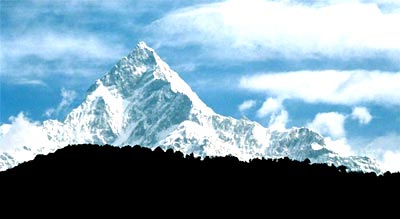 Machhapuchare (Fishtail)
Access to the Sanctuary is via an intensely scenic gorge; a narrow, winding trail through dense bamboo and huge trees. You scramble over river boulders; gnarled, polished hardwood roots; traverse the most recent avalanche tracks; climb bamboo ladders.
There are no permanent settlements here. This is the only major trekking route in Nepal subject to serious avalanche risk. Occasionally backpackers are trapped at basecamp when tons of snow collapse into the gorge from the unseen. On November 11, 1995 a freak early winter storm resulted in the death of 63 people in Nepal. This caused a bit of unease when it started raining, hailing, and snowing while I ascended to the notch of the Sanctuary gate.
The basecamp itself is bleak. An eerie calm. No wind, though clouds swirl in every direction up on the mountain tops. The scene is dominated by huge, white, vertical Annapurna — one of the most difficult faces ever climbed. On Christmas day 1997 an avalanche here killed Anatoli Boukreev, the Tiger Woods of high altitude, and subject of the best seller, The Climb.
In high season there are more backpackers than beds. Many sleep on tables or the floor. Of course I was snow snug in my tent. In the morning I pulled open the flap to watch first light on Fishtail.
A Canadian woman in our lodge said that it had a bit of a Christmas dinner atmosphere. True. It was snowing yet we were toasty around a big table draped with heavy carpets. A kerosene burner blasted underneath, keeping our feet warm. A boisterous night. Rum and hot chocolate. Canadians were in the majority at the table. (Jomson was visited by only 400 Canadians in 1997 but this year it felt like I met 400 on the trail. We are easy to identify. MEC gear and a Maple Leaf — except the Quebecois, of course.)
Herzog survived Annapurna and so did I. Actually, Herzog is the only one left alive of the team, still a National hero, though a hero without any toes or fingers.
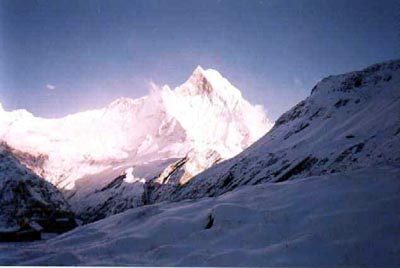
Annapurna Sanctuary as seen from my tent
I’d recommend Annapurna to anyone. A high level of fitness is not required. If you can walk 4-5 hours with a day pack, you can do the 300 km. Circuit. Actually less than a quarter of walkers carry their own pack — most hire porters. French groups mount unnecessary expeditions (like Herzog), a massive entourage carrying tents, kitchens, toilets, and food. We met one elderly Brit who had somehow signed on to one of these monstrosities. He sheepishly admitted that for 16 tourists they started with a support team of 47! (I wondered how many of the French walkers, if any, were embarrassed to see their coolies humping dining tables over the 5400 metre Thorong La.)
I’d like to do the whole circuit with a trained, certified cultural guide who could explain the village ways, point out the flora and fauna along the way through the various climatic zones. Pack horses would be better than porters. A group would all enjoy the Circuit. The faster, more adventurous could sidetrip, meeting-up at specified lodges at the end of the day.
I’d consider trying a Trekking Peak. These are hills(only peaks with permanent snow cover are called mountains here) that require a guide but no particular mountaineering expertise. I talked to many who had Peak permits, but not one who actually made it to any summit. All of the designatedhills are higher than any mountain in Canada.
But is this Trek tourism sustainable? Can tourists actually help more than they hurt?
I think so. The best of the Trek villages are wonderful — clean, happy, friendly. You might be walking in the Swiss Alps. People don’t ruin natural beauty, motor vehicles and electrical wires do. Stone fences and irrigation canals, terraced fields, villages clinging improbably to ridge tops — all very pretty.
And local artisans are flourishing. And I’ve seen that tourism can promote cultural reclaimation.
I rode back to town on the top of a bus with a second generation Tibetan woman (she had been born in a refugee camp). She was articulate, educated, self-confident and very proud of her heritage. She was well groomed and very well dressed. She shouted encouragement and waved at the dusty Tibetans bringing their horse caravans in to Pokhara to trade. “Can you believe it?”, she exclaimed. “They NEVER bathe!”
 PS
PS
Herzog’s book Annapurna is the classic of traditional mountaineering exceeded only, perhaps, by Bowman’s Ascent of Rum Doodle.
PPS
I saw the Tibetan phenomenon of a blue and gold striped sky many times in Nepal. As the sun sets behind high mountains, the entire sky is filled with a golden glow, except for bluer shadows from the highest peaks, some of which are out of sig
PStravelogue – I’ll Never Do It Again – I.N.D.I.A.
India, again.
I visited here once before. The following is the gist of a letter I sent to friends after that LAST visit. I want to see how my impressions change this time.
1995
I saw India mainly through the eyes of V.S. Naipaul, one our best living writers. Though removed from his ancestral land by 100 years and half a world, Naipaul was compelled to brutalize India in his 1964 book, An Area of Darkness. He was condemned by many for a too critical analysis. Salmon Rushdie said that visiting India ruined Naipaul as a writer.
In 1976 Naipaul revisited the same themes in India: A Wounded Civilization. Still critical, but less so.
Naipaul is clean, precise, completely unsentimental. Maughmy. His observations ring true.
Indians defecate everywhere. They defecate, mostly, beside the railway tracks. But they also defecate on the beaches; they defecate on the hills; they defecate on the river banks; they defecate on the streets; they never look for cover. … the one thing we can and must learn from the West is the science of municipal sanitation.
They do uncoil anywhere and everywhere. It is a great mingling of cow, dog, goat and human faeces. Shit dust is in the air.
I don’t mention the other usual noxious filth, open sewers, the mountains of spent trash.
Where are the sweepers? Where are the Children of God?
And disease. I just left Gujarat State where BLACK PLAGUE broke out in ’94. The government advisedantibiotics, flight, and prayer.
What personally irks me is the amount of eye disease here, of every disgusting variation. I’m told that much of this is avoidable. I saw a shapely Hindu woman walking my way — and the progressive women of Bombay are allowed to look at and even smile at tourists. I hoped to meet her gaze. As she approached I saw that one eye socket was empty.
You can imagine how I appreciate the public hawking, farting, snotting, and nose picking. Loud and proud.
I entered the National Bank in one small town; employees were spitting gobs of red betel nut on the floor.
I agree with Naipaul that Hinduism is failing India in this modern age. (I much prefer tolerant Buddhism.) Massive inefficiency, nepotism, and injustice due to the Caste System persist. Fatalism is evident; people put up with their lot in hope of reincarnation to a higher caste. Marriage is still arranged by family within caste, even among the urban educated elite.
The Indian government practices reverse discrimination, allotting jobs to specified low castes. Well-intentioned but, reportedly, problematic. Seventy upper caste students burned themselves to death in protest during a highly publicized one-week period. (One low caste entrepreneur went door-to-door in the ritzy neighbourhoods selling fire extinguishers to worried parents.)
Naipaul relates the story of a foreign businessman who educated his intelligent untouchable servant. On leaving Delhi, the businessman placed the servant in a good job. On his return he found the man back cleaning latrines. The servant had been boycotted by his clan, barred from his smoking group in the evening. Alone and unable to marry, the man was forced back to his God-allotted caste.
Widow burning? Yes. And thousands of wives die inkitchen fires every year. The husband upgrades to a new wife and another fat dowry.
Naipaul painted a depressing picture: over-population, pollution, urbanization, persecution of minorities.
The tourist is harassed by touts, hacks, and beggars. Every second encounter with an Indian is a scam. Every financial contact an attempted rip-off. Even government officials short-change.
But then I thought that I had over-estimated Naipaul. His argument is eloquent, persuasive but, perhaps, wrong.

I arrived first in mystical Benares (Varanasi), holiest and most disreputable city of India, pilgrimage site of the dying. And me in the midst of some mid-life death and aging fixation. Where better to throw myself on a pyre?
Yet I had the opposite reaction. I became Mr. Gregarious, in love with life. Some kind of zealous minor prophet. A Jewish-Canadian yoga hippie and I spent a day being nice to hawkers and beggars. (What’s your name? How are you doing? Where do you live?) He rang a bell to cleanse the air of ill-feeling.
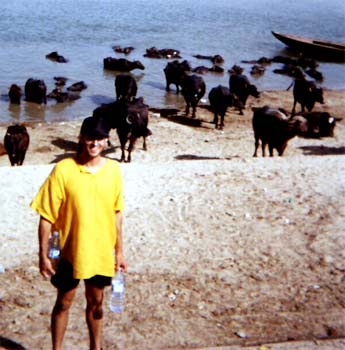
Our strange behaviour attracted the attention of a cool Indian sadhu and soon found ourselves in the Ghat Ashram of an equally cool Swiss-French Guru. We smoked a ritual bong and talked bullshit spiritualism for hours. These Hessian journeyers seek something higher and find, usually, diarrhoea. India does, though, seem to bring out the noble best in Western travellers. It did for me.
 These sadhus look great; ganja-eyed, painted, flowered, bangled, seeded and beaded; dreadlocks, rags, and fierce tridents for the Shivites. I have a guarded respect for the true Holy men of Hinduism, some of whom are officially declared dead by the courts before setting out. One ascetic did not leave his cave for over 50 years. Many sadhus, unfortunately, have fled debt, the law, or their families who are often left helpless.
At the Ashram a woman from Boston told us that they use the term sadhu loosely in Benares. Here it means anyone who hasn’t had sex yet today. She told us that American women with gold cards like to hang here with their Indian Gurus. I wondered if she was one of these sexual adventuresses.
I started listening to Enigma and lighting incense. I read on India.
India is impossible for a list-making sort. (Those who would have things organized in India might, as well, try to straighten a winding road.) There is no reliable information. Nothing is up-to-date. Yet in my new found Buddhist acceptance, I simply embraced the non-system. Nothing works in India and yet millions get where they are going anyway. OK.
These sadhus look great; ganja-eyed, painted, flowered, bangled, seeded and beaded; dreadlocks, rags, and fierce tridents for the Shivites. I have a guarded respect for the true Holy men of Hinduism, some of whom are officially declared dead by the courts before setting out. One ascetic did not leave his cave for over 50 years. Many sadhus, unfortunately, have fled debt, the law, or their families who are often left helpless.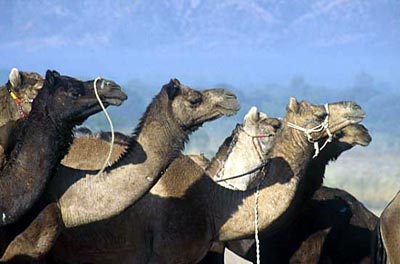
Leaving the wonderful little camel town of Pushkar, I simply stood in the middle of the highway at 11 PM waiting to see how I would reach the train station 15 km away. I was not surprised when the first car stopped. The enthusiastic dentist-gent was the Olympic Judge for Table Tennis and would be going to the Atlanta Olympics. We had much to talk about. I was soon sipping whiskey at his fine house. The driver got me to the train right on time (2 hours late) and directly to the sleeper car.
Everyone loves the trains. They move 10 million people every day and employ over 1.5 million workers. I sleep wonderfully on the train but I’m a neophyte compared with skinny Indians who can dead-sleep on concrete, any time, anywhere.
Naipaul wrote that Gandhi was a magnificent failure. That he glorified poverty. That he slowed progress. That he didn’t free India. And that Gandhi didn’t change India. I disagree.
Consider that India, without Pakistan and Bangladesh, is bigger than Europe (my statement here will be refuted later) and has more different cultures, languages, and climates. Consider that Punjabis, Sikhs, Gurkhas and the many other separatists are still part of India. Who is more to credit or blame than Gandhi?
Consider that soldiers of pop-cultural imperialismlike myself make little dent here. Coke was thrown out of India recently (though they are making a strong comeback now). The kids listen to nothing but Hindi. Bollywood rules. India has absorbed every invader so far except the British who escaped. Tourists wear Indian clothes, perform Puja, and decide on cremation instead of burial.
Naipaul wrote, India is poor and cruel. All Indians are implicated. Yet this place has millions of University graduates, a highly educated elite.
The Indian culture is strong, surviving even in wintry Saskatoon.”
After 50 years India remains the worlds largest democracy — a model for other developing countries.
1998
That was my last trip to India. I was a little brutal in my critique, don’t you think?
This time Darjeeling was my first stop. The guesthouse visitors book was full of comments like,This was our favourite place in India. Darjeeling is charming. But it is not India.

Separatists here would call it Ghorkaland. To me it looked like Nepal; Himalayan lands wedged between Nepal and Bhutan. About 75% of the population speaks Nepali.
You’ve heard of the famous tea from 78 aging, failing plantations here. Darjeeling is a British construct, a Hill Station. High altitude, low latitude — perfect for tea and tourists.
The quaint legacy of the British; impressive, imposing, decaying public buildings; pastries and tea at Glennaries; botanical gardens; billiards at the Gymkhana (Tea Planters) Club.
I loved strolling the pedestrian mall on Observatory Hill. It is almost unchanged since the days of the Raj. The clock towers and fountains haven’t worked, though, since the Brits Quit. And of course they took the sign with them; Dogs and Indians not allowed on the Mall.
The Toy Train still works occasionally, hauling tourists up the hill. Gricers know that this steam line has 5 switchbacks and 4 full loops.
I came to see the magnificent views of Kachenjunga floating above the clouds.
I came too to visit the famous breeding centre for that most mythical of cat — the Snow Leopard.

Actually, the animal prison here is quite good specializing in local and endangered beasts. They’ve had success breeding Red Panda, Tibetan Wolf, and Siberian Tiger (huge!).
Automobiles here are cute, mostly Hindustani Ambassadors, the design unchanged from the British Morris Minor of the 50s. You feel like you’re on the set of some really old James Bond movie.
I rode a battered Land Cruiser farther North into Sikkim. They have inspirational slogans painted roadside.
Better late than The Late.
My favourite was Chop your own wood and it will warm you twice.
Next instalment the REAL India, the City of Joy.
Your pundit.
Rick
PS
I’m keen to read the new nasty book about Naipaul written by Paul Theroux, the most successful and controversial travel writer. I like Theroux for his amusing, paranoid worldview. Writers are like cannibals. People are their subjects.
Of course the untrustworthy Theroux doesn’t deserve to hold a candle to Naipaul.
travelogue – Never Ending Peace And Love – N.E.P.A.L.
I remember fondly the first time I visited Nepal. I arrived by air.
This was my introduction to the commission problem — for example, Hotels pay touts a percentage for delivering a customer. At the airport, touts hold up signs advertising their favourite Hotel.
The next bit is an excerpt from a letter I wrote to friends on that first visit to Nepal:
1995
I love the anticipation you feel when arriving at a new place. It’s a little like Christmas eve when you were a kid. Over here there are the delicious uncertainties of entry visas, currency exchange, and where to stay on arrival. Mass confusion. And I haven’t even got to India yet.
Today I reached Kathmandu. I really, really wanted to. Another mad scramble.
We psyched up and then plunged into the manswarm of touts, louts, and taxi hacks. Like the stock market floor but with a greater sense of urgency.
I pointed to a little guy in the back and called out TIBET GUEST HOUSE. Surprisingly, I actually made it to a taxi with him despite the tugging and shouting of his competitors who insisted he was insane, a murderer, and that his hotel had burned down. The tout would pay the cab.
As we escaped the airport the authorities decided to shut down the highway for (speculating wildly) road repair. We U-turned to take a crumbling backroad shortcut. When we were far enough away the taxi pulled over and insisted on doubling the agreed fare. A charged argument ensued in Nepalese.
I Buddha smiled, content as a sacred cow in the middle of rush hour traffic.
Canadian author Tim Ward tells of the time he came upon a destroyed Buddhist temple converted to village latrine. The central statue had a big decaying turd in the middle of it’s lap. Ward admired the Lord Buddha’s composure in the midst of decomposure.
1998
I aspire to the inner calm of the Buddhist.
But, entering Nepal this time, it was not to be.
I spent my last night in Tibet, not surprisingly, sleeping slumped over the steering wheel of a parked truck in which I had hitched to the border. (The drivers were afraid that they might be caught by the police if I walked into the border town of Zhangmu at night.)
At first light I strolled down, elated to be leaving Tibet. Someone called my name from above. It was Matt, a mellow, musical American whom we had rescued (in our horse cart) descending from Everest. Matt had ruined his legs trying to hike out — he could no longer walk. Matt and I were soon scarfing a fabulous Nepali breakfast at a funky cliffside restaurant looking way down into Nepal. The air was full of music, curry, and portent.
En route to Kathmandu (standing in an open truck!) we lost 4500 metres and gained 2 hours and 15 minutes. (You won’t be surprised to hear that all of China runs on Beijing time.) We Tibetan refugees were a giggle of schoolgirls, our senses open, excitedly pointing out banana palms, pigeons, and butterflies. Sensory overload after the deprivations of China and Tibet.
Kathmandu is polluted, loud, and crowded. We didn’t care.
They got hot rain falling from the ceiling. They got MACHINES wash your clothes!
We marveled at flush toilets, tall buildings, women decidedly not in Tibetan robes. We overdid it in the best bookstores in Asia.
 Nepal is a feast! We gorged on calzone, apple strudel, lasagna, and bagels. I could live on bread alone — dark European brot which gets sweeter as you chew. Restaurants offer patio gardens, rooftop lookouts, hammocks, and Blues music. The birds are table tame.
For my birthday I treated myself to a barber shave and head massage; one of the best travel bargains on all 7 continents.
Nepal is an amalgam of 3 religions; Hinduism, Buddhism, and Tourism. There are about 120 National holidays. Some sort of festival happens every day.
 I just missed Kalatri (Killing Night) when Hindus make sacrifice in Durga (The Destroyer) temples. All manner of beasts are cut, the blood dappled on cars, buses, rickshaws. Even Royal Nepal Airlines sacrifices goats in the name of aviation safety. The blood ensures that Durga will not use these vehicles as instruments of destruction over the coming year. (Durga seems to be the most severe of the many powerful, easily-miffed Gods.)
This is a country of temples and half-built hotels. (Tax break for making improvements to your business. Therefore, leave rebar sticking up from the roof.) I stayed at The Earth Hotel in Kathmandu. In Pokhara the Holy Lodge and Nirvana were full, but I found Heaven’s Gate strangely vacant.
My second night in Kathmandu I was invited to attend the wrap-up session of the biggest convention in town; The International Conference on Spiritual and Moral Values for a 21st Century. I had some doubts. The conference was sponsored by a group of Nepali upper-caste Brahmin. I’m not sure how they justified their cause with the intrinsic injustice of their too elevated social status.
I was seated with the uncastes in a foreigners section by well-meaning, white-robed volunteers. Only a tinge of cult. Like every conference, this one was mostly protocol and very little content. When the ethnic dancing started, I looked for the door — but then stayed when I saw a pretty woman (with whom I had chatted in a shop) dressed in white leading a dignitary on stage.
The highlight was an Ozzy delegate who told a lengthy tale of a young man, like himself, who dreamed of changing the world. By middle age he had resolved to just improve his neighbours, his family, and friends. Who, in old age, found that it was challenge enough to simply improve himself a little bit.
I could relate to that.
They spoke a great deal about healing. I could use some of that too.
Where better than Nepal? It’s like a spiritual new age Kingdom. Yoga, Astrology, Tibetan and holistic medicine, Reiki, Acupressure, Shamonry. Westerners take courses in Consciousness Transference, Insight to Compassion, and even Meditation while Trekking. My Dharma Bum friends from Tibet signed-up for a course in Dharma, hanging out at the Great Buddhist Stupa of Boudanath.
I had been there before. I rarely revisit — there are too many new destinations. But Boudanath is just too wonderful a place.
The chaos of the Monkey Temple at night was great fun again; dogs chasing monkeys chasing tourists.
And I went back to Bhaktapur, a village preserved as a living museum. The timeless rituals of pottery, dyeing wool, threshing grain by hand on wicker trays, women gathering around the communal water tap, and hundreds of children playing among ancient temples.
Many Westerners go all philosophical here. We voice our deepest thoughts on the evils of creeping cultural homogeneity … in our favourite Western restaurants (Helena’s) and our favourite German Bakeries (Brezel’s).
Many seek solace and spiritual transformation. The most rapt devotees at Boudanath, faces lit by butter candle lamp, aren’t the monks but Western women.
Never Ending Peace And Love is, I suppose, all well and good. But I’m not in the right frame of mind for meditative posturing. I will seek sanctuary in the Nepali Himalayas.

travelogue – The North Face – Tibet
 Huge pinnacles of ice, soaring as high as 15 metres above the glacier; icebergs which will never calf; described in our guidebook as resembling dozens of Sydney Opera Houses. To me the most elegant are white-blue sailboats. I had to be restrained from climbing in and on top of the frozen waves.
Damian said, “We are damn lucky to see this.”
True.
But how did I get here?
On the Ganden – Samye trek we got inspired to next try the Highest Trek in the World; a trip to Everest’s North Face advanced Base Camp III (6340 metres). Nowhere else on Earth can you walk to such an elevation with no need for crampons, ice axe, or any mountaineering skills.
To have enough time I would need to extend my visa. This demanded 4 trips to the Police in two cities. On my last attempt I promised, if successful, to do a kora (ritual counter-clockwise circumambulation) at the Shigatse monastery, home of the Panchen Lama.
To gain merit. Soup-up my karma.
Unexpectedly I got 7 days. Time enough to try Everest!
I set out at dusk for the 1 hour fast walk. I knew from our morning kora that there were perhaps 1000 dogs asleep (only 1 was dead for sure) around the monastery walls. When I started the walk a number lay with eyes open, watching. As I moved up the mountain some were sitting. More trotted down from the hills. I accompanied women who gave out water, left-overs, bits of rice. Snarls. Growls. The curious fallen puppy we had returned to the litter in the morning was again whimpering on the path below the den. But this time the sick, crazed mother was watching. I didn’t dare touch the pup.
I hurried to safety as the city erupted; a canine chorus.
Damian, a great travelling companion, and I were travelling the Friendship Highway (Lhasa to Kathmandu via Everest). Damian is Swiss, a ski guide and mountaineer who attempted the Weisshorn in September (unsuccessful due to weather). More importantly he speaks German, French, English, and reads, writes, and is fluent in Chinese. He loves to barter in the Chinese manner, organizing huge meals for groups of 8 to 10 backpackers.
Of course we travelled illegally, refusing to join any government approved tour group. This means we had to hitch the trip, variously on tractors, horse carts, Tibetan people movers (dump trucks jammed with sacks and singing locals). We learned that open trucks are the best ride; taking in the air & scenery, standing to absorb the bumps.
I don’t like hitching. It teaches patience too well. Picture me sitting roadside watched by sharp-eyed, oily Tibetan crows. Mean opportunists, these demon birds sharpen their cruel beaks remembering the last tourist who died hitching at this spot.
Once we sat all day, finally hiring a mini-bus to take us over a high pass. The driver, fearing the police, spent several hours negotiating the charter (bribe). The Chinese compromise was that the bus could drive us up to the police checkpoint, we would then walk across (somehow less illegal), and then the bus could pick us up again on the other side.
The Friendship Highway is infamous. On one high pass we squeezed by a huge semi almost capsized in the mud. Several other trucks were stranded. A bus seemed to have slid down the mountain.
It was a struggle to reach the trailhead.
Tingri to Everest Base Camp Trek:
The most popular big hike in Tibet, this is a long, harsh slog. We managed the 70 km in 3 days, hiring a packhorse for a half day and riding up a jeep track for the last hour with a Canadian family. We slept in
- my tent
- a smoke-blackened Tibetan home (pots big enough to cook a goat)
- the Rongphu monastery guesthouse
We ate gourmet imported camp food we had purchased from a Nepali tour guide. We sampledtsampa with butter tea (inedible) and thugpa stew (which tastes as good as it sounds). Damian tried the raw, dried meat but had to spit it out.
This food is what the Tibetans eat every day, all day.
Rongphu monastery, the world’s highest, has stunning views of Everest — far superior to the Nepal side. Everyone sits out to watch the play of light at sunset, the North Face golden. In October the weather is stable, day after day of sunny skies. At times even the peak was clear; no blowing snow off the top.

North Face Everest (or Chomolunga)
It is quite warm except when it is windy. It is always windy. We heard hypothermic horror stories from those who tented at the base camp.
At the Rongphu monastery the ambiance is end-of-the-world euphoria. When an Israeli pulled a pistol out of his parka to punctuate some anecdote, no one even blinked. The Tibetan cook there thought I should pay for a meal I hadn’t ordered or eaten. When I tried to leave he shook me by the lapels, pushed me out the door, on to the ground, and fell on top of me. I was too surprised to be angry.
(One of the big disappointments for travellers is the realization that many Tibetans just are not friendly. In fact, it is hard to picture a more disreputable rogue than a Tibetan man. I tried to be tolerant, knowing that the Tibetans are not far removed from a peasant, rural existence. But three times I saw Tibetan men kick women. Each time I stopped to yell incomprehensibly at the offender. The third instance, to demonstrate how I should mind my own business, the man then slapped his wife backhand. I stood stupefied as two other men consoled and hurried her away. Tibetan children routinely stone foreign cyclists,
Damian & I set off determined to climb high. We reached advanced base camp I (5460 metres) and pitched the tent in a protective ring of stones. A surprisingly healthy monastery dog followed us all the way up the mountain. We pondered whether we (and the dog) were tenting higher than anyone else on Earth that night.
Next day we got an early start, carrying only a daypack. We calculated a 2:30 PM turn-around time. This was it. Climb high and then hustle back to the monastery. Perfect weather. It was a 10 hour walking day.
Along and atop the glacier was rock, ice, and dust. No snow. Creaking and continual rock slide. Caves, tunnels, and under-ice rivers. At one point there was a 700 metre drop-off. We drank glacial melt water to prevent dehydration.
We reached the littered advanced interim base camp II at 5760 metres and climbed higher, perhaps reaching 5900 metres. We lost the trail. Dead-ended several times. Game over.
We took photos. Scrambled around the seracs. And turned back.
This was a long, exhausting hike. I was tired of scree underfoot.
Yet this is an adventure I would recommend unreservedly. (As I do the Lost City trek out of Santa Marta, Colombia.) To do it right you need the first 3 weeks of October, flying into Lhasa and out of Kathmandu. YOU could walk to base camp III!
I am ready and eager to leave Tibet. I’m tired of the bureaucratic idiocy in this sad, subjugated colony. Tired of the misinformation and the mistreatment of valued foreign friends.
I will remember the stark landscape; the intense sunlight and black shadows; the detailed relief. You can see more clearly in Tibet. I’ll remember the skies, particularly one otherworldly evening — alternating streaks of blue and yellow, which had all travellers straining to explain the phenomenon.
I will remember the traditional Tibetan costumes; the great Tibetan teeth; the happy, healthy, filthy, scabby, snot-caked children. (I’m much more compassionate of Tibetan dirt after 9 days without a shower. My hands will not come clean no matter how much I wash them.)
I’ll remember the picturesque Tibetan towns marred by drab Chinese buildings, telecommunication tower, and loud-speakers still shouting distorted Communesque lies in 1998.
I’ll remember the pilgrim touching-up the colours on beautiful rock paintings.
And I’ll remember the monk who cleaned the monastery assembly hall sliding around in over-sized sheep-skin “skates”.
Opinion not fact.
As you’ve already surmised, I’m no careful reporter. This is Gonzo journalism; subjective, personal impressions. Take care.
After a few short weeks in Tibetan lands (on your map Tibet is only about 1/4 the size of ethnographic Tibet) I’ve grown less sympathetic of Tibetan independence.
To start with, I was suspicious of any cause that is so popular. It is trendy to Free Tibet, but boring to talk of the Kurds who are far worse off. (In the same way that AIDS is chic, but prostrate cancer should not be discussed in polite company.)
In all my backpacker pro-Tibet propaganda nowhere is it mentioned that pre-invasion Tibet was a backwards, impoverished Theocracy, an unsanitary slum.
One quote I did pick up somewhere — Past tragic, present painful, future bleak. It has never been easy to live on this plateau.
Theocracy is bad government. Religion is Monty Python’s Life of Brian. God often becomes an excuse for corruption and excess. One funeral pyre of a Dalai Lama is covered with 3700 kg. of gold, encrusted with pearls and jewels paid for by donations of poor pilgrims.
I believe in a separation of church and state.
(One of the great stories of Tibet is that of the 6th Dalai Lama. Born to be God-king, he never took his vows preferring women, late nights in chang houses, riding and archery with his friends. He was murdered at age 23.)
 On the other hand, it would be interesting to see what the current Dalai Lama (like Nelson Mandela) could have done. Even Confucius called for leadership by the wisest sage. I found the film Kundun to be very believable. I respect the Dalai Lama’s philosophy of non-violent resistance. But I fear for the cause after his death. Finding his reincarnationwill be a disaster.
To be fair, the Chinese are doing some good things here. They are masters of infrastructure; roads, bridges, telephones. The minorities enjoy a surprising number of privileges, as do our own First Nations. It could be that more Tibetans live in comparative comfort and security than ever before. The biggest problem is education. Literacy rates are very low; rural Tibetans can’t get to schools and many urban Tibetans can’t afford school fees.
Tibetan culture and religion are as safe as any in the world. Why? Touri$m! What is more compelling than Tibetan Buddhism?
After a few weeks of casual discussion, observation and beer drinking; despite intensive lobbying by two Tibetan advocates. (Lama in Xiahe and Tenzing in Lhasa); I’ve concluded that there will never be aFree Tibet. The Chinese will absorb these lands by immigration. The Clinton visit to China slammed the door. China now has legitimacy — in exchange for a few economic crumbs.
The best I hope to see is one final visit by the Dalai Lama to Tibet in his lifetime.
There will never be a Free Tibet. But the greater danger for Tibet and even China is world monoculture — Coca-colonization.
When I think of Chairman Mao, the “Great Helmsman”, I think of his stern, gigantic white statue in Chengdu … dwarfed in a sea of neon advertising for Cognac, Toyota trucks, and Swiss watches.
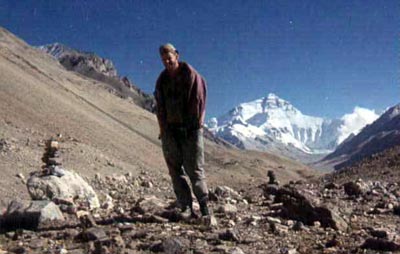
 Rick McCharles