The 3rd in an entertaining series where the author himself is in the story, a dim bulb Watson to investigator Daniel Hawthorne — who’s a gruff, modern Sherlock.
It was a goal to have Horowitz the “the most stupid person in the book“. 😀
In this one Horowitz convinces Hawthorn to join him at a book festival on tiny Alderney island, just three miles long and a mile and a half wide.
… Alderney is in turmoil over a planned power line that will cut through it, desecrating a war cemetery and turning neighbour against neighbour.
The visiting authors – including a blind medium, a French performance poet and a celebrity chef – seem to be harbouring any number of unpleasant secrets.
When the festival’s wealthy sponsor is found brutally killed, Alderney goes into lockdown and Hawthorne knows that he doesn’t have to look too far for suspects.
There’s no escape. The killer is still on the island. And there’s about to be a second death…
In fact, she doesn’t believe women are at any disadvantage in ultra-endurance sports. BUT most races are 90% men, 10% women.
Lael has a BIG YEAR planned for 2023 again racing the Tour Divide and Arizona Trail.
Her current goal is to encourage more girls and women to cycle. To that end, she documents her races even at risk of being disqualified as she was in the 2019 Tour Divide.
Foolishly, many ultra-endurance races don’t allow video crews, considering them psychological support. That’s true, of course. BUT those races should encourage ALL to have media support people.
AND he names names. These are some of the women he follows:
Ann Johansson – Mairawa – Cycled Sweden to Tajikistan and Sweden to Thailand Anna Kitlar – Bikexploring – Cycled North America, Asia to Europe, Africa Anne Westwards – Anne Westwards – 1.5 years through Asia and the Middle East Astrid Domingo Molyneux – Cycling Full Circle – 2 years through Europe, the Middle East, Asia and North America Blanca Fernandez – Blanca on a Bike – Cycled London to Asia, now travelling Africa Blandine – Kick The World – 5 years, 57000km, 37 countries Barbara Graf – Caretaker – Long bicycle journeys all over the world Carmen Mickley – Vegan Cycling – 41,250km, 31 countries, three continents, three years Cinderella Servranckx – Cycling Cindy – 50000km across 45 countries Dervla Murphy – Full Tilt – Ireland to India on a bicycle… in 1963! Check out her book on the experience. Dorothee Fleck – Women’s Cycling Guide – 12 years, 98 countries, 180,000km by bike Eleanor Moseman – Wander Cyclist – 2 years, 26,000km, China, Mongolia & Central Asia Emily Chappell – That Emily Chappell– Europe to Asia, North America and currently focussing on ultra-endurance cycling Ewa Świderska – Ewcyna – Travelling by bike around the world since 2013 Fredrika Ek – The Bike Ramble – 1000 days around the world, 51000km, 45 countries, 25 years old Gaëlle Bojko – Bike to the Blocks – One year around Europe, Lake Baikal in Siberia (lots of snow!) Genevieve Fortin – On The Bike Again – Has cycled dozens of countries since 2006 Heike Pirngruber – Push Bike Girl – Travelling by bike around the world since 2013, an amazing photographer Helen Dainty – Hels on Wheels – Cycling for six years (so far!), three continents, 43 countries on the bike Helen Lloyd – Helen’s Take On – 45 countries, 45,000km, four continents Hera van Willick – Wild Awake – Cycled extensively in Europe, Asia, North & Central America Hyojin “Jin” Jeong – Universe With Me – 80000km around the world since 2011 Ishbel Holmes – World Bike Girl – Cycled 20 countries over three years Jeannette Gagne – A Voyage of Mysterious Me – Cycled to the “North Pole”, in Oceania and currently in Africa Jenny Graham – JennyGrahamIs – Fastest woman to cycle around the world (124 days) Joanna Kaszewiak – On By Ways – Europe to Asia by bike, bus and plane Josie Dew – Josie Dew – 35 years of solo adventures, author of seven bicycle touring books Jude & Astrid – Foons On Bikes – Australia to the UK, then the UK to South Africa Juliana Buhring – Juliana Buhring – Around the world in 152 days, ultra-endurance extraordinaire Kate Leeming – Breaking The Cycle – Lots of big bike expeditions since 1993 Lael Wilcox – Lael Wilcox – Extensive touring experience with her ex-partner, more recently has won ultra-cycling events solo Leana Neimand – Leana Neimand – Around the world since 2007, 89 countries, seven continents Loretta Henderson – Solo Female Cyclist – Cycled five continents, 51 countries, author of a book for solo women cyclists Louise Sutherland – Louise Sutherland – Cycled 60,000 kilometres through 54 countries in the 1940s through to the 1970s Lydia Leibbrandt – Lydia Leibbrandt – The Netherlands to China as a 20-year-old Mareike Dorf – Mina Travels The World– Cycled Europe, the Americas, Asia, Australia and NZ Marielle Jauring – The Biking Viking– 39000km across Australia, NZ, USA and Canada Martina Gees – Colorfish – Five years, 25 countries, 60,000km in multiple continents Mirjam Wouters – Cycling Dutch Girl – Cycling all over the world, now with a toddler! Nicole Heker – Unlearning By Bike – 22 countries, 377 days, Thailand to Spain Phoebe Tan – Riding Cyclette – Northern Europe to South East Asia Sarah Outen – Sarah Outen – London to Russia’s far east, also long-distance ocean rower and kayaker Snezana Radojicic – Snezana Radojicic – Cycling around the world since 2011 Tara Weir – Margo Polo – 21 countries, 37,000km, extensive travels through Asia in particular, but also Aus, NZ & N.America Valentina Brunet – Valentina On Wheels – 25000km from Vietnam to Italy
More:
Anna Kortschak – A Thousand Turns – Alaska to Argentina (Europe too!) Anna McNuff – Anna McNuff – Bolivia to Patagonia and 50 states of the USA Anna-Luisa Becke – Radmaedchen – Canada to Guatemala, 10000km, 10 months Cynthia Valladares – En Bici al Fin del Mundo – Ecuador to Patagonia as a 24-year-old Hilde Green – Working On My Calves – 30,000km bike trip from Alaska to Argentina Juli Hirata – Juli Hirata – Alaska to Argentina Kate Rawles – Carbon Cycle Kate – Brazil to Patagonia on a bamboo bicycle she made herself Leah Manning – Cycle South Chica – Cycled from the USA to Argentina Maria Garus – Solo Woman Cyclist – Alaska to Argentina, 24000km, 33 months Stefania Cioldi – She Is Around – Cycled about South America with a very cute cat Sissi Korhonen – Strangerless – Argentina to Mexico over three years Wiebke Lühmann – Pack and Tri– Colombia to Argentina over six months as a 23-year-old
I enjoyed the first book in the P.T. Marsh series — The Good Detective — and enjoyed #2, as well.
A hard-nosed real estate baron is dead, and detectives P.T. Marsh and Remy Morgan learn there’s a long list of suspects.
Mason Falls, Georgia, may be a small town, but Ennis Fultz had filled it with professional rivals, angry neighbors, and a wronged ex-wife.
And when Marsh realizes that this potential murder might be the least of his troubles, he begins to see what happens when ordinary people become capable of evil. …
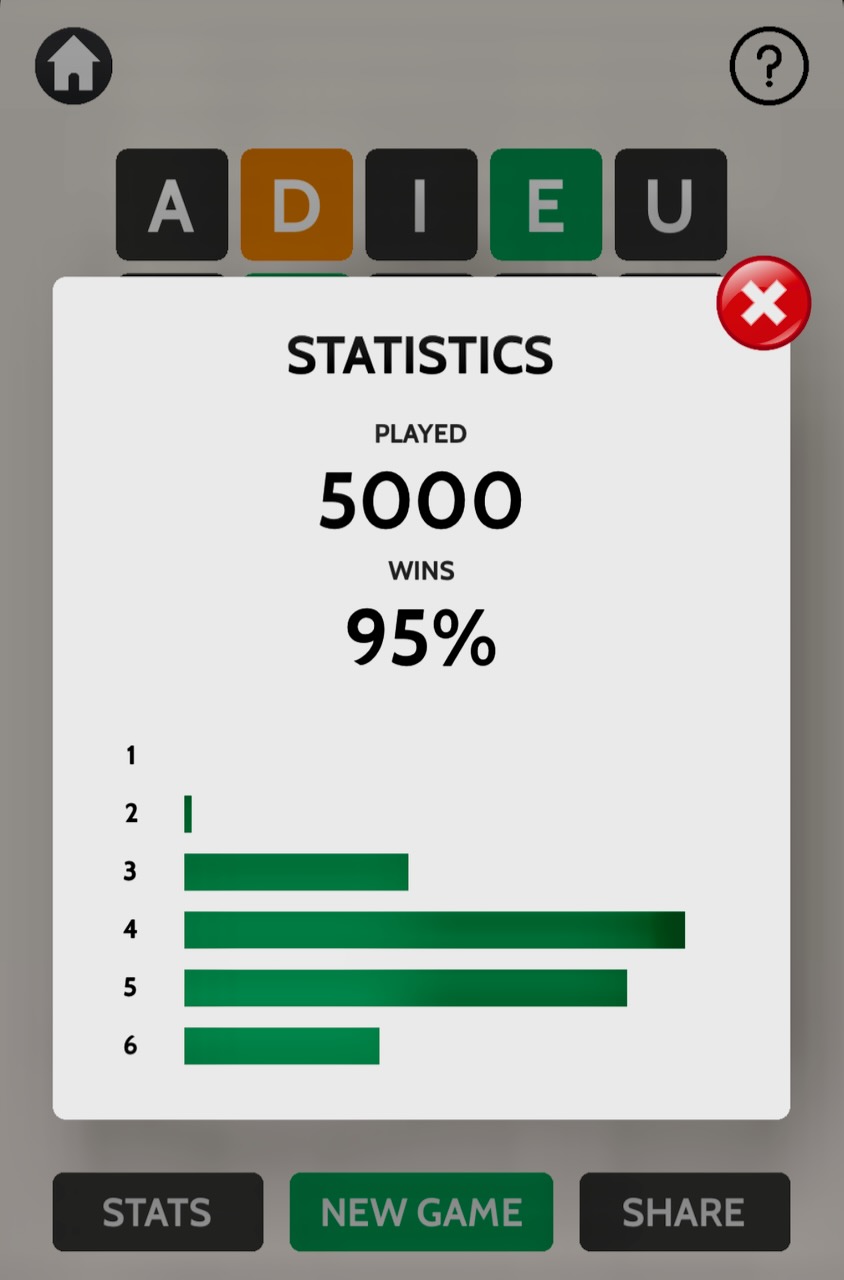
Instead of doing Wordle online once a day, I downloaded a free app called Word Guess and have now done the challenge 5000 times. I use it as relaxation time — not a mental challenge.
I use the same strategy every time:
ADIEU
PORTS
All the vowels — but not “Y”. (I consider going WINGY if it seems a Y might be needed.)
I usually get a good idea of the word at that point. And next guess a word
If not, I go FLOCK or FILCH or FLUKE or FLUNK or some variation.
I finally got around to trying one of the John Connolly novels.
Best known for his series of novels starring private detective Charlie Parker.
The Wolf in Winter (2014) is 13th in the series.
Quite good.
It reminded me a bit of a Stephen King plot.
The community of Prosperous, Maine has always thrived when others have suffered. Its inhabitants are wealthy, its children’s future secure. It shuns outsiders. It guards its own. And at the heart of Prosperous lies the ruins of an ancient church, transported stone by stone from England centuries earlier by the founders of the town . . .
But the death of a homeless man and the disappearance of his daughter draw the haunted, lethal private investigator Charlie Parker to Prosperous. …
The Fugitive (2015) The Scandal (2016) The Accomplice (2019)
I enjoyed the first 4 books much more than the final three. Greatly amused by a 13-year-old boy who considers himself a Kid Lawyer.
5th in the series is The Fugitive. And it’s pretty good, actually.
On a Washington D.C school trip Theo spots Pete Duffy who had skipped town after his trial for murder ended in mistrial.
The Scandal was a dull plot concerning teachers manipulating exam scores to raise average grades for their school. Some kind of argument against standardized testing.
Last is The Accomplice. Didn’t really work for me.
This over-the-top video by Bashir Abu Shakra won the 2022 Skypixel Drone Grand Prize. It features some stunning footage from the Alps, Brazil, and Mongolia.
The Skin Collector (2014) is 11th in the series. And very good, as always.
A new type of serial killer is stalking the streets of New York …
… The Skin Collector: a tattooist with a chamber of torture hidden deep underground. But instead of using ink to create each masterpiece, the artist uses a lethal poison which will render targets dead before they can even entertain the prospect of escape . . .
Drafted in to investigate, NYPD detective Lincoln Rhyme and his associate Amelia Sachs have little to go on but a series of cryptic messages left etched into the skin of the deceased. …



 Rick McCharles