… At a time when one technology giant after another — Dell, Microsoft, Motorola, Sony, Sun, Yahoo — has stumbled, Apple seems to be doing everything right.
It’s not just that the company is making money, or that it’s just re-entered the Fortune 100, or that it’s kept growing at 40 per cent per year even as it hit $33 billion in sales — though in the teeth of the worst recession since at least the early 1980s, those two accomplishments alone would be remarkable. It’s that Apple has become a cultural icon. …
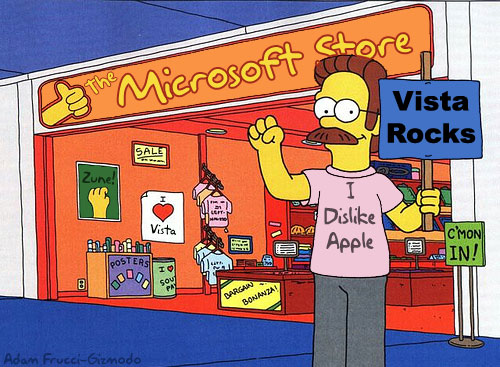
Crispin Porter + Boguksy, the agency that produced the ad, has clearly hit a nerve. The campaign goes directly at what may be Apple’ biggest vulnerability: the growing differential between Macs, which have largely held their prices throughout the recession, and PCs running Windows, which have been engaged in a brutal price war that forced the industry’s ASP (average selling price) down more than 13% in the last quarter of 2008 alone.
The deepest cut comes when the “average shopper” says:
“‘I’m just not cool enough to be a Mac person.”
Brilliant marketing, Microsoft.
No one cares that …
“Lauren” is an actress, not the ordinary American shopper the ad claims
The Apple Store scene was faked; before-and-after photos suggest that she never actually went into the store to try the computers
The $699 HP Pavillion dv7 she chose over a $999 MacBook is a mess. “It is the epitome of what people dislike about PCs,” writes Computerworld’s Seth Weintraub. “It runs Vista Home on a slow AMD mobile processor … its screen is abysmal … its networking is five years old … it is loaded with crapware and trial antivirus software that will have to be purchased or wiped off the machine.”
I bought an armband case, as I use it a lot for running and cycling.
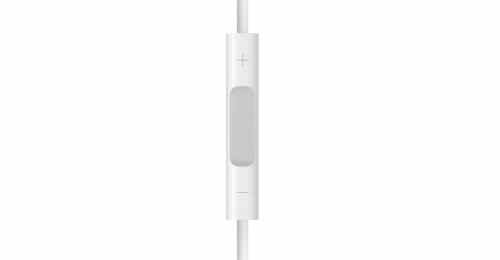
And — recently — the new Earphones with Remote & Mic. They work perfectly. I can increase and decrease volume. Pause and restart from a tiny, convenient button.
I also use the tiny, convenient microphone for voice notes using a software app called iTalkRecorder. (One of several free options from the iTunes store.)
That’s for documenting my BRILLIANT ideas while out and about.
Leave a comment if you have other recommendations for the iPhone or Touch.
I’m using the new glass and aluminum basic MacBook these days as my primary computer.
Small. Light. I like the LED screen despite how reflective it is.
The glass multi-touch trackpad definitely takes a few days to get used to.
But the biggest improvement is durability. It feels far more rugged than any other laptop I’ve used.
The old white MacBook starts at about US$1000. This new aluminum one about $1300. The cheaper one is better for most. But if you fancy yourself a “power user”, go with the new aluminum MacBook.
The engineers at Apple are watching it. (And building it into the next version of the iPhone.)
It was released a few days ago at the Wharton Business Technology Conference by Microsoft’s Business Division president Stephen Elop. It’s the latest production from Microsoft Office Labs.
Microsoft has the vision.
But — for some reason — they simply cannot bring anything cool to market.
… Microsoft needs to focus.
And it needs to realize quickly that focus doesn’t include wasting huge amounts of time and money on fights it will never win. Fights like the ones it’s bogged down in with Google for Internet search and advertising, and with Apple in portable media players.
Products like its Surface computer show that Microsoft has the potential to fulfill the promises made by the video above. And if it does that, I’ll have no problem once again using Microsoft products in my life. …
How many years have I been waiting for micropayments to become the norm on the internet? The buying and selling of product in fractions of a penny.
It looked like PayPal would be the future … at one time.
But PayPal was purchased by Ebay. And never fulfilled the potential I envisioned. Many don’t like PayPal. Ebay does not know how to build the company.
People do like buying from the Apple iTunes store. It’s insanely easy and convenient to one click a $.99 purchase of a music track.
What if Apple extended their payment system to third party companies?
If I could buy a product on the internet, relaying the transaction via the iTunes store.
Speculates Narendra Rocherolle:
… Apple is in the catbird seat to dominate micropayments. Their “batch and bill” implementation in iTunes, which boasts perhaps the smoothest online purchasing UI ever, now serves as a foundation for the App Store …
I would be spending a lot more if Apple extended the API to allow for the ability to transact within apps. It would give real viability to virtual gifts, currencies and goods across the myriad of apps out there by allowing pennies and dollars to change hands in a frictionless way. As both a developer and a consumer, that is exciting. …
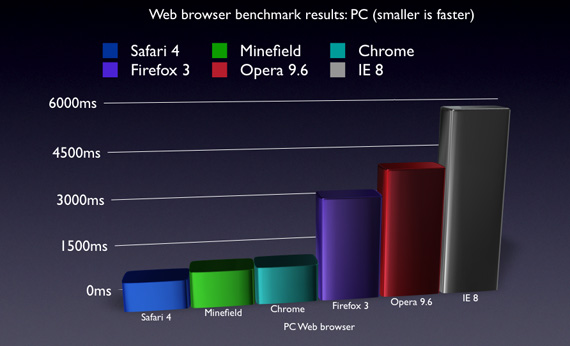
As my default browser, I’m just about to switch from Opera to the beta version of Safari 4 on Mac.
It’s fast. (smaller is faster)
The main thing this graph shows is that Internet Explorer is for idiots. It’s horribly slow.
Opera is good. But has some annoying features that cannot be modified.
In future, I will keep Firefox and Safari open at the same time, switching back and forth. Safari now offers full screen zoom like Firefox. That’s the main feature I need, aside from speed.
I love the Hunter S. Thompson line so often attributed to the Record Industry:
“The music business is a cruel and shallow money trench, a long plastic hallway where thieves and pimps run free, and good men die like dogs. There’s also a negative side.”
This week Apple announced that all 10 million songs in itunes will soon be DRM (Digital Rights Management) free. A death sentence for the old model of music distribution.
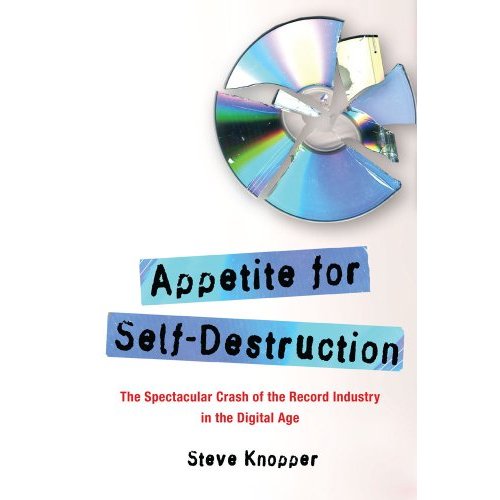
The Spectacular Crash of the Record Industry in the Digital Age
… Should anyone care that in the process, the iPod has all but killed the music industry as we’ve known it? Maybe not, Steve Knopper writes in “Appetite for Self-Destruction,” his stark accounting of the mistakes major record labels have made since the end of the LP era and the arrival of digital music. These dinosaurs, he suggests, are largely responsible for their own demise. …
This quotation has has achieved the status of urban legend. Here’s the original:
… The TV business is uglier than most things. It is normally perceived as some kind of cruel and shallow money trench through the heart of the journalism industry, a long plastic hallway where thieves and pimps run free and good men die like dogs, for no good reason. …