Bush and McCain – Fannie Mae and Freddie Mac

Stifling my effort at demonizing McCain and Bush …

Brian points out:

… the fact is, President Bush in 2003 tried desperately to stop Fannie Mae and Freddie Mac from metastasizing into the problem they have since become.

Here’s the lead of a New York Times story on Sept. 11, 2003: “The Bush administration today recommended the most significant regulatory overhaul in the housing finance industry since the savings and loan crisis a decade ago.”

Bush tried to act. Who stopped him? Congress, especially Democrats with their deep financial and patronage ties to the two government-sponsored enterprises, Fannie and Freddie.

“These two entities — Fannie Mae and Freddie Mac — are not facing any kind of financial crisis,” said Rep. Barney Frank, then ranking Democrat on the Financial Services Committee. “The more people exaggerate these problems, the more pressure there is on these companies, the less we will see in terms of affordable housing.”

It’s pretty clear who was on the right side of that debate.

As for presidential contender John McCain, just two years after Bush’s plan, McCain also called for badly needed reforms to prevent a crisis like the one we’re now in.

“If Congress does not act,” McCain said in 2005, “American taxpayers will continue to be exposed to the enormous risk that Fannie Mae and Freddie Mac pose to the housing market, the overall financial system and the economy as a whole.”

Sounds like McCain was spot on.

But his warnings, too, were ignored by Congress. …

Two links he had me check out:

  • Congress Pushed Fannie, Freddie In Wrong Direction During 1990s
  • Congress Lies Low To Avoid Bailout Blame
  • Still, the current under-regulation of GREED in the USA started in earnest with Reagan. Continued under Democrat Jimmy Carter. Slowed somewhat under Clinton. And, most to blame, are the two Bush administrations.

    … Who’s most likely to fix it now?

    McCain?

    I think not.
    the internet hates McCain

    Must be the sites I visit. I NEVER see a good comment for John McCain online.

    Here’s a typical attack on him, supposedly by a private citizen.

    Slightly more balanced is another private citizen’s video comparing the two lead candidates for President in the face of the current economic crisis.

    One more bit of propaganda for Obama: Economists Support Obama Over McCain By More Than 2 to 1

    the great American consumer crash

    James Quinn is senior director of strategic planning, the Wharton School, University of Pennsylvania. He posted a very gloomy projection on Prudent Bear:

    The 6,000 sq ft McMansion buying, BMW leasing, $5 Starbucks latte drinking, granite countertop upgrading, home equity borrowing days are coming to an end. …

    … the tremendous prosperity that began during the Reagan years of the early 1980’s has been a false prosperity built upon easy credit. …

    I have been accused by many of my friends and family as someone who sees the glass as half empty. I disagree with their assessment. I see the glass as it is. I find myself scratching my head trying to figure out why a society that always saved for a rainy day, consistently saving between 8% and 11% of their disposable income, now has a negative savings rate. …

    In the past, the USA could have grown economically out of this kind of debt. That time is over.

    … the gathering storm has arrived. It will be long, painful and destructive. Those who prepared for the storm by not taking on excessive debt and living above their means, will ride it out unscathed. Those who built their house on sand by leveraging up and living the “good” life, will see their house swept out to sea. The storm will pass and we will rebuild. Our country is resilient. …

    There has been and will be resistance to the inevitable deep recession that is coming. The American consumer is not cutting back willingly. They are being dragged kicking and screaming towards the joys of frugality. The “material generation” needs to dematerialize. My biggest concern is that our politician leaders and their cronies running our government will continue to try and reverse the normal capitalistic course of recession and expansion. Companies need to fail, housing needs to find its bottom based on supply, demand and price. Those who gambled must be allowed to lose and suffer the consequences. …

    It’s worth reading the entire impassioned post: The Great Consumer Crash of 2009

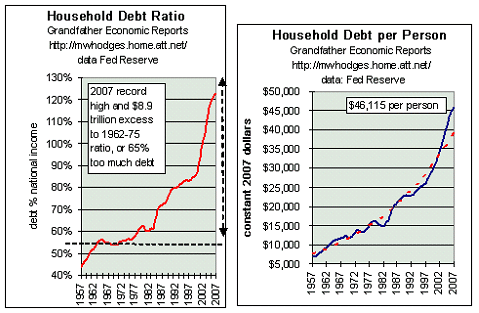
    The USA must leave Iraq as soon as possible, whether they want to or not. The war has already cost each household about $20,000. From the graph above, it’s obvious families cannot afford this war.

    Why anyone would want to vote for McCain — who wants to stay in Iraq for as long as it takes — is beyond me.

    Obama may also be unable to soften the economic blow, but at least there is a chance with him.

    war on Iraq costs $3 trillion

    Let’s say you believe the War on Iraq was justified. And that U.S. security has been improved by the occupation.

    How much are you willing to pay to secure your safety?

    Stiglitz, former chief economist of the World Bank and winner of the Nobel Prize in Economics, has stated the total costs of the Iraq War on the US economy will be three trillion dollars in a moderate scenario, and possibly more in the most recent published study, published in March 2008. Stiglitz has stated: “The figure we arrive at is more than $3 trillion. Our calculations are based on conservative assumptions. They are conceptually simple, even if occasionally technically complicated. A $3 trillion figure for the total cost strikes us as judicious, and probably errs on the low side. Needless to say, this number represents the cost only to the United States. It does not reflect the enormous cost to the rest of the world, or to Iraq.” …

    Wikipedia

    Via an excellent 60 Minutes TV investigative report.

    related – The cold price of hot blood – Salon

    I’m not a goofy enough peacenik to believe that the USA should have done nothing after 9-11. Sadam Hussein was a modest threat. I’m not 100% against the invasion, even.

    But it should have been a one-time military strike. Disabling the Iraqui airforce. Removing Sadam from power.

    Perhaps 3-4wks tops. A fixed budget.

    … However, the real reason for the Iraq invasion was for the USA oil industry to gain more control over the second largest proven reserves in the World. That hasn’t really worked out for them.

    who to believe about oil prices

    A superb audiocast called Supply and Command by On The Media is essential listening for anyone angered.

    It explains why and how the media has been duped by Big Oil.

    portfolio-oil.jpg

    Also recommended is this article by Howell Raines. (He’s on the Big Oil hit list, for sure.)

    When it comes to the cost of gasoline, who should we believe? Here are some nominees and their viewpoints:

    1. The oil companies: It’s supply and demand at its most basic, just like your professor outlined in your freshman economics course.
    2. The petro-toadies in Congress: All we have to do is open up the Arctic National Wildlife Refuge and the waters off Florida and California.
    3. The Department of Energy: OPEC has to pump more, and we’ve got to allow more refineries by rolling back environmental restrictions.
    4. King Abdullah: OPEC pumps plenty of crude but “despicable” oil-futures speculators in the West are driving up the prices due to their “selfishness.”
    5. Senator John McCain: Exxon Mobil has done such a good job of demonstrating the magic of the marketplace that it deserves another $1.2 billion in tax breaks.
    6. Senator Barack Obama: Impose a windfall-profits tax to remind American oil executives that price gouging can backfire politically.
    7. About 90 percent of the print and TV reporters in America: See No. 1. It really is that ol’ devil supply and demand.
    8. The White House: Never mind. Nobody’s home.

    For my money, a sounder answer as to whom to believe is Don Barlett and Jim Steele, the investigative reporting team that has won two Pulitzers and two National Magazine Awards for exposing government theft and corporate greed. Their 2003 series for Time magazine on oil economics remains required reading for anyone who wants a better understanding of how gas at $4 to $5 a gallon represents a carefully arranged screwing of consumers. “The bottom line for the oil people is, How much can I make while spending the least I can get by with on refineries, synthetic fuels, and for exploration and drilling on the vast, unused acreage in existing oil leases?” Barlett says. He notes that Canada has become the United States’ No. 1 oil supplier by funding joint government-industry exploration of the tar-sand fields of Alberta. “The most chilling statistic is Exxon Mobil’s. It spent twice as much last year to buy back stock as it did on exploration.”

    As journalism has passed from a hungry to an elite profession, there’s no shock value in the fact that Exxon Mobil paid only $5 billion in U.S. income taxes last year while it paid $25 billion to foreign governments. …

    Portfolio magazine – Crude Reporting

    Click through. You are getting screwed.

    gaspriceseb1.jpg

    are newspapers dead?

    I thought so.

    Here’s the conventional wisdom for the United States:

    … The heyday of the newspaper industry was the 1940s, but the percentage of Americans reading newspapers began to decline with the increased competition from radio and television. A growing population helped the absolute circulation numbers continue to increase until the 1970s, where it remained stable until the 1990s, when absolute circulation numbers began declining.

    Wikipedia

    Readership aging. Readership in decline. Advertisers fleeing for Craig’s List. Electronic alternatives (e.g. Kindle) improving. …

    Newspapers are not a horse on which one should bet the mortgage.

    But Ron Shewchuk (long time print apologist) keeps prodding the dying horse, linking to articles like this:

    There is plenty of evidence to support print media’s survival:

    Most of the 10 largest newspapers are gaining, not losing, circulation. Nationwide, daily newspaper circulation is 50,827,454, down .1% from a year ago, according to the Newspaper Association of America. …

    While readership is declining among 18-24-year-olds, it is declining slowly. The age group may place less value overall in print newspapers, but some will continue to read them. (There are even young people who prefer listening to vinyl instead of CDs.)

    Local and national newspapers are also trusted more than web resources …

    The readership decline is gradual and there are plenty of people who will continue reading newspapers, at least long enough for newspapers to make the adjustments necessary to find their new niche in the mostly-digital media landscape.

    The future of newspapers (and the $100 I’m going to take from Jose Leal)

    toilet-newspaper.jpg

    larger version
    – flickr – Mr. Flibble

    So, turns out Newspapers are going to survive. Whew!

    But not many journalists.

    rich and poor in Phnom Penh

    My hotel in the Cambodian capital is EXCELLENT. (Even the U.N. election watchdogs here right now deem it worthy.)

    A frequent sponsor of the Cambodian Olympic Committee, they are probably only charging a cut rate $140 $86 / night. Or something like that.

    Across the street is the OKAY Guesthouse. The sweaty backpacker crowd are paying $1 / night for dorm bed with mosquito net and fan. $4 / night for a private room. $6 / night for private room with bath and T.V.

    A can of Diet Coke is $4 at my hotel.

    When I told my host that 10yrs-ago I stayed at the infamous Cloud 9 Guesthouse, he was mortified. “There’s no security there!”

    No security. But much more FUN.

    A truism so overwhelming as to be boring is the contrast between rich and poor in developing countries.

    This guy and his family own a garbage cart.

    poor-cambodia.jpg

    The conspicuous rich (and how many could have actually earned these fortunes) MUST drive Toyota Land Cruisers or Lexus SUVs. It’s the #1 status symbol. And just to be sure you cannot miss seeing their status symbol, the companies now put the name in really big letters.

    lexus.jpg

    How embarrassing.

    … HEY. Where’s my personal driver and Mercedes van? He’s LATE!

    Nudge – the book – libertarian paternalism

    Listened to an Economist magazine interview with one of the authors of a fascinating new book called Nudge.

    Improving Decisions About Health, Wealth, and Happiness

    Nudge: Improving Decisions About Health, Wealth, and Happiness

    … how to steer people toward better health, sounder investments, and cleaner environments without depriving them of their inalienable right to make a mess of things if they want to.

    Thaler is a hard core economist who believes government should intervene in our lives. But only by giving us better information to make decisions.

    … policymakers should “focus on making the world easier”, he argues in a new book, “Nudge: Improving Decisions About Health, Wealth and Happiness”, written with Cass Sunstein, a law professor (and an adviser to Barack Obama). By this he means defining more carefully and simply the financial choices that people have to make, and building “sensible default options” into the design of financial products …

    Getting it right on the money – The Economist

    why would a bank loan me $500,000?

    During the insane housing boom, a frequent talking point I had with friends was: Something has to go wrong.”

    Ever increasing house prices could not continue forever. It was obvious to everyone.

    I was certainly surprised to learn — after the subprime mortgage crisis crash — that U.S. banks were giving half million dollar loans to N.I.N.A. folks like me. No income, No Assets.

    Where were the regulators?

    money.jpg

    I’d never understood the process by which everyone in the chain held their nose and signed off on all those bad loans until I heard an audiocast on National Public Radio.

    A special program about the housing crisis produced in a special collaboration with NPR news. We explain it all to you. What does the housing crisis have to do with the turmoil on Wall street? Why did banks make half-million dollar loans to people without jobs or income?

    … to tell the story – the surprisingly entertaining story – of how the US got itself into a housing crisis. They talk to people who were actually working in the housing, banking, finance and mortgage industries, about what they thought during the boom times, and why the bust happened.

    This American Life – The Giant Pool of Money

    Stephen Colbert – Total Gas Holiday

    Stephen Colbert sends up the idiotic gas holiday idea floated by a desperate Hillary Clinton.

    In the USA you can watch it below:

    COMEDY CENTRAL SUCKS in most of the rest of the world. But at least you can watch it on Spike: Stephen Colbert’s Total Gas Holiday