Nilanjana Sudeshna “Jhumpa” Lahiri (born 1967) is a Bengali American author known for her short stories, novels, and essays in English and, more recently, in Italian.
Lahiri was born in London, the daughter of Indian immigrants from the Indian state of West Bengal. Her family moved to the United States when she was three …
The stories are about the lives of Indians and Indian Americans who are caught between their roots and the “New World”.
London Rules is the 2022 book in the Slough House series — where the failed MI5 spies (Slow Horses) are sent when there is no way to fire them.
There are some mentions of Covid.
In London’s MI5 headquarters a scandal is brewing that could disgrace the entire intelligence community. The Downing Street superforecaster—a specialist who advises the Prime Minister’s office on how policy is likely to be received by the electorate—has disappeared without a trace. Claude Whelan, who was once head of MI5, has been tasked with tracking her down.
But the trail leads him straight back to Regent’s Park itself, with First Desk Diana Taverner as chief suspect. Has Taverner overplayed her hand at last? Meanwhile, her Russian counterpart, Moscow intelligence’s First Desk, has cheekily showed up in London and shaken off his escort. Are the two unfortunate events connected? …
There are bad actors everywhere, and they usually get their comeuppance before the credits roll. But politics is a dirty business, and in a world where lying, cheating and backstabbing are the norm …
It follows U.S. Secret Service agent Ethan Burke as he unravels the mystery surrounding his unanticipated arrival in the small town of Wayward Pines, Idaho, following a devastating car accident. …
The residents of this picturesque town don’t know how they got there and are forbidden to talk about their prior lives. An electric fence surrounds the town, and the residents are under 24-hour surveillance. The mysteries and horrors of the town build until Ethan discovers its secret. Then he must do his part to keep Wayward Pines protected from threats both within and beyond the fence.
The series covers themes of isolation, bucolic Americana, time-displacement, man vs nature, human evolution, and cryonics. …
In Slough House, the London outpost for disgraced MI5 spies, memories are stirring, all of them bad. Catherine Standish is buying booze again, Louisa Guy is raking over the ashes of lost love, and new recruit Lech Wicinski, whose sins make him an outcast even among the slow horses, is determined to discover who destroyed his career, even if he tears his life apart in the process.
Meanwhile, in Regent’s Park, Diana Taverner’s tenure as First Desk is running into difficulties. If she’s going to make the Service fit for purpose, she might have to make deals with a familiar old devil . . .
And with winter taking its grip, Jackson Lamb would sooner be left brooding in peace, but even he can’t ignore the dried blood on his carpets. So when the man responsible for killing a slow horse breaks cover at last, Lamb sends the slow horses out to even the score.
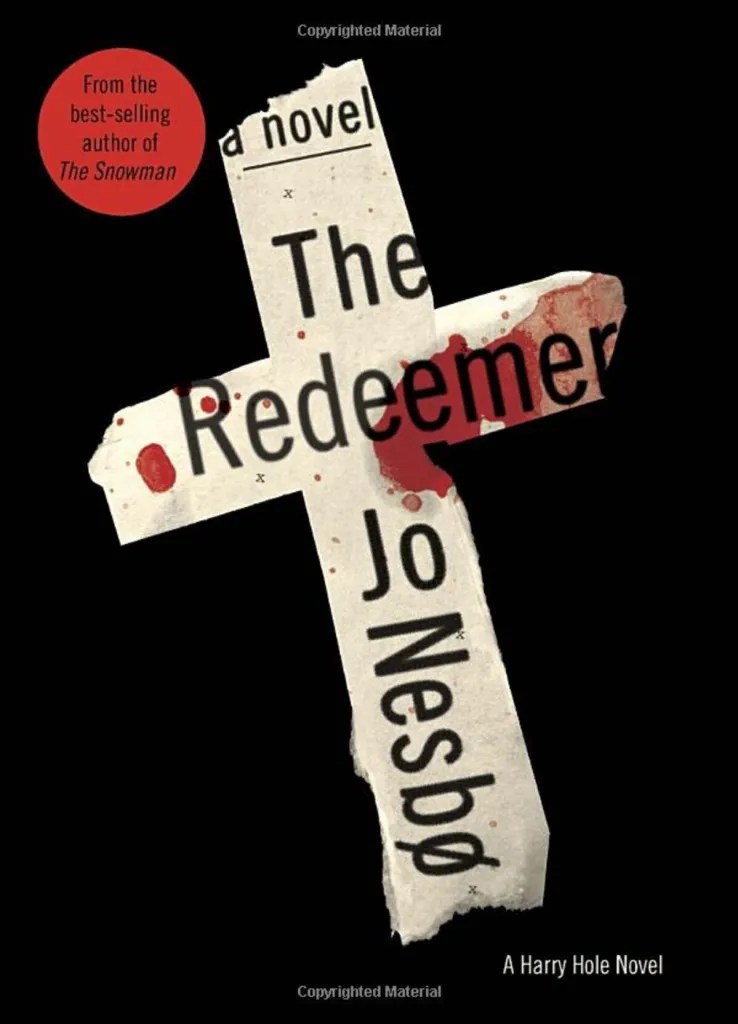
Jo Nesbø is a super popular Norwegian writer. But I don’t much like Inspector Harry Hole, the lead character of his dark crime novels. An angry drunk much of the time.
At the start of The Redeemer (book #6), Harry is on the wagon. And even attends AA meetings.
Harry is both Oslo Crime Squad’s most brilliant detective, and its most frustrating. He struggles with authority
… the assassin – calling himself Stankić – arrives in Oslo and kills a Salvation Army officer, Robert Karlsen, during a Christmas street concert. Stankić has a facial anomaly known as hyperelasticity, wherein his facial muscles can be manipulated voluntarily to stop people from recognizing him. …
When a murder attempt is made on Robert’s brother Jon, it is believed that the Karlsen family is being attacked. …
From there it’s a long, complicated plot. Well written.
Still … I’m not a huge fan of this series. I’m only reading it because I’m back in Norway.
London Rules is 6th in the Slough House series — where the washed-up MI5 spies go to while away what’s left of their failed careers.
The “slow horses,” as they’re called, have all disgraced themselves in some way to get relegated here. If they can’t be fired for any reason, they are reassigned to work under Jackson Lamb.
Herron is a very funny writer. Most of the best lines are from Lamb who’s a bigoted, philistine, obese, spectacularly flatulent, alcoholic chain-smoker.
But smart. And loyal to his misfits.
Oscar-winning actor Gary Oldman plays Lamb in the TV series.
In this book — the weakest in the series, so far — the head of MI5 is trying to protect the prime minister.
Politicians are corrupt and much mocked.
Over at Slough House, somebody wants to kill their tech geek, Roddy Ho. Nobody can imagine why.
The new book is also set specifically after the EU referendum.
Its antagonist, Dennis Gimball, is the UK’s leading Eurosceptic MP, with a wife who writes a tabloid column.
As in earlier books, which featured a floppy-fringed bicycling Westminster populist, Herron adeptly negotiates the rules of satire and the laws of libel to create fictional public figures who simultaneously hit more than one real-life bullseye.
During a series of terrorist attacks on Britain, Slough House detects a threat to Gimball, making the reader wonder whether the espionage rejects are capable of saving the politician and, frankly, whether we want them to. …
Spook Street (2017) is the 5th book in the Slough House series — and the best so far.
Herron is an entertaining writer. Most of the best lines are from boss Jackson Lamb who’s a bigoted, philistine, obese, spectacularly flatulent, alcoholic chain-smoker.
Oscar-winning actor Gary Oldman plays Lamb in the TV series.
What happens when an old spook loses his mind? Does the Service have a retirement home for those who know too many secrets but don’t remember they’re secret? Or does someone take care of the senile spy for good?
These are the paranoid concerns of David Cartwright, a Cold War–era operative and one-time head of MI5 who is sliding into dementia, and questions his grandson, River, must figure out answers to now that the spy who raised him has started to forget to wear pants. But River, himself an agent at Slough House, MI5’s outpost for disgraced spies, has other things to worry about. A bomb has detonated in the middle of a busy shopping center and killed forty innocent civilians. The “slow horses” of Slough House must figure out who is behind this act of terror before the situation escalates.
Though Kingsolver lives in southern Appalachia, I can’t fathom how effectively she puts herself into the mind of the boy — Demon Copperhead. It’s a coming of age story.
Ground zero of the opium epidemic. Demon is born to a drug-using teenage single mother in a trailer in Lee County, Virginia.
Since his mother is in and out of rehab, Demon is partly raised by the sprawling, warm-hearted Peggot clan.
Almost everyone in this dirt poor place is drastically hurt by the Sackler family’s killer drug OxyContin.
“I don’t know a single person my age that’s not taking pills,” Demon says at one point.
The Sacklers paid a $6 billion settlement to avoidcivil lawsuits. It’s fair to call them killers.
I listened to the audio book. Recommended, as the reader has the right accent and tone of voice.