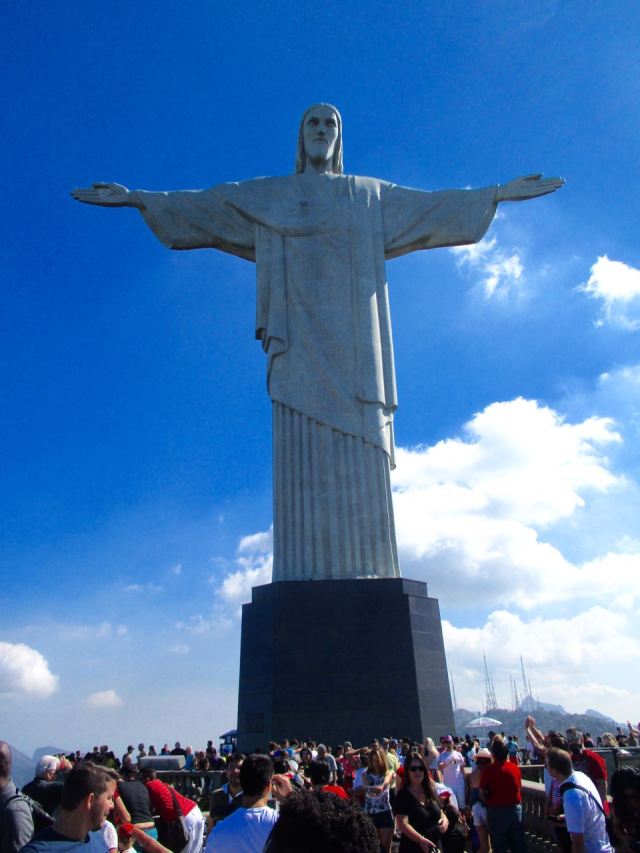
Like everybody, I’ve always wanted to visit this most famous statue.
Live everyone, I found it to be no let down. 🙂
Most take the quaint cog railway up and down. (But there is a rough scramble trail which starts close to the Botanical Gardens.)
Things go better with …
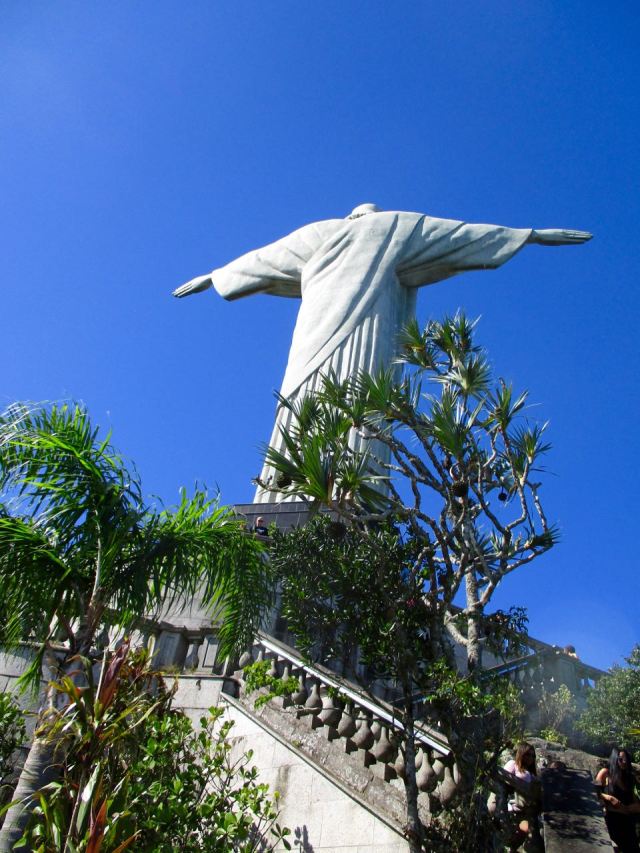
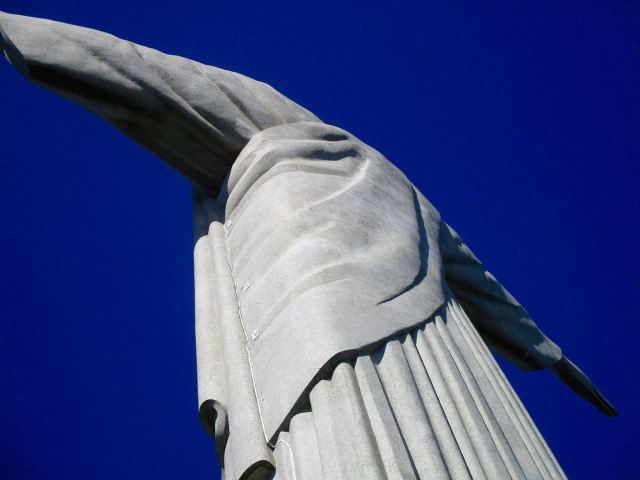
You arrive at the top to his back facing. Interesting.
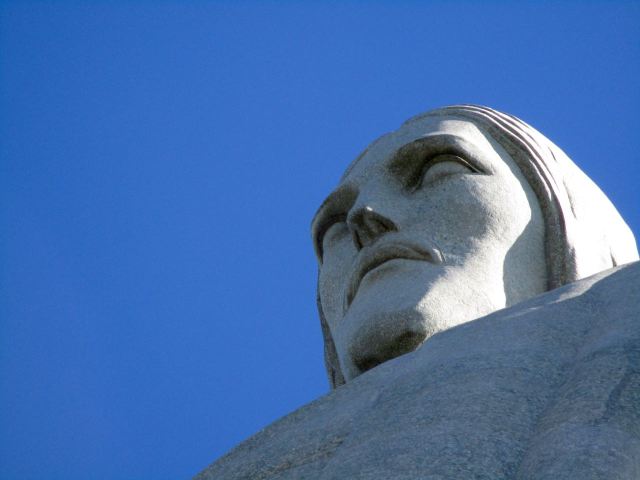
I like the face. It’s as tranquil as many Buddha statues.
The views are terrific. Obviously.
There’s Maracanã Stadium. It will host Opening & Closing Olympic ceremonies.
This guy’s certainly going to be cheering Brazil to win the men’s futebol gold medal.
Everybody here is happy, happy.
But the Russian girl – Lena – I arrived with nearly got us kicked out. She climbed the Redeemer for a photo. 🙂
… A symbol of Christianity across the world, the statue has also become a cultural icon of both Rio de Janeiro and Brazil, and is listed as one of the New Seven Wonders of the World. It is made of reinforced concrete and soapstone, and was constructed between 1922 and 1931. …
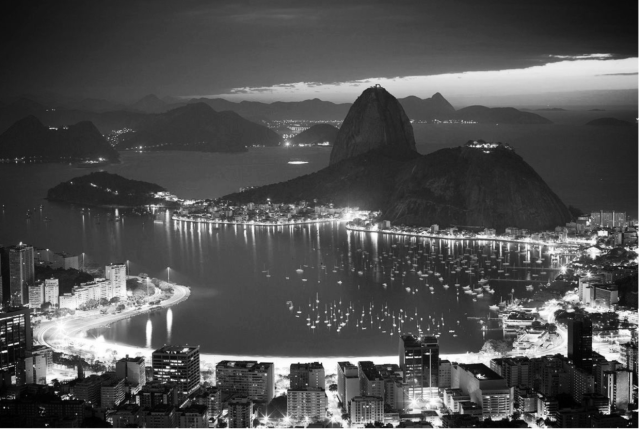
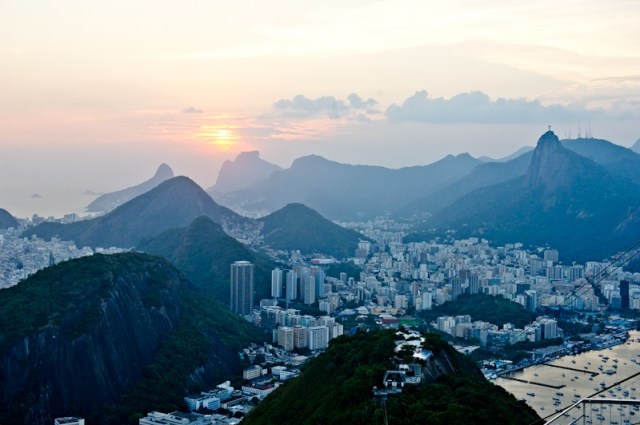
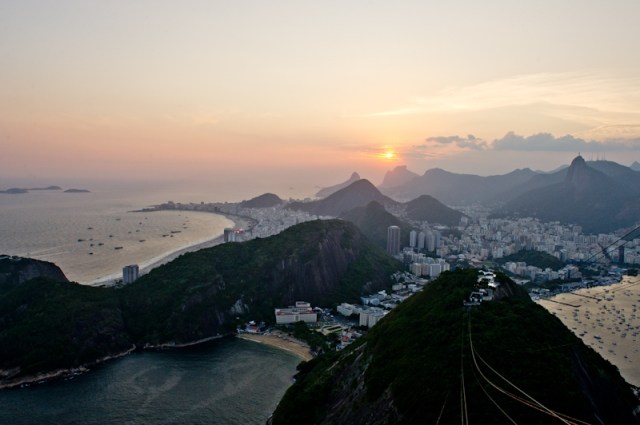
The weather still overcast, I thought I’d do this mandatory Rio tourist attraction at dusk, my favourite time of the day. Then stay to see the lights.
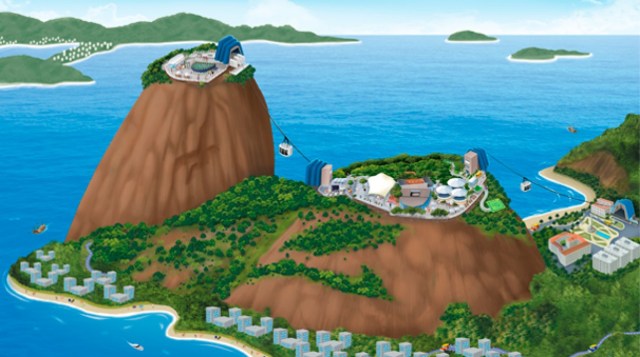
There are two cable cars with at stop in-between.
You can actually hike to the top of the first hill, but would need a guide and mountain climbing equipment for the second. Cost is the same whether or not you hike – $22 in 2016.
The cableway was envisioned by the engineer Augusto Ferreira Ramos in 1908 who sought support from well-known figures of Rio’s high society to promote its construction. Opened in 1912, it was only the third cableway to be built in the world. …
… In 1951, an accident occurred in which one of the two cables snapped, leaving 22 people dangling on one cable. One mechanic aboard, Augusto Goncales, climbed out and slithered down to Urca station and helped to build an emergency car to go back up and rescue the other passengers, 12 women and girls, 6 men and 3 children, in an event which took about 10 hours …
I renewed my travel insurance for another year. This still looks the best deal for me. I haven’t made a claim … so I don’t know for sure.
__ original post April 2015:
What’s the best travel insurance for a 57yr-old who spends a good deal of time in the States. And who hikes remote nations?
Year round policies.
Budget backpackers, including myself, have long used World Nomads.
But the last time I went to book with them, there was some sort of weird exclusion for Albertans. 😦
Right now they want CAD$408.45 for 6 months. FAR too expensive.
The best site for Canadians researching the topic is Travel Insurance Review. Click through for a list of options with commentary.
There’s no coverage for anyone over 60 with many policies, including World Nomads. I’ve got a couple of years left.
World Escapade insurance is available to travelers who are 74 years old or younger. Travel CUTS Bon Voyage insurance is only sold to those age-50 or younger.
With my TD Bank account I can get less coverage for 1 year for $128.00. Rather than trying their lousy online system, call 1-866-566-1464.
TD uses Meloche Monnex to handle their insurance. The very inexpensive cost is offset by a deductible on any claim. $100 to $1000 deductible. I’ve never made a claim in the past. Don’t expect to make one in future. But this covers me (partly) for worst case scenarios.
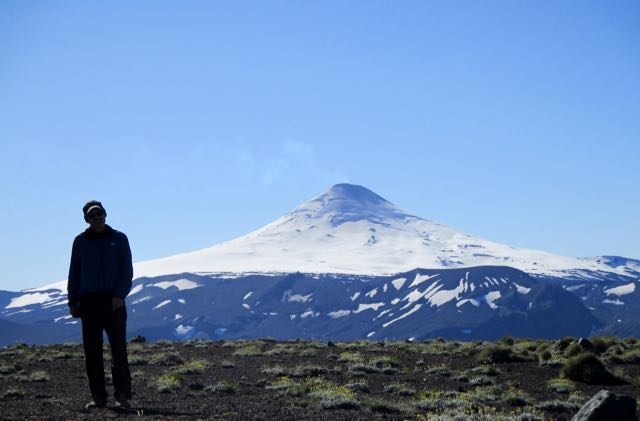
Chile is 2600 miles long and never more than 110 miles wide. From the main north/south highway it’s easy access to fantastic wilderness.
how could Rick not LOVE Chile?
Chile should be a tourist destination as good as New Zealand.
But it’s not. 😦
I’ve spent about 2 months total in Chile traveling most of the 2600 miles. Costs are similar to Canada … but quality of goods and services are poor by comparison.
If you find something of quality – Casa Azul hostel, for example – chances are it’s run by a foreigner. Probably German.
People on the trail are good. But I’m not much impressed with the interactions I have with Chileans in the towns and cities.
A currency exchange guy tried to give me only half my money one time. (I’ve seen scummy practice like this in Italy recently, too.)
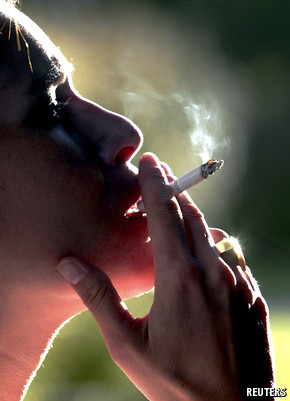
The World Health Organisation (2013) says over 40% of Chileans smoke, compared with 27% of Argentines and 17% of people in Brazil, where curbs on smoking began in the late 1990s. Chile’s health minister, Jaime Mañalich, says that treating tobacco victims takes a quarter of the $10 billion public health-care budget.
Chile’s smokers are getting younger. According to the Tobacco Atlas, a study of the industry, nearly 40% of girls aged 13-15 in Santiago, Chile’s capital, smoke cigarettes. That is up from just 20% in 2003, and is the highest rate in the world. …
The population looks unhealthy. Walking the streets reminds me of walking in Mexico. A very high percentage of people are conspicuously overweight. This is new to these nations.
Founded in 1541, Santiago has been the capital city of Chile since colonial times. The city has a downtown core of 19th century neoclassical architecture and winding side-streets, dotted by art deco, neo-gothic, and other styles. …








 Rick McCharles