why we share online …

Jeff Jarvis, author of Public Parts:

We are sharing for good reason—not because we are insane, exhibitionistic, or drunk. We are sharing because, at last, we can, and we find benefit in it. Sharing is a social and generous act: it connects us, it establishes and improves relationships, it builds trust, it disarms strangers and stigmas, it fosters the wisdom of the crowd, it enables collaboration, and it empowers us to find, form and act as publics of our own making.

For individuals, sharing is a choice; that is the essence of privacy.

Facebook’s founder, Mark Zuckerberg, told me that before the net, we had “privacy through obscurity”. We had little chance to be public because we had little access to the tools of publicness: the press, the stage, the broadcast tower (their proprietors were last century’s 1%). Today, we have the opportunity to create, share and connect, and 845m people choose to do so on Facebook alone. Mr Zuckerberg says he is not changing their nature; he is enabling it. …

read more on Buzz Machine

Jeff Jarvis is defending sharing in an Economist magazine debate with Andrew Keen.

I voted for Jeff.

Online sharing is one of the best things that’s happened in my lifetime. But I’m surprised bloggers have not changed the world MORE.

If you are against empowering idiots to spew hate and misinformation online, your best argument is a blog called “LITERALLY UNBELIEVABLE“:

… examples from Facebook of people who think stories from The Onion are real.

You’d successfully argue that many people shouldn’t be allowed to share online. 🙂

(via Kottke)
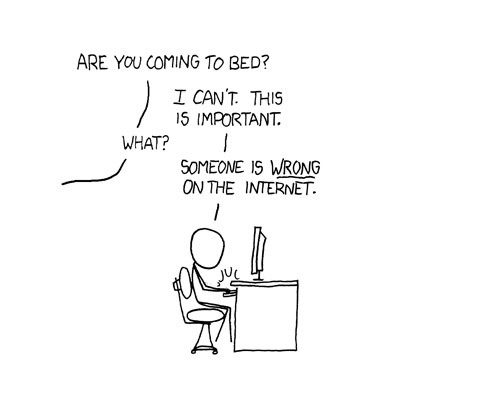
blogging and online comments

I listened to an excellent audiocast:

Hosts: Leo Laporte and Tom Merritt

Best known as a prominent blogger, and Vice President and Chief Evangelist of Expert Labs, Anil Dash is this week’s guest.

Triangulation

Three of the smartest internet gurus, together.

Of greatest interest to me was Anil’s opine on why true blogging (better) was eclipsed by microblogs like Twitter & Facebook (inferior). The true blogging platforms (e.g. WordPress & Blogger) are still too much work. Tumblr is better.

Next … the pros and cons of online comments.

Gurus MG Siegler and Anil, amongst others, recently turned comments off on their sites.

Matt Gemmell did too. Then posted the most detailed commentary I’ve seen on online comments – Comments Still Off

Personally, I have few enough hateful and ignorant comments on my blogs not to feel compelled to turn them off. The value — especially comments correcting my many errors — outweigh the negative Karma.

Issues regarding comments come up about once a week or so on my Gymnastics blog. I try not to delete or edit, but am forced to occasionally.

My advice, as always — DON’T READ COMMENTS.

12 work-relevant truisms of online life

The Wall Street Journal’s Gary Hamel:

… I compiled a list of 12 work-relevant characteristics of online life. These are the post-bureaucratic realities that tomorrow’s employees will use as yardsticks in determining whether your company is “with it” or “past it.” In assembling this short list, I haven’t tried to catalog every salient feature of the Web’s social milieu, only those that are most at odds with the legacy practices found in large companies. …


1. All ideas compete on an equal footing.
2. Contribution counts for more than credentials.
3. Hierarchies are natural, not prescribed.
4. Leaders serve rather than preside.
5. Tasks are chosen, not assigned.
6. Groups are self-defining and -organizing.
7. Resources get attracted, not allocated.
8. Power comes from sharing information, not hoarding it.
9. Opinions compound and decisions are peer-reviewed.
10. Users can veto most policy decisions.
11. Intrinsic rewards matter most.
12. Hackers are heroes.

The Facebook Generation vs. the Fortune 500

in praise of internet sharing

Despite fear mongering and pragmatic cautioning, people are sharing online like there’s no tomorrow.

I’m a big fan of journalism professor / internet pundit Jeff Jarvis, author of What Would Google Do?

His newest publication is Public Parts, the book. It touts the societal benefits of sharing:

… A visionary and optimistic thinker examines the tension between privacy and publicness that is transforming how we form communities, create identities, do business, and live our lives.

Thanks to the internet, we now live—more and more—in public. More than 750 million people (and half of all Americans) use Facebook, where we share a billion times a day. The collective voice of Twitter echoes instantly 100 million times daily, from Tahrir Square to the Mall of America, on subjects that range from democratic reform to unfolding natural disasters to celebrity gossip. New tools let us share our photos, videos, purchases, knowledge, friendships, locations, and lives. …

Click PLAY or watch an introduction on YouTube.

via my Gymnastics Coaching site

Typinator vs TextExpander vs Snippets

I downloaded trial versions of these 3 software packages (but not Presto), useful for a blogger.

… And eventually decided on Typinator. (20Euro … though I found a discount code for 30% off)

TextExpander is supposed to be a little better, but I had several problems with it on my particular MacBook Air.

Head to Head: Text Expander Mac Software Compared

in praise of bloggers

My second and third favourite sources of information in 2011 are audio:

• Audiocasts
• Audio books

I pretty much always have an audio book or two in progress, buying most of those from Audible.com. … Sadly not every book I want is available in audio.

Audio podcasts are still quite crude. The most evolved, however, are superb: RadioLab, This American Life, CBC Spark, Economist Editor’s Highlights, and On The Media. Almost all audio podcasts are still free.

But my main sources of information … my most trusted … my most detailed and nuanced … are blogs.

The best are labours of love by passionate, often amateur writers. Most bloggers are unpaid, spending thousands of hours focused on a specific topic simply because they love that topic.

more photos of bloggers

For example, the best Apple blog is Daring Fireball. I don’t pay much attention to any other.

I do whatever I’m told by Michael Geist when it comes to Canadian government regulation of the internet. A big election issue right now.

There are 4-5 essential blogs on gymnastics, but if I only was allowed to read one blogger it would be Blythe Lawrence.

If you read Kraig Becker, you’ll know more about outdoor adventure than you’ll ever need to know for one lifetime.

… Those are just a few examples. Leave a comment if you’ve got a blog that I should follow.

(blogger photos via Spark)

Say No to Stuff, Yes to Trips

My favourite blog these days is philosophical adventurer, Alastair Humphreys.

Can money buy you happiness? asked Stephanie Rosenbloom in The New York Times. That depends. Several different studies point to the conclusion:

“Spending money for an experience–concert tickets, French lessons, sushi-rolling classes, a hotel room in Monaco–produce longer-lasting satisfaction than spending money on plain old stuff.” …

details – Say No to Stuff, Yes to Trips

If you are a Shaw Cable subscriber, you can pay your monthly bill knowing that titular Jim Shaw is getting a $16,000-a-day pension.

He can say Yes to Stuff, Yes to Trips.

blogging is dead … again

The NY Times must have 6 of these posts scheduled each year – Blogs Wane as the Young Drift to Sites Like Twitter

Matt, founder of WordPress, the most popular blogging platform:

… Underneath the data in the article there’s an interesting super-trend that the Times misses: people of all ages are becoming more and more comfortable publishing online. …

… at some point you’ll have more to say than fits in 140 characters, is too important to put in Facebook …

BLOGGING DRIFT

I use Twitter. Rarely. It’s so limited.

Facebook non-stop all day. Love it. … Though ‘Facebook Pages’ are crap.

Blogs are where I put serious ideas. With a permanent address. Something I might want to refer back to one day.

Different tools for different purposes. Over time people that post things online will find the right tools for what they want to say.

The intriguing one to me, actually, is Tumblr.

Like Facebook. But more powerful. More personal.

Here’s a Tumblr to which I’ve just subscribed – Camping Links

what if you had only 5min to live?

I’ve been following Alastair Humphreys‘ adventure blog closely for many months.

Check out one of his posts:

What Would You Say If You Had Only 5 Minutes Left To Live?

Life is precious. It is short. It is wonderful. It is fun. It is filled with limitless possibility.

Do good things for other people. You don’t have to do this all the time, for we are not saints. But do it more often than you have previously done. And you may be surprised how good it makes you feel.

Stop caring about stuff. With just one minute left before I die I cannot believe I wasted hours and days earning extra money to buy a bigger car, a bigger telly, and jeans with a fancy brand badge sewn on to them.

In all the spare time saved by not needing to buy expensive stuff I would encourage myself to spend more time outdoors, climbing up hills, sledging down them, jumping into rivers, walking the streets of my home town talking to people. Read more books, listen to more music, watch less lazy TV.

Laugh more, whinge less.

Run more, eat less.

Take time now and then to stop and watch the sunrise or set, watch the power of a summer thunderstorm, look up at the full moon, or kick your feet through a pile of crunchy autumn leaves. The world is a wild and beautiful place. And it is easy to forget that when we spend so much time indoors.

Don’t settle for “good enough”. Make your life as interesting, varied, exciting and challenging as possible. You will regret it if you do not.

Strive to live each minute as though you had but five more minutes to live.

read more

with Rob Glaser exploring a glacier