Nudge – the book – libertarian paternalism

Listened to an Economist magazine interview with one of the authors of a fascinating new book called Nudge.

Improving Decisions About Health, Wealth, and Happiness

Nudge: Improving Decisions About Health, Wealth, and Happiness

… how to steer people toward better health, sounder investments, and cleaner environments without depriving them of their inalienable right to make a mess of things if they want to.

Thaler is a hard core economist who believes government should intervene in our lives. But only by giving us better information to make decisions.

… policymakers should “focus on making the world easier”, he argues in a new book, “Nudge: Improving Decisions About Health, Wealth and Happiness”, written with Cass Sunstein, a law professor (and an adviser to Barack Obama). By this he means defining more carefully and simply the financial choices that people have to make, and building “sensible default options” into the design of financial products …

Getting it right on the money – The Economist

the greatest recluse author – Trevanian

I recently learned that one of my favourite authors died in 2005.

One obituary:

TREVANIAN, author of The Eiger Sanction, Shibumi and The Summer of Katya, is no longer with us. He died on Dec. 14 in London. Even when he was alive, no one knew who he was, because Trevanian was merely a pseudonym. Rodney Whitaker was his real name, and he published both fiction and nonfiction under multiple pen names. He may be the only person who can claim to have sold millions of books worldwide without making one single promotional appearance or doing one single booksigning or live interview. …

Metroactive

It was often rumored that he was actually Robert Ludlum using a pen name to which Trevanian stated, “I don’t even know who he is.

Mr. Whitaker lived much of his life in a little Basque village on the French side of the Pyrenees and used it as a setting in his writing.

Trevanian tried to disappear in 1979, actually doing a farewell interview with the NY Times that year. But that pseudonym did not die until The Summer of Katya (1983).

Then nothing for 15-years.

When I saw — unexpectedly — Incident at Twenty-Mile (1998) appear on the shelves, I assumed it was a successor, perhaps a son. The book was excellent — but much different than his earlier work.

Then <a href=”Hot Night in the City (2001)

And Death Dance (2002)

Finally, the last book before his death:

crazyladies.jpg

The Crazyladies of Pearl Street: A Memoir (2006)

It’s an excellent read, somewhat based on the author’s own life. A life still shrouded in mystery.

Trevanian’s final novel is the warm, entertaining coming-of-age story of an imaginative boy in working class New York.

He has additional unpublished works in the works, I understand.

Middlesex wins most important prize in literature

Middlesex is a novel by Jeffrey Eugenides. It was published in 2002 and was selected the summer 2007 must read for Oprah’s Book Club.

A Novel

Middlesex: A Novel

Just finished listening to it on MP3. Excellent.

The narrator and protagonist, Calliope Stephanides (later called “Cal”), an intersexed person of Greek descent …

Born a girl, he lives his live as a man.

The books jumps between the story of his coming-of-age and his immigrant family history.

New to me in this book was the horrific description of the Great Fire of Smyrna (1920). I’ve often wondered why Greeks and Turks are such mortal enemies. It’s because of atrocities like this: up to 360,000 Anatolian Greeks killed in the Pontic Greek Genocide during and after WW I.

It’s from this horror that Cal’s grandparents (brother and sister) escape to Detroit, Michigan.

Middlesex is entertaining and fascinating from start to finish. Extremely well written, yet very down-to-Earth and accessible. It would make a terrific movie.

The author Jeffrey Eugenides teaches at Princeton.

eugenides_jeffrey200211072.gif

Mighty Hermaphrodite – NY Review of Books

eat whatever you want without gaining weight

Futurist Ray Kurzweil has some good news …

images.jpegDo you have trouble sticking to a diet? Have patience. Within 10 years, Dr. Kurzweil explained, there will be a drug that lets you eat whatever you want without gaining weight.

Worried about greenhouse gas emissions? Have faith. Solar power may look terribly uneconomical at the moment, but with the exponential progress being made in nanoengineering, Dr. Kurzweil calculates that it’ll be cost-competitive with fossil fuels in just five years, and that within 20 years all our energy will come from clean sources.

Are you depressed by the prospect of dying? Well, if you can hang on another 15 years, your life expectancy will keep rising every year faster than you’re aging. …

NY Times

He’s the author of The Singularity Is Near: When Humans Transcend Biology.

Fleshmarket Alley – Ian Rankin

200px-ianrankin.jpgOver the years at least a half dozen people have recommended the Scottish author Ian Rankin.

I’ve just finished listening to one of his books on MP3. Excellent.

Rankin is a “grape-picker, swineherd, taxman, alcohol researcher, hi-fi journalist, college secretary and punk musician” turned writer.

Fleshmarket Close is a 2004 novel … named after a real close off Edinburgh’s Royal Mile. It is the fifteenth of the Inspector Rebus novels. It was released in the USA under the title Fleshmarket Alley. It was the second episode in the second Rebus television series starring Ken Stott, airing in 2006.

I’d like to see that BBC production. Rebus is a compelling, complex character.

An Inspector Rebus Novel

Fleshmarket Alley: An Inspector Rebus Novel

If you like crime fiction, Ian Rankin is highly recommended.

listen to statistician Bjorn Lomborg

Global warming is an important issue and one which we should address. But there is no sense of proportion either in environmental terms, or indeed in terms of the other issues facing the world.

If you just take the environmental problem first, it’s very clear that what causes by far the majority of deaths is lack clean drinking water and lack of sanitation. Millions of people are dying each year from this. …

mariama-drinking-clean-tangarwashane-water-smaller-735851.jpg
Courier-Journal

The second biggest problem is indoor air pollution, which probably kills somewhere between 1 and 3 million people each year, basically because people are too poor to use good fuels and end up using dung or cardboard or whatever they can find. Only a very distant third comes climate change, which the WHO puts at 150,000 to die right now. …

indoor-air-pollution.jpg

One of the top climate change economists has modelled – and several papers that came out a couple of weeks ago essentially point out – that climate change will probably mean fewer deaths, not more deaths. It is estimated that climate change by about 2050 will mean about 800,000 fewer deaths.

… the bottom line is there are many problems in the world where we can do much more at much lower cost. …

TCS Daily – A Conversation with Bjorn Lomborg

Lomborg’s the author of The Skeptical Environmentalist: Measuring the Real State of the World.

the decline of Lonely Planet

Through my websites, people have bought hundreds, perhaps thousands of Lonely Planet guidebooks. They reinvented the genre, in my opinion. Never buy any other company without first comparing against LP.

Sadly, for the past 6-7 years I’ve started to notice problems.

LP author Thomas Kohnstamm has a new book coming out this week:

A Swashbuckling Tale of High Adventures, Questionable Ethics, and Professional Hedonism

Do Travel Writers Go to Hell?: A Swashbuckling Tale of High Adventures, Questionable Ethics, and Professional Hedonism

THE Lonely Planet guidebook empire is reeling from claims by one of its authors that he plagiarised and made up large sections of his books and dealt drugs to make up for poor pay.

Thomas Kohnstamm also claims in a book that he accepted free travel, in contravention of the Melbourne-based company’s policy.

His revelations have rocked the travel publisher, which sells more than six million guides a year – guides that generations of tourists have come to rely on.

Mr Kohnstamm, whose book is titled Do Travel Writers Go To Hell? said yesterday that he had worked on more than a dozen books for Lonely Planet, including their titles on Brazil, Colombia, the Caribbean, South America, Venezuela and Chile.

In one case, he said he had not even visited the country he wrote about.

“They didn’t pay me enough to go Colombia,” he said.

“I wrote the book in San Francisco. I got the information from a chick I was dating – an intern in the Colombian consulate. …

News.com.au

These days I am more likely to buy from other companies: Moon and Footprint, for two.

BBC recently purchased controlling interest in Lonely Planet. BBC has their own problems, however. I’m not sure LP can recover.

growing up in the 1950s

I enjoyed the last audio book by Bill Bryson so much — A Short History of Nearly Everything — that I followed up by listening to his latest book:

A Memoir

The Life and Times of the Thunderbolt Kid: A Memoir

It’s back to the much loved Bryson comedy. But this time, the funny stories are nostalgic commentary on growing up in American in the 1950s.

He recounts meeting the infamous Stephen Katz, for the first time.

I loved the book. Bryson is a few years older than myself. But some of the experiences paralleled my own upbringing in Calgary, Canada.

A Shorter History of Nearly Everything

Brian recommended this book, one I had years ago dropped like a hot potato after learning it was not a funny travel story.

One of my favourite writers, Bill Bryson, had switched to science.

A Short History of Nearly Everything

A Short History of Nearly Everything

At the library, I got the 6hr abridgment on CD read by the author. Excellent. In fact, an abridgment may even be better for this text. Bryson should have called it A Shorter History of Nearly Everything.

… explores the history of biology, botany, and zoology, and traces life from its first appearance all the way to today’s modern humans, placing much emphasis on the development of the modern Homo sapiens. All along the book, humorous stories about the scientists behind the discovery and their half-crazy behaviour is given. Throughout the book, there are many reports on the way humans change the Earth’s climate and destroy other species, as well how the Earth was and is a very destructive planet itself, briefly touching about earthquakes, volcanoes, tsunamis, hurricanes, and mass extinctions. His tendency to look for big explosions and awe-inspiring devastation takes him to the most destructive disasters in the history of the world, from Krakatoa to Yellowstone National Park. ….

Wikipedia

Brian learned how LITTLE we actually know about “everything”.

I was most struck by how much confusion was caused when scientists started analyzing DNA in human fossils. One group of people living in Australia, for example, were “impossible” by all known science.

I highly recommend it.

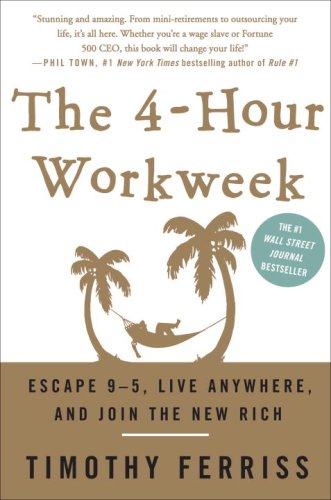
Tim Ferriss – The 4-Hour Workweek

You’re the right track, Tim. Keep going.

Escape 9-5, Live Anywhere, and Join the New Rich

Timothy Ferriss, nominated as one of Fast Company’s “Most Innovative Business People of 2007,” is author of the #1 New York Times, Wall Street Journal, and BusinessWeek bestseller, The 4-Hour Workweek.

He has been featured by dozens of media, including The New York Times, The Economist, TIME, National Geographic Traveler, CNN, CBS, and MAXIM. …

tim.jpg

Check his blog: Four Hour Work Week