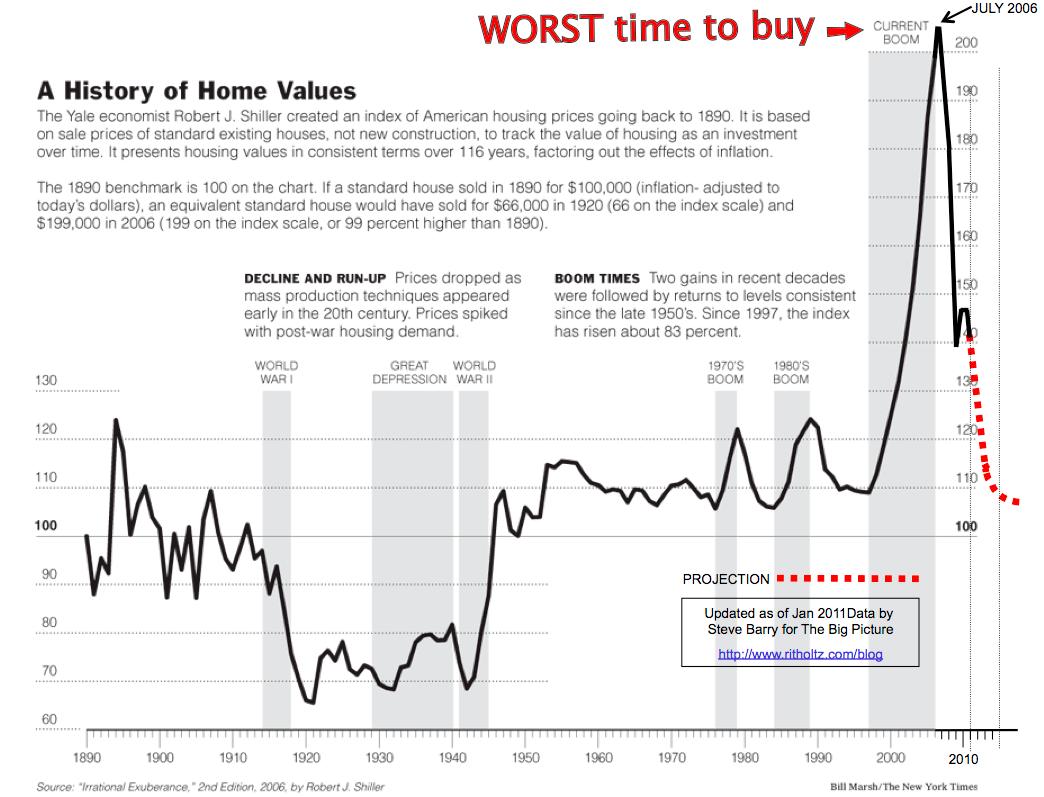
The situation in Vegas is worse than the national average.
Last week I toured the new Vegas home of a couple who defaulted on their old mortgage. They could easily afford to pay the (high) mortgage on their current house, but they got a far better home for much less due to the current market.
This was a strategic default.
People who default on mortgages they can afford to pay are savvy about credit and tend to have better credit histories than other defaulters, new research shows …
The University of Chicago Booth School of Business estimates that strategic defaults accounted for 35% of defaults in September vs. 26% in March 2009. In January, the Nevada Association of Realtors released a study showing that 23% of Nevadans who lost homes admitted to strategically defaulting. …
They don’t seem to be too worried about any drop in credit rating. So many people are making strategic defaults that it’s become normal business practice.
According to the National Bureau of Economic Research, the Great Recession ended almost two years ago, in the summer of 2009. Yet we’re all uneasy. Job growth has been disappointing. The recovery seems fragile. Where should we head from here? Is that question even meaningful? Can the government steer the economy or have past attempts helped create the mess we’re still in?
In “Fight of the Century”, Keynes and Hayek weigh in on these central questions. Do we need more government spending or less? What’s the evidence that government spending promotes prosperity in troubled times? Can war or natural disasters paradoxically be good for an economy in a slump? Should more spending come from the top down or from the bottom up? What are the ultimate sources of prosperity?
Keynes and Hayek never agreed on the answers to these questions and they still don’t. …
How am I going to replace my IBM Selectric after it dies ??
After selling only 800 models last year – down from over 10,000 as recently as 2009 – the last typewriter factory in the world (according to The Daily Mail) has closed its doors and halted production. The factory was run by Godrej and Boyce and was based in Mumbai, India. …
“There are two novels that can change a bookish fourteen-year old’s life: The Lord of the Rings and Atlas Shrugged.
One is a childish fantasy that often engenders a lifelong obsession with its unbelievable heroes, leading to an emotionally stunted, socially crippled adulthood, unable to deal with the real world.
… explores a dystopian United States where leading innovators, ranging from industrialists to artists, refuse to be exploited by society.
The protagonist, Dagny Taggart, sees society collapse around her as the government increasingly asserts control over all industry (including Taggart Transcontinental, the once mighty transcontinental railroad for which she serves as the Vice President of Operations), while society’s most productive citizens, led by the mysterious John Galt, progressively disappear. …
I’ve given Atlas Shrugged to a number of teens. It’s an important book …
Kids need to learn that all men are not created equal, rather that all men should have equal opportunity.
Kids need to learn that we should promote and encourage greatness.
Kids need to learn that authority organizations can ruin their lives ... OK, they already know that.
Now I find myself defending Ayn Rand alongside fans as odious as Glenn Beck and Rush Limbaugh. That does hurt.
The new Ayn Rand movie adaptation Atlas Shrugged Part 1 got nuked and ridiculed on the Slate Culture Gabfest audiocast.
… California is now called a “dysfunctional”, “ungovernable” and even “failed” state. When Mr Brown began his first stint as governor, California had an AAA credit rating, the best there is. Today its rating is A-, the worst among all 50 states and not much better than “junk”. The boss of JPMorgan Chase, America’s second-largest bank, last year told investors that he was more worried about California’s solvency than Greece’s. For three years and counting, California has been mired in a budget crisis. At its nadir, the state was paying its bills in IOUs instead of cash. …
I’ve never understood how California can be failing. This article helps clarify:
The people’s will
California is an experiment in extreme democracy gone wrong, says Andreas Kluth. But reform could make it a model for others …
starting in 1978, the culture and system mutated. Jerry Brown was governor when Californians passed Proposition 13, ostensibly an anti-tax measure but in reality a fundamental constitutional change with vast, and mostly unforeseen, consequences. It led to hundreds of ballot measures as citizens increasingly legislated directly and in tense competition with their own representatives.
Finally somebody in power is talking about the debt and deficit.
The proposals of Paul Ryan and Barack Obama are both ludicrous, but it’s a start.
Of the two disingenuous plans, Ryan’s is even worse. Claiming that giving a trillion dollars to the rich because they are “job creators” is as credible as President Donald Trump.
If you give a rich person money, what guarantee do you have that they will create a job?
Can’t Ryan imagine a more efficient way to create jobs with a trillion dollars than to give it to a rich man or company?
… Republicans are still shoveling as much tax money to their rich friends as they can, but there’s not much left in the government coffers.
Though personally I prefer MY VERSION of Brian Mason, global warming skeptic … he keeps clarifying his views.
Brian:
… here an example of some good science that shows a completely different view than the alarmist one. To me, this video does NOT do a great job of explaining WHY we are seeing warming but it isn’t trying to do so. Instead, it does a very good job of explaining that there is much we don’t know, much that hasn’t even been considered, and that the stated certainty that we are doomed is ludicrous.
Click PLAY or watch Dr. Vincent Courtilloton YouTube.
… YEESH. 1930 was the hottest year in the USA. The last 12 years are flat or decreasing in temperature. Temperature variations have more to do with solar activity than my jet contrails. …
Don’t give us more uncertainties, Brian. Get definitive. What DATE will the world not burn up due to Global Warming. 🙂
______
original post March 22, 2011:
Brian Mason closely follows the science of the “global warming” debate.
He tells me there’s no real evidence that global warming is happening, nor that man is causing it.
He tells me that graphs like this are fear mongering.
…
There are lies, damn lies … and statistics.
I believe Brian. But most of my other friends (and Economist magazine) feel that there is enough evidence. That our planet is warming. That we should rally to FIGHT and reverse that temperature increase.
Here’s an interesting argument independent of whether or not Global Warming is actually happening.
Let’s say you agree with this argument. … Unfortunately for YOU, I fear there’s not the money nor political will to make any serious effort to fight Global Warming. We’d better hope it doesn’t exist.
Dave Sykes points out that this is a variation of Pascal’s Wager.
____ UPDATE from Brian:
Just wanted to correct your misinterpretation of my beliefs on this.
I suspect global temperatures are likely increasing (though data quality issues probably give a significant upward bias to the trend).
I suspect also that CO2 emissions have some effect (but realize that radiative effects such as these are not the whole story). If there were no (positive) feedbacks, we would have close enough to zero problems and I have little faith in the large and positive feedbacks posited by “the climate models”.
Why? Climate is messy and the climate models haven’t been able to deal correctly with clouds (see Roy Spencer for more here) and water vapour. I don’t think there is a conspiracy but I do think the big boys leading the scientific charge for alarmism are WAY out of line (see Muller’s recent video .)
Net net: I’m not concerned about global warming, but I am concerned that our concern with CO2 is going to push us into increased nuclear and into uneconomic (read subsidized) green energy such as windmills.
My second and third favourite sources of information in 2011 are audio:
• Audiocasts
• Audio books
I pretty much always have an audio book or two in progress, buying most of those from Audible.com. … Sadly not every book I want is available in audio.
But my main sources of information … my most trusted … my most detailed and nuanced … are blogs.
The best are labours of love by passionate, often amateur writers. Most bloggers are unpaid, spending thousands of hours focused on a specific topic simply because they love that topic.
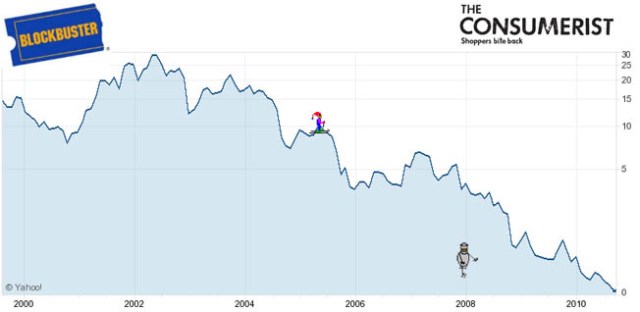
I recall years ago the CEO of Blockbuster (at the time driving local video stores out of business) mocking an upstart called … Netflix.
Just like Borders, Blockbuster could not adapt to a rapidly changing marketplace.
… Bloomberg News is reporting that the video chain will be making the filing official on Thursday morning. …
Billionaire investor Carl Icahn, who bought about one-third of Blockbuster’s bonds, will join with a group of creditors in swapping their debt for all of the video-rental company’s stock, …
If creditors get all of Blockbuster’s stock, current shareholders will be wiped out. …








 Rick McCharles