IN THE crowded field of Ebola alarmists, Rand Paul of Kentucky stands out. …
Governor Bobby Jindal of Louisiana says planes must be grounded “to protect our people”. …
Some leaders are more responsible. The Republican governor of Texas, Rick Perry, has tried to keep people calm. Few countries are better equipped than America to keep the public safe, he has assured Texans. He is right. It should not need saying. …
In the late ’90s, Smith & Wesson was facing a major lawsuit filed by cities and states that blamed the company for rampant gun violence. The company stood to lose millions.
So in 2000, under pressure from the Clinton administration, Smith & Wesson’s chief executive, Ed Schultz, made a fateful decision — and raised the ire of the powerful National Rifle Association and its supporters. …
On 11 May 2001, Saf-T-Hammer Corporation acquired Smith & Wesson Corp. from Tomkins plc for US$15 million, a fraction of the US$112 million originally paid by Tomkins. Saf-T-Hammer assumed US$30 million in debt, bringing the total purchase price to US$45 million …
In December 2014, Smith & Wesson Holding announced it was paying $130.5 million for Battenfeld Technologies, a Columbia, Missouri-based designer and distributor of hunting and shooting accessories. The company made the acquisition with the eventual intent to merge all its existing Smith & Wesson, M&P and Thompson Center Arms accessories into a single division
We know, in the world that surrounds us, there are terrorists and home invaders and drug cartels and car-jackers and knock-out gamers and rapers, haters, campus killers, airport killers, shopping-mall killers, road-rage killers, and killers who scheme to destroy our country with massive storms of violence against our power grids, or vicious waves of chemicals or disease that could collapse the society that sustains us all. …
He lies. He exaggerates.
He lies exaggerates I assume, to help increase sales of firearms. He exaggerates for money.
I can’t imagine any other reason to overstate the way he does.
LaPierre’s central message: Owning a gun is the solution. The world is a scary place. There are bad guys everywhere threatening you and your family, and the only thing they’re afraid of is a gun in your hands.
Tragically, a record number of Americans subscribe to some version of this mythology, with 63 percent (67 percent of men polled and 58 percent of women) believing that guns truly do make them safer. The public’s confidence in firearms, however, is woefully misguided: The evidence overwhelmingly shows that guns leave everybody less safe, including their owners. …
The NRA is wrong: Owning a gun is far more likely to harm you than protect you.
I agree with LaPierre on a couple of things. He supports:
• Increasing funds for a stricter and more efficient mental health system, and reform of civil commitment laws to facilitate institutionalization of the mentally ill when necessary.
• Creating a computerized universal mental health registry of those adjudicated to be incompetent to help limit gun sales to the mentally ill.
It’s deflection, I’m assuming. Taking those positions makes no sense relative to his other positions.
He’s totally against the government regulating firearms, even though they are dangerous. (More Americans American children and youth are now killed by weapons than motor vehicle accidents.) … But totally for the government regulating mental health. Because the mentally ill are dangerous. 🙂
Citizens United was a terrible ruling. Most people asked to think about the issue for 10 seconds conclude that it’s a bad idea.
An ABC–Washington Post poll conducted February 4–8, 2010, showed that 80% of those surveyed opposed (and 65% strongly opposed) the Citizens United ruling, which the poll described as saying “corporations and unions can spend as much money as they want to help political candidates win elections“.
If he had it all to do over again, he wouldn’t have carried a loaded firearm in his vehicle. 😦
Jordan Russell Davis, a 17-year-old African American high school student, was fatally shot by Michael David Dunn, a 45-year-old software developer from Brevard County who was visiting the city for a wedding.
The incident began when Dunn asked Davis and his companions to turn down the loud music that was being played in the vehicle in which Davis was a passenger …
After Dunn shot up the teen’s car, he ordered pizza. Did not call the police. 😦
The film is getting good reviews. I definitely want to see it.
David and Charles Koch are pissed. They orchestrated the spending of a lot of money to influence the American government. Yet Romney lost.
Americans for Prosperity, the most prominent arm of the Koch brothers’ organization, put Republican lawmakers on notice …
Tim Phillips, president of AFP, said at a Washington press conference that congressional Republicans “failed miserably” a decade ago, especially on cutting the federal budget. “They’ve been given a second chance by the American people,” he said, “and we’re going to hold them accountable. …
1. taxes including repeal of the estate or death tax
2. energy headlined by a call to build the Keystone XL pipeline
3. health care, which includes repealing the Affordable Care Act
I’m slightly in favour of Keystone. But I’m against unelected rich guys having so much influence on legislation. In backrooms I have no doubt they discuss which politicians can be bought. And which are a bad investment.
That’s what the term “accountable” means. 😦
The Koch brothers invested $400 million because they expected to get far more than $400 million back. You cannot trust them.
___
The Koch’s “labyrinthine network of political groups — none of which reveal the names of their donors — showed that the coalition raised more than $400 million during the 2012 election.”
Oklahoma police released a video Friday from the body camera of a cop who fatally shot a suspect earlier this month.
Muskogee Officer Chansey McMillin, responding to a domestic abuse complaint, approached 21-year-old Terrance Walker outside the Old Agency Baptist Church on Jan. 17, according to local media. (Reports were that Walker had threatened his girlfriend with a weapon.)
The video shows Walker run away and McMillin give chase. The suspect then stops to bend over and pick up something he has dropped in the street.
From the video, it is not clear what he is attempting to retrieve, but police say it was a loaded semiautomatic pistol.
McMillin fires five shots at Walker, who had set off running again, which strike and kill the young man …
Mohamedou Ould Slahi – torture and detention without charge 😦
On or about Sept. 11, 2001, American character changed.
What Americans had proudly flaunted as “our highest values” were now judged to be luxuries that in a new time of peril the country could ill afford.
Justice, and its cardinal principle of innocent until proven guilty, became a risk, its indulgence a weakness.
Asked recently about an innocent man who had been tortured to death in an American “black site” in Afghanistan, former Vice President Dick Cheney did not hesitate.
“I’m more concerned,” he said, “with bad guys who got out and released than I am with a few that, in fact, were innocent.”
In this new era in which all would be sacrificed to protect the country, torture and even murder of the innocent must be counted simply “collateral damage.”
“Guantánamo Diary” is the most profound account yet written of what it is like to be that collateral damage. …
I visited Vietnam for the first time in 2014, almost 50 years after the end of the American War.
The nation is thriving. Tourists love the country. 🙂
The Fall of Saigon was the capture of Saigon, the capital of South Vietnam, by the People’s Army of Vietnam and the National Liberation Front of South Vietnam (also known as the Việt Cộng) on April 30, 1975. The event marked the end of the Vietnam War …
The city was renamed Hồ Chí Minh City, after the Democratic Republic’s President Hồ Chí Minh. …
The fall of the city was preceded by the evacuation of almost all the American civilian and military personnel in Saigon, along with tens of thousands of South Vietnamese civilians associated with the southern regime. The evacuation culminated in Operation Frequent Wind, the largest helicopter evacuation in history. …
Evacuation of CIA station personnel by Air America on the rooftop of 22 Gia Long Street in Saigon on April 29, 1975. Photo: Hubert van Es / UPI
Academy Award®-winner for Best Documentary Feature, THE FOG OF WAR is the story of America as seen through the eyes of the former Secretary of Defense under President Kennedy and President Johnson, Robert S. McNamara.
The title derives from the military concept of the “fog of war” depicting the difficulty of making decisions in the midst of conflict.
Robert McNamara’s 11 lessons from Vietnam
From Robert McNamara’s 1995 book “In Retrospect: The Tragedy and Lessons of Vietnam“:
We misjudged then — and we have since — the geopolitical intentions of our adversaries … and we exaggerated the dangers to the United States of their actions.
We viewed the people and leaders of South Vietnam in terms of our own experience … We totally misjudged the political forces within the country.
We underestimated the power of nationalism to motivate a people to fight and die for their beliefs and values.
Our misjudgments of friend and foe, alike, reflected our profound ignorance of the history, culture, and politics of the people in the area, and the personalities and habits of their leaders.
We failed then — and have since — to recognize the limitations of modern, high-technology military equipment, forces, and doctrine. We failed, as well, to adapt our military tactics to the task of winning the hearts and minds of people from a totally different culture.
We failed to draw Congress and the American people into a full and frank discussion and debate of the pros and cons of a large-scale military involvement … before we initiated the action.
After the action got under way, and unanticipated events forced us off our planned course … we did not fully explain what was happening, and why we were doing what we did.
We did not recognize that neither our people nor our leaders are omniscient. Our judgment of what is in another people’s or country’s best interest should be put to the test of open discussion in international forums. We do not have the God-given right to shape every nation in our image or as we choose.
We did not hold to the principle that U.S. military action … should be carried out only in conjunction with multinational forces supported fully (and not merely cosmetically) by the international community.
We failed to recognize that in international affairs, as in other aspects of life, there may be problems for which there are no immediate solutions … At times, we may have to live with an imperfect, untidy world.
Underlying many of these errors lay our failure to organize the top echelons of the executive branch to deal effectively with the extraordinarily complex range of political and military issues.
The USA lost the Vietnam war. It was un-winnable from the start.
I’d argue that they’ve lost the wars in the Middle East since. None of McNamara’s lessons were learned.
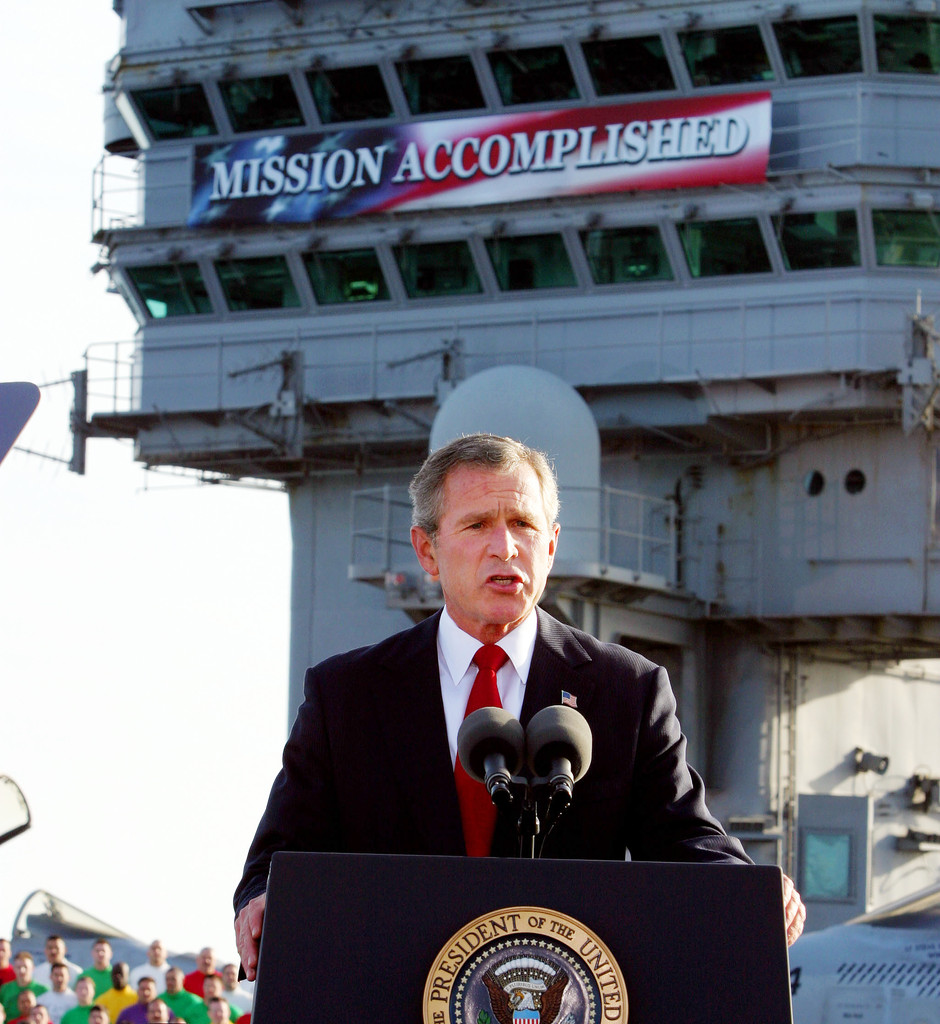
G.W. Bush is most to blame for the stupidity and waste of military action.
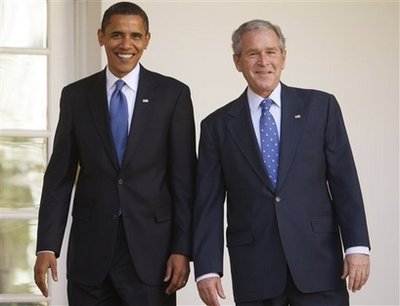
I’m disappointed Obama did not do more to reverse the damage wrought during the Bush years.
… more than 2,100 documented cases of suicide bombings from 1980 to 2009 and concluded that most of the perpetrators were acting in response to U.S. intervention in the Middle East.
The best thing the USA, Canada and the rest of the nations who have troops on the ground in the Middle East could do is … QUIT the Middle East.
Go home and focus on Home Security.
The American intervention is not appreciated by the majority of citizens there. Why stay?
Review:
… compelling analysis of the root causes of suicide terrorism.
The authors challenge the assumption that Islamic fundamentalism generates the peculiar phenomenon of suicide terrorism, suggesting instead that military occupation is the proximate cause. …
Robert A. Pape is professor of political science at the University of Chicago and the author of Dying to Win: The Strategic Logic of Suicide Terrorism and Bombing to Win: Air Power and Coercion in War.
James K. Feldman has taught decision analysis and economics at the Air Force Institute of Technology and defense policy analysis at the School of Advanced Airpower Studies.
Professor Pape:
“… the sustained presence of heavy American combat forces in Muslim countries is likely to increase the odds of the next 9/11. …”