SHAW does something right

Internet service providers are normally sneaky, or downright evil. One of the most hated industries.

But SHAW in Canada is garnering a wee bit of praise in the Tech community for this:

“We’ve created a non-cap kind of regime. If you’re always going over, we’re going to ask you to go into a package that really fits you.”

The immediate result is that the download limits on existing plans will at least double, so that high speed jumps to 125 gigabytes from 60 and Extreme to 250 gigabytes from 100 at the current price.

The company will also offer a number of new plans that provide choice in download and upload speeds, as well as increased data limits, including two unlimited options.

Those will become available next month, with new additions rolling out over the next 16 months as the analogue to digital TV upgrade happens and capacity is created.

“It should provide sufficient choice for our customer” …

Shaw responds to public outcry over Internet pricing, increasing data limits

Those packages are still way over-priced. But it’s the right direction.

The BIGGER issue is whether or not SHAW and the other Canadian oligopoly carriers will be able to convince the new FREE ENTERPRISE Conservative government to stiffle competition …

Click PLAY or watch a CBC TV News feature on YouTube.
keep the Internet FREE

Jeff Jarvis has been working on a A Hippocratic oath for the internet.

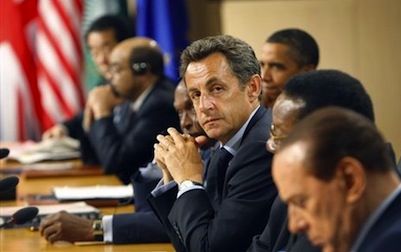
He’s attending the first e-G8 summit on the internet gathered by French President Nicolas Sarkozy this week in Paris.

I. We have the right to connect.
II. We have the right to speak.
III. We have the right to assemble and to act.
IV. Privacy is an ethic of knowing.
V. Publicness is an ethic of sharing.
VI. Our institutions’ information should be public by default, secret by necessity.
VII. What is public is a public good.
VIII. All bits are created equal.
IX. The internet must stay open and distributed.

Jeff makes the point that the internet “frightens institutions of legacy power”. That’s why they keep trying to regulate and limit “using convenient masks — privacy, security, civility….”

The last one is the internet’s best protection: its own structure. To the leaders gathered in Paris, I say of that architecture: Primum non nocere. First, do no harm.

If you have no legacy power to protect, you should be fighting to keep the internet as free as possible. It’s our best hope for the future.

I signed Jeff’s recommended online petition.

not recommended: Boingo Wi-Finder

This is an update of an old post.

____ original from April 10th, 2011:

I’ve been a Boingo member in the past.

… a private company that provides global Wi-Fi services at more than 125,000 325,000 Boingo hotspots worldwide – including hundreds of airports, thousands of hotels, and tens of thousand cafes and coffee shops. …

Though signup is seamless, canceling the service requires a call into customer services. …

It works. But there are some deceptive billing practices. At times you THINK you are logging into your Boingo account, but in reality it’s some ‘premium’ partner. … At the end of the month you find you’ve been billed extra. Without warning.

UPDATE:

Baochi from Boingo responded instantly to this post. (They really do have superb customer support.)

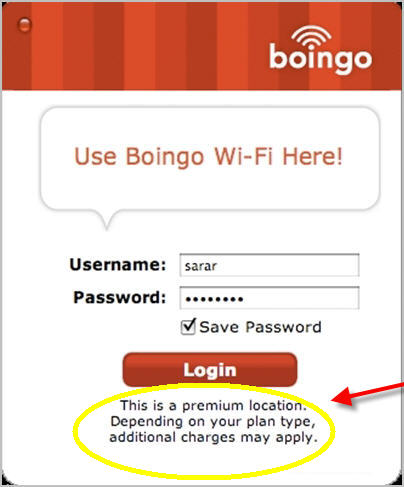
Due to complaints like mine, Boingo has improved the notification that you are going to get DINGED for an extra (unknown) amount. It now looks like this:

The premium locations that incur additional charges are available by default. … Perhaps they should be OFF by default, and only turned on by two or three clicks.

Certainly every month Baochi gets complaints from customers charged more than their expected monthly total. Most cannot recall clicking on any premium locations. They were in a rush, and didn’t pay attention to that text.

If you travel, you could get good value. … On the other hand, since Starbucks went free, I’ve not needed a paid subscription. And don’t plan to get one in future. Starbucks has a strong WiFi signal 99% of the time. Many Boingo hotspots cannot stream a YouTube video.

However, Boingo’s now released a brilliant FREE service that I recommend for everyone.

A FREE app that helps you find and locate FREE and Boingo hotspots at thousands of locations worldwide.

Click PLAY or see how it works on YouTube.

Download it here.

Choose Windows, Mac, iPhone / iPad, or Android.

Every time you open up your computer in a new location, the app will tell you if there’s free Wi-Fi available.

Brilliant.

After testing it the past couple of weeks in California and Nevada, I’m getting about 70% false positives. The app says there is free WIFi … but that’s not true. I’ve deleted the app on my laptop.
__________________________

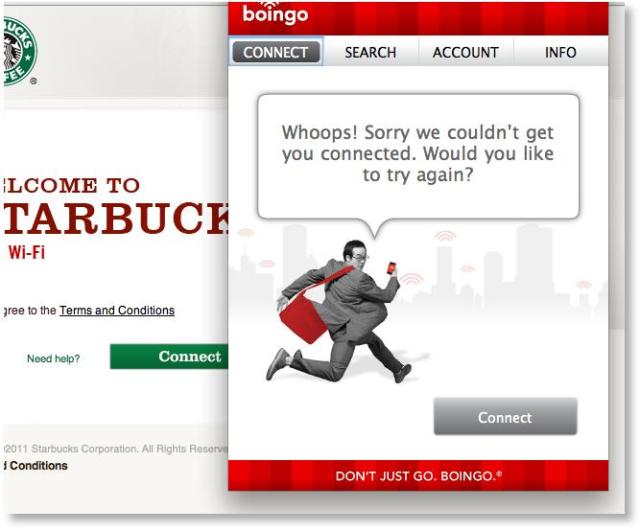
For example, in the case of Starbucks (log-in required) it gets it wrong.

screen grab

I have to find the Starbucks log-in page. And log-in, as usual.

Prime Minister Layton

ELECTION tomorrow.

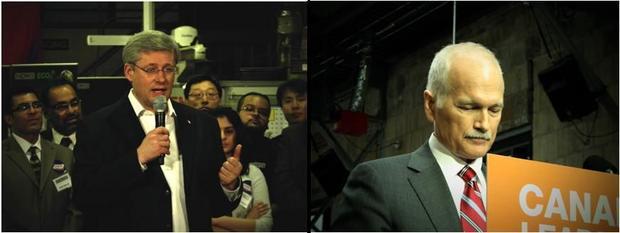
It’s looking increasingly like same old, same old … a minority Government led by Steven Harper.

Or, a coalition NDP / Liberal government led by Prime Minister Layton.

hmm

Jack Layton is the most likable of the leaders, certainly. I enjoy having the NDP around as the moral conscience of Canadians.

But to actually have an NDP Prime Minister … ??

Even if the ‘massage therapist’ was legal and of legal age.

I think I’d rather have Harper.

What socialists like Jack never acknowledge is that every subsidy to one disadvantaged group is a penalty to the non-subsidized one.

… Right now I plan to spoil my ballot. I’m voting for the Internet.

My riding is going to go Conservative, in any case.

I’m sending Jack Layton a copy of Atlas Shrugged just in case he is our new PM.

are YOU distracted by devices?

Clifford Nass is a professor of communications at Stanford University and a renowned authority on Human Computer Interaction.

I was quite alarmed by a radio interview with him on CBC Spark.

Are you wondering why you can‘t seem to get the important things in your life done?

… “Chronic multitaskers are suckers for irrelevancy. Everything distracts them. They can’t ignore things, can’t remember as well, and have weaker self-control,” writes Stanford University communications professor Clifford Nass in a report that’s not well received in nearby Silicon Valley where buildings are full of computer experts who get lost in cyberspace. …

Technology pushing new multitasking apps, while experts say it’s too much

I consider myself a fair average multi-tasker. One of the few people who doesn’t seem to have some sort of ADD.

… But social networking has gone too far for me.

How are kids handling the new reality?

Young people, readers of Discovery Girls Magazine, are online 6.9hrs / day.

Yet they report feeling ‘better’ when face-to-face with friends, rather than on Facebook or texting them.

Here’s a good article on the topic – Multitasking and the Brain: The War on Productivity

THAT”S IT. As Oprah commandsNo mobile phone for me.

I don’t trust myself to manage that distraction.

If you MUST have a mobile phone, schedule OFF time.

reactions to Borders bankruptcy

Economist:

… We can spare a little thought for Borders.

It has a particular relevance for American small towns and suburbs that isn’t apparent in urban centres.

In the latter, the chain bookstores are the impersonal monoliths that destroyed small independents by undercutting them on prices. But elsewhere, the arrival of a Borders would mean that a town was finally getting a bookstore, rather than a rack of paperbacks and Sudoku books at the supermarket.

(Similarly, while Starbucks might have hurt local coffeeshops in, for example, New York, in rural America it has achieved its stated goal of creating a “third space”.) …

Beyond Borders

L.A. Times – Carolyn Kellogg responds:

It’s an interesting argument, but the only example the Economist provides is a counter: In Austin, Texas, longstanding indie BookPeople successfully prevented a Borders from moving in nearby.

It’s nice to think that Borders provided bookstoreless towns with their first bookstores, creating new community space around books — but I’m not entirely sure that it’s true. …

Borders should die. … But I really don’t think the online experience is anywhere near as good. Yet.

in praise of bloggers

My second and third favourite sources of information in 2011 are audio:

• Audiocasts
• Audio books

I pretty much always have an audio book or two in progress, buying most of those from Audible.com. … Sadly not every book I want is available in audio.

Audio podcasts are still quite crude. The most evolved, however, are superb: RadioLab, This American Life, CBC Spark, Economist Editor’s Highlights, and On The Media. Almost all audio podcasts are still free.

But my main sources of information … my most trusted … my most detailed and nuanced … are blogs.

The best are labours of love by passionate, often amateur writers. Most bloggers are unpaid, spending thousands of hours focused on a specific topic simply because they love that topic.

more photos of bloggers

For example, the best Apple blog is Daring Fireball. I don’t pay much attention to any other.

I do whatever I’m told by Michael Geist when it comes to Canadian government regulation of the internet. A big election issue right now.

There are 4-5 essential blogs on gymnastics, but if I only was allowed to read one blogger it would be Blythe Lawrence.

If you read Kraig Becker, you’ll know more about outdoor adventure than you’ll ever need to know for one lifetime.

… Those are just a few examples. Leave a comment if you’ve got a blog that I should follow.

(blogger photos via Spark)

CANADA – 4 elections in 7 years

… It will be the fourth federal election in less than seven years for Canada, where no party has been able to obtain anything but a minority-government mandate from voters since 2004.

Globe and Mail

Everybody hates the waste of money and media time … except me.

Oddly I’m interested in this election. I might even vote. So few Canadians vote that I could decide the next minority government. 🙂

I’ll likely vote for the most fiscally conservative party. … … Since we don’t have one, it may come down to the best candidate in my riding – Calgary West.

Currently that’s Rob Anders, Conservative, “the sole parliamentarian to vote against making Nelson Mandela an honorary citizen of Canada in 2001“.

He sounds moron hard right.

Who are the alternatives? … Green party candidate Anna Wagner?

Who else?

My pet issue is government regulation of the internet. So far I’ve like the talk of the ruling Conservative party. But they’ve yet to walk that talk.

Perhaps I’ll vote for whatever party is recommended by Michael Geist.

the future of computers

Graphene is an allotrope of carbon, whose structure is one-atom-thick …

… a stack of 3 million sheets would be only one millimeter thick.

The Nobel Prize in Physics for 2010 was awarded to Andre Geim and Konstantin Novoselov “for groundbreaking experiments regarding the two-dimensional material graphene …

Here’s the future.

Click PLAY or watch it on YouTube.

Thanks Maureen. Thanks Rocco.

online privacy – be very AFRAID

I follow Jeff Jarvis religiously, one of the best pundits on the WWW:

At two privacy conferences—one in New York, the other right now in Victoria, B.C.—I’ve watched the growth of privacy’s regulatory/industrial complex and seen its strategy in action: scare, then sell. …

… the emergence of Privacy, Inc., as a industry built on scaring people is beginning to scare me. …

Buzz Machine – The privacy industry: Scare and sell

Jeff tells us not to be so worried about privacy online … unless you’re doing something illegal.

related – Your Privacy Online: The Internet’s Greatest Bait and Switch