Canada does something RIGHT

The Supreme Court of Canada transformed the country’s libel laws Tuesday with a pair of decisions that proponents say will expand the boundaries of free speech.

The court ruled that libel lawsuits will rarely succeed against journalists who act responsibly in reporting their stories when those stories are in the public interest.

It also updated the laws for the Internet age, extending the same defence to bloggers and other new-media practitioners. …

“Freewheeling debate on matters of public interest is to be encouraged and the vital role of the communications media in providing a vehicle for such debate is explicitly recognized,” Chief Justice McLachlin said in a pair of 9-0 decisions. …

Globe and Mail

more news stories on this topic

Our politicians ususally blunder when drafting legislation around new media, clinging to flawed, outdated models. But the Supreme Court is to be praised. Click through if you want to see their names.

I’m proud to be a Canadian today … after being so disappointed this week in the lack of transparency, accountability and fiscal responsibility of our Ministry of Indian Affairs,

Copenhagen carbon footprint

From Jon Bowermaster

… 1,200 limousines, 140 private jets, 15,000 delegates, 10,000 environmental activists and lobbyists, over 100 world leaders and 5,000 journalists. According to summit organizers the 11-day conference, including the participants’ travel, created a total of 41,000 tons of “carbon dioxide equivalent,” equal to the amount produced over the same period by a U.S. city, population 225,000. …

The Life Antarctic: Thoughts On Copenhagen

Likely some of the decisions made will quickly offset this.

But wouldn’t if be great if they held future Summits online, allowing anyone from around the world to participate?

We could vote and comment on the speeches in real-time.

The future of news is entrepreneurial

Jeff-JarvisThere’s a brilliant guy named Jeff Jarvis with a blog called Buzz Machine.

Rockin’ reads it religiously.

I find it bloody dense. Wordy. Few graphics or photos. A video once-in-a-while if you’re lucky.

But one dense Buzz Machine post is dead on, something explained better than I’ve heard before:

The future of news is entrepreneurial
:

The future of news is not institutional… The news of tomorrow has yet to be built…. The structure – the ecosystem – of news will not be dominated by a few corporations but likely will be made up of networks of many startups performing specialized functions

That statement also holds many implications for sectors of the economy and society: investment (put money into the new, not the old)… public policy (don’t protect and preserve the incumbents but nurture the startups by creating a fertile and level playing field)… education (how do we train journalists when everyone can do journalism? – how do we train everyone?)… marketing (advertising won’t be one-stop shopping anymore and that means it may support news less)… PR (influence will be no longer be concentrated)…
Ryerson-blog

He writes this, I think, as a response to the idiotic proposals that governments should support your local paper with tax dollars.

Are you telling me the Calgary Herald is too big to fail? … It’s not.

There’s a cheesy sounding news service called Demand Media, founded 2006. It’s already the single largest contributor to YouTube.

Also founded 2006, but better, is a company called Examiner.com. My friend Blythe Lawrence went to work for them. She’s a trained journalist. Check out Blythe’s “blog” – Gymnastics Examiner. It’s as good as any of the old media in my business.

Jeff Jarvis is associated with another new (2007) media company called Daylife.

daylife

Looks like all 3 of these companies are going to survive. Dozens more will be founded. Some will flounder.

All 3 are radically different business models. In all 3 most of the people producing the content are paid very little.

Those are all “news” sites. More likely to survive longterm are speciality sites. I frequently read Matador Travel, for example. It’s an online travel magazine and social network. I’m more likely to check Matador for travel, or the Gadling travel blog, than look at travel pieces in a news site like DayLife. Matador and Gadling specialize in travel.

A friend of mine Kraig Becker went to work for Gadling recently. He’s getting paid something, and really enjoying posting for them. I’m totally happy with the quality of Kraig’s writing. And scan each and every one because I like his perspective on adventure travel.

We don’t know yet how we will get our news 2 years from now. It’s being fought out in the market place of ideas right now.

Perhaps they’ll even find a way to monetize news. To pay the people that produce it in micropayments. … My guess is that very few journalists will be well paid in future, however.

Certainly I won’t be subscribing to the Calgary Herald dead tree edition, ever again.

==== UPDATE:

I heard Jeff Jarvis on Leo Laporte’s new audiocast, This Week in Google.

Jarvis is a genius. Much better in audio than in text, IMHO.

His book, however, What Would Google Do? is high on my “to listen to soon” list.

is the internet ruining writing?

Rockin’ links to research out of Stanford:

… today’s students are writing much more than previous generations, and in a profoundly different way. Consider these findings:

  • An amazing 62 percent of student writing is outside of school. That’s a giant paradigm shift from the pre-Internet age, when almost all writing was for the classroom.
  • Not only are students writing more, they’re writing things they truly care about and want others to read.
  • And they’re writing in a lively, competitive and very public marketplace (text messaging, Twitter, Facebook, etc.) that hones their rhetorical skills and teaches them how to influence their audience.
  • Trunk’s loveably brazen conclusion: “So everyone can just shut up about how no one can write anymore.”

    details – For Your Approval – Another reason employee communication is changing for good

    7-ways-internet

    Perhaps it’s the mobile phone that’s ruining writing.

    R u a Facebook addick?

    A few people still claim that social networking online is just a “fad”.

    They are as wrong as wrong can be.

    Click PLAY or get the amazing statistics in a video called Social Media Revolution.

    (via BluePeak)

    lingering in Bad Gastein, Austria

    If you’re as fluent oaf Deutsch as I am, you can translate the name of this mountain town:

    Bad Gastein = Bad Gas Town

    Not exactly great marketing to attract tourists.

    But I love weird & unique Bad Gastein. I stayed over a week.

    Catching up on the internet. Day hiking the Austrian Alps. And biking when I needed a change of pace.

    Austria is very inexpensive this Summer due to the recession. Tourism is way down. I paid US$22.50 / day for a private room. With breakfast. (I can drink $20 worth of coffee in the morning.)

    You could stay in the dorm for US$10 day. And get a complimentary mountain bike. It just might be the least expensive hostel in Western Europe.

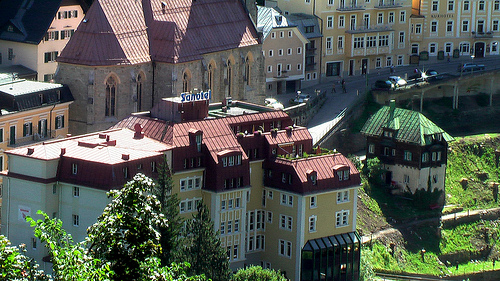
    The townscape is characterised by historic multi-storey hotel buildings erected on … steep slopes.

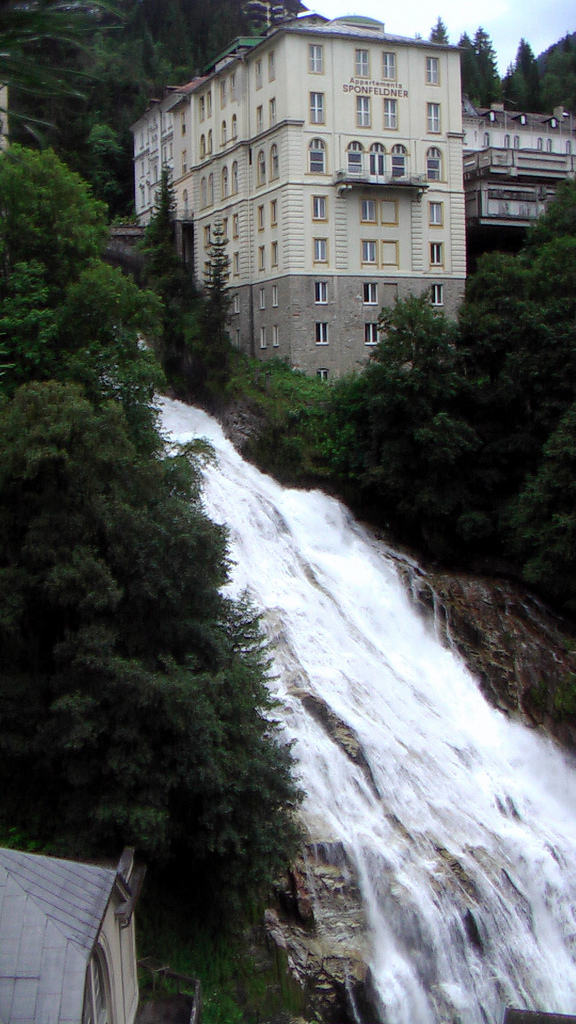
    It surrounds a series of waterfalls, in fact.

    empty-hotels

    The spas of Bad Gastein are a fashionable resort, visited by European monarchs as well as the rich and famous. … Well, they were in the 1860s.

    Since the 1960s imposing and massive hotels mostly sit empty.

    Somerset Maugham could have used this town as a setting for one of his short stories about eccentric expat recluses running out the clock.

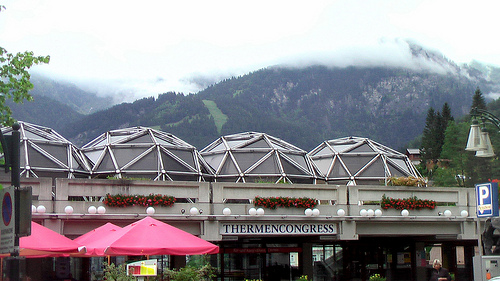
    The good people of the Rathaus have made an effort. To rejuvenate the resort, Bad Gastein renovated the hot springs and added an ultra modern (in 1970) Convention Centre.

    convention-centre

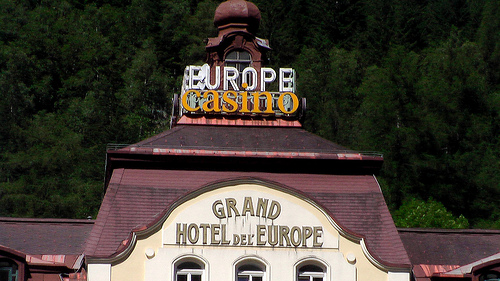
    The Casino is a little more appealing.

    Casino

    I’d love to shoot a movie here. In one scene an engrossed young couple, deep in conversation in the foreground, wouldn’t notice as a despondent hotel owner throws himself off the balcony into the waterfall.

    hotel-waterfall

    Soccer balls, as well as the corpses of suicide victims, get washed downstream, eventually finding an eddy.

    soccer-ball

    more bad Bad Gastein photos

    I’m aus. En route to the Swiss Alps.

    how do you CONNECT with people?

    One of the best articles I’ve seen lately was published on a blog about “greatness” called Baekdal.com.

    It gives an overview of the history and rapid evolution of information technology.

    Here’s a sample slice from where we’re at right now.

    marketflow10

    People get information from TV, websites, blogs and social network sites. Oh, and the old people still cling to newspapers and magazines.

    … But 2009 is also going to be the start of the next revolution. Because everything we know is about to change. …

    The first and most dramatic change is the concept of Social News. Social news is quickly taking over our need for staying up-to-date with what goes on in the world. News is no longer being reported by journalists, now it comes from everyone. And it is being reported directly from the source to you – bypassing the traditional media channels.

    I highly recommend you check out Baekdal – Where is Everyone?

    I think the graphic is wrong, by the way.

    Social News (e.g. Twitter) is not nearly as much the NEXT BIG THING as is shown above.

    Some future evolution of Facebook or Friendfeed is the best way to CONNECT with people that’s been invented so far. Twitter is already a subset of those two vastly superior systems now.

    (via bluepeak)

    I am not a Geek

    … a rallying cry for geeks around the world to stand proud and unite. Embrace your inner geek and be the geek who keeps on giving!

    Click PLAY or watch the viral geek video on YouTube.

    Geek Advancement

    look and feel of RickMcCharles.com

    I’ve been playing around with some settings on this site.

    The major change was to increase the size of the font in the main post. (Old folks like me have trouble reading small words on screen.)

    Most browsers have excellent ZOOM functions. But many users don’t know about them.

    I zoom in and out of pages constantly using keyboard shortcuts.

    MiFi – Personal Hot Spot – WiFi to go

    The latest in technology from the Times’s David Pogue

    Someday, we’ll tell our grandchildren how we had to drive around town looking for a coffee shop when we needed to get online, and they’ll laugh their heads off. Every building in America has running water, electricity and ventilation; what’s the holdup on universal wireless Internet?

    pogue.600

    Getting online isn’t impossible, but today’s options are deeply flawed. Most of them involve sitting rooted in one spot — in the coffee shop or library, for example. (Sadly, the days when cities were blanketed by free Wi-Fi signals leaking from people’s apartments are over; they all require passwords these days.)

    If you want to get online while you’re on the move, in fact, you’ve had only one option: buy one of those $60-a-month cellular modems from Verizon, Sprint, T-Mobile or AT&T. The speed isn’t exactly cable-modem speed, but it’s close enough. You can get a card-slot version, which has a nasty little antenna protuberance, or a U.S.B.-stick version, which cries out to be snapped off by a passing flight attendant’s beverage cart.

    A few laptops have this cellular modem built in, which is less awkward but still drains the battery with gusto.

    But imagine if you could get online anywhere you liked — in a taxi, on the beach, in a hotel with disgustingly overpriced Wi-Fi — without messing around with cellular modems. What if you had a personal Wi-Fi bubble, a private hot spot, that followed you everywhere you go?

    Incredibly, there is such a thing. It’s the Novatel MiFi 2200, available from Verizon starting in mid-May ($100 with two-year contract, after rebate). It’s a little wisp of a thing, like a triple-thick credit card. It has one power button, one status light and a swappable battery that looks like the one in a cellphone. When you turn on your MiFi and wait 30 seconds, it provides a personal, portable, powerful, password-protected wireless hot spot. …

    AWESOME – US$60/month – details on NY Times – Wi-Fi to Go, No Cafe Needed

    Click PLAY or watch it on YouTube.