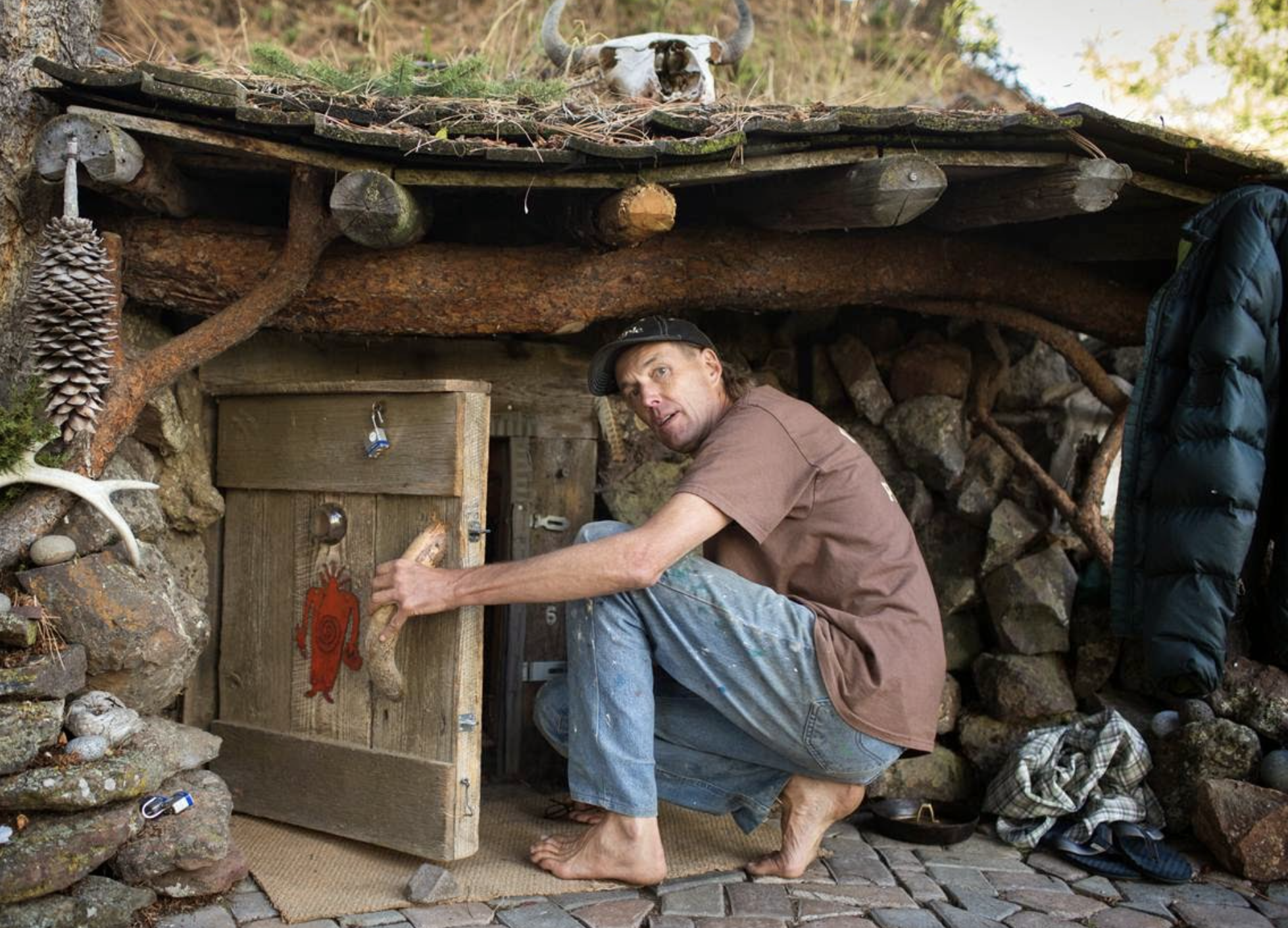
Since 1990 Dan has been living off the land in Oregon.
He’s an artist. A writer. A traveller.
For the last 15 years or so he’s been living in a little Hobbit House only 8ft (2.4m) wall to wall with a roof only 4ft (1.2m) high at the entrance rising to 5ft (1.5m) at the back.
Dan has a website called moonlight chronicles where he documents his simple life.
The audio book is even better, by my favourite reader Gerald Doyle.
Mark did not touch cash for over 3 years, writing about his experience in The Moneyless Man.
Later, he tried living with as little modern technology as possible.
It was 11pm when I checked my email for the last time and turned off my phone for what I hoped would be forever.
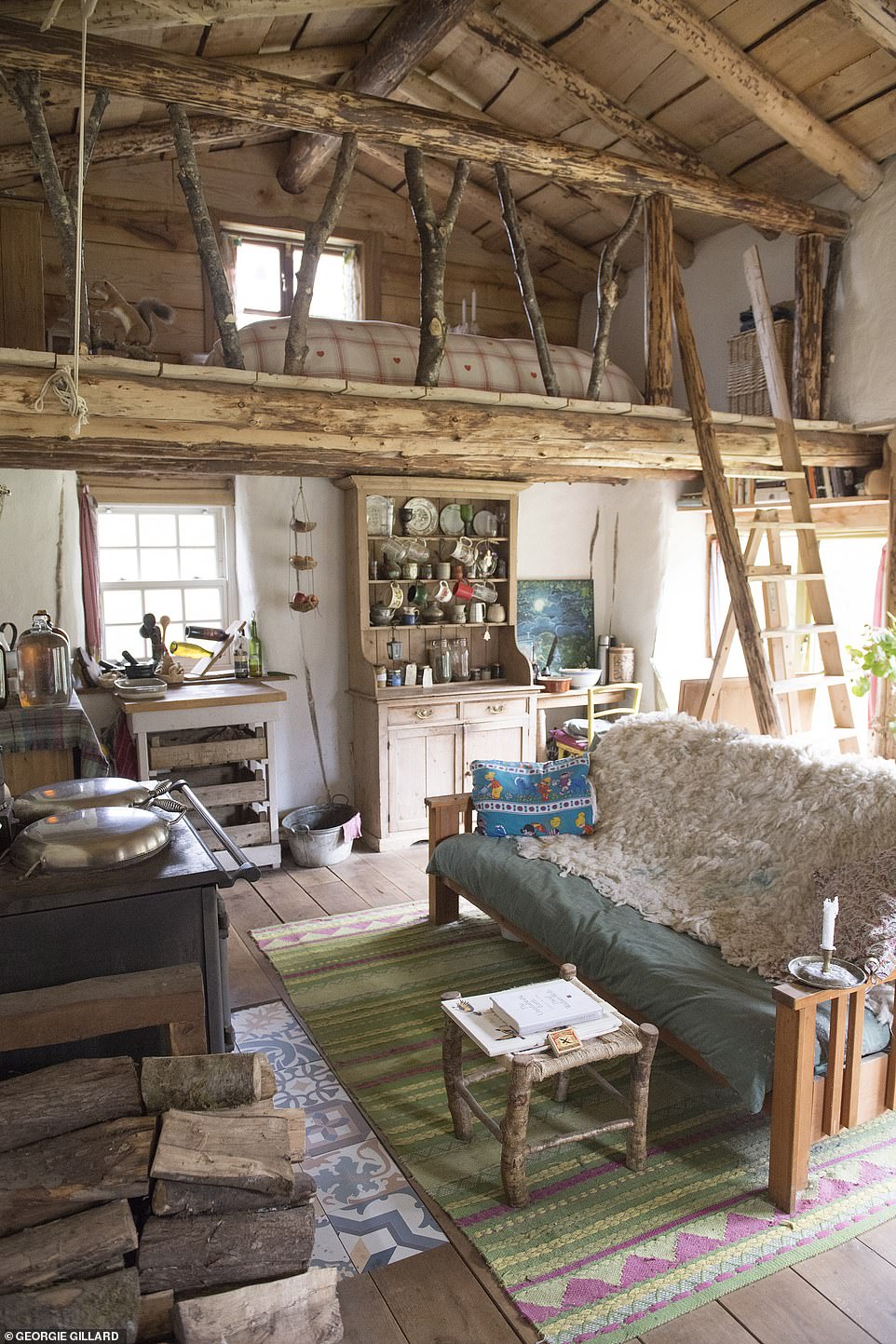
No running water, no car, no electricity or any of the things it powers: the internet, phone, washing machine, radio or light bulb. Just a wooden cabin, on a smallholding, by the edge of a stand of spruce.
In this honest and lyrical account of a remarkable life without modern technology, Mark Boyle explores the hard won joys of building a home with his bare hands, learning to make fire, collecting water from the spring, foraging and fishing.
What he finds is an elemental life, one governed by the rhythms of the sun and seasons, where life and death dance in a primal landscape of blood, wood, muck, water, and fire – much the same life we have lived for most of our time on earth. Revisiting it brings a deep insight into what it means to be human at a time when the boundaries between man and machine are blurring.
And finds herself offered a chance to reinvent her life by going back and making different major life decisions.
Some include Nora becoming a glaciologist, Olympic swimmer, and rock star.
Haig put together this construct to talk philosophically about regret, hope and second chances. The author is a a champion of mental health causes. Instead of preaching medical science, he puts the same messages across in an entertaining narrative.
I found the book very uplifting.
Between life and death there is a library, and within that library, the shelves go on forever.
Every book provides a chance to try another life you could have lived. To see how things would be if you had made other choices
. . . Would you have done anything different, if you had the chance to undo your regrets?”
John … claims to be a Cro-Magnon (or Magdalenian caveman) who has secretly survived for more than 14,000 years. The entire film is set in and around Oldman’s house during his farewell party and is composed almost entirely of dialogue. …
Almost a home movie, a budget of just US$200k.
The most impressive man John ever met was … the Buddha.
Like Bill Bryson, he can make academic subjects interesting and lively.
Critics call it sensationalistinfotainment.
He is a simplifier. I like his frequent analogies to well known references.
There are endless interesting factoids.
Critics complain he gets some facts wrong by over-simplifying.
In Sapiens he postulates that humans now rule the earth because of our ability to organize and coordinate in large numbers.
Bees, ants and other species cooperates even better, but they are too inflexible to evolve. And have comparatively small numbers.
We are the only animal that can believe in things that exist purely in our imagination, such as gods, states, money, human rights, corporations and other fictions, and we have developed a unique ability to use these stories to unify and organize groups and ensure cooperation.
In The New York Times, Bill Gates calls the book “fascinating” and his author “such a stimulating writer that even when I disagreed, I wanted to keep reading and thinking.” For Gates, Harari “has teed up a crucial global conversation about how to take on the problems of the 21st century.”

 Rick McCharles