Thursday, MAY 14th, 2009 is National Bike to Work Day.
I normally bike about an hour to work. But Tuesday and Thursday I ride the big, public limo.
Perhaps I need move to Freiburg, Germany:
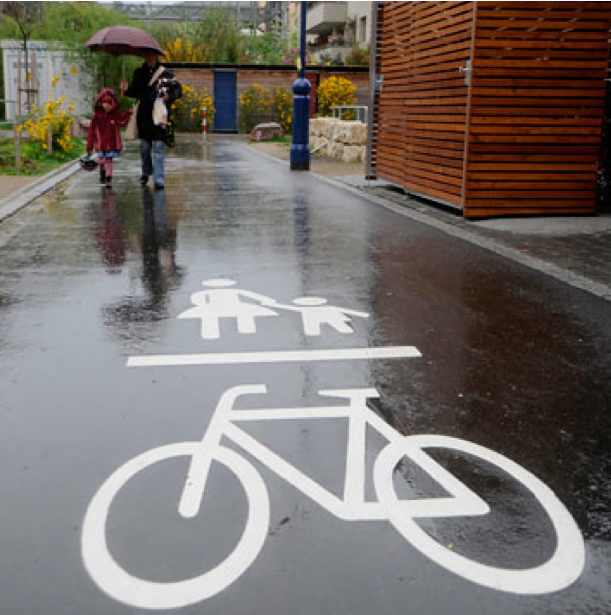
… Street parking, driveways and home garages are generally forbidden in this experimental new district on the outskirts of Freiburg, near the French and Swiss borders. Vauban’s streets are completely “car-free” — except the main thoroughfare, where the tram to downtown Freiburg runs, and a few streets on one edge of the community. Car ownership is allowed, but there are only two places to park — large garages at the edge of the development, where a car-owner buys a space, for $40,000, along with a home.
As a result, 70 percent of Vauban’s families do not own cars, and 57 percent sold a car to move here. …
Ten days ago, Don Braid, local columnist for The Calgary Herald, blogged about the abysmal care that his wife received at the emergency.
It’s something we all know about, it’s something we all wring our hands about, and it was nice to see it written about. Sparked a bit of an outroar, but nothing will happen.
Our politician’s pretend all is good, except that we need to cut back on health care. What a difference from the States. We just returned from San Francisco, where we observed bus ads for local emergency departments that guaranteed patients would be seen within a half hour after arrival. It was shocking not just to compare that half hour guarantee with Don Braid’s wife’s nine hours of intense pain before seeing a doctor but even more basically to imagine a health care system where you are seen as an opportunity (to make money, to be sure) instead of a burden.
Certainly private Health Care is the only model that stands a chance, long term. But it isn’t working yet in the USA. Once Obama gets through with reforms it will be further muddled.
The Canadian model is too expensive as well as inefficient and impersonal.
My advice … DON’T GET SICK. In either the USA or Canada.
For the record, when I dislocated my finger last Fall, my emergency care in Calgary was very good.
… Caffeine, it turns out, actually works. And it is legal, one of the few performance enhancers that is not banned by the World Anti-Doping Agency. …
Exercise physiologists have studied caffeine’s effects in nearly every iteration: Does it help sprinters? Marathon runners? Cyclists? Rowers? Swimmers? Athletes whose sports involve stopping and starting like tennis players? The answers are yes and yes and yes and yes.
Starting as long ago as 1978, researchers have been publishing caffeine studies. And in study after study, they concluded that caffeine actually does improve performance. In fact, some experts, like Dr. Mark Tarnopolsky of McMaster University in Canada, are just incredulous that anyone could even ask if caffeine has a performance effect. …
About half the people in the world need corrective lenses.
Yet when you travel in the developing world, very few people wear glasses or contact lenses. They can’t afford them.
Taxi drivers, bus drivers work “blind”. It’s terrifying!
Josh Silver, a retired physics professor at Oxford University, has developed what he calls “adaptive glasses”. His specs are made of “tough plastic with with silicone liquid in the lenses. When purchased, each lense will have a syringe attached to it, and the wearer will be able to adjust the amount of liquid in the lenses — which essentially changes the prescription — without the need for an optician.”
About 30,000 pairs of his glasses have been distributed in trials in Africa. They work.
Zulu man wearing adaptive glasses. Photograph: Michael Lewis
They plan to sell these at $1 each.
… Silver calls his flash of insight a “tremendous glimpse of the obvious” – namely that opticians weren’t necessary to provide glasses. This is a crucial factor in the developing world where trained specialists are desperately in demand: in Britain there is one optometrist for every 4,500 people, in sub-Saharan Africa the ratio is 1:1,000,000.
The implications of bringing glasses within the reach of poor communities are enormous, says the scientist. Literacy rates improve hugely, fishermen are able to mend their nets, women to weave clothing. During an early field trial, funded by the British government, in Ghana, Silver met a man called Henry Adjei-Mensah, whose sight had deteriorated with age, as all human sight does, and who had been forced to retire as a tailor because he could no longer see to thread the needle of his sewing machine. “So he retires. He was about 35. He could have worked for at least another 20 years. We put these specs on him, and he smiled, and threaded his needle, and sped up with this sewing machine. He can work now. He can see.” …
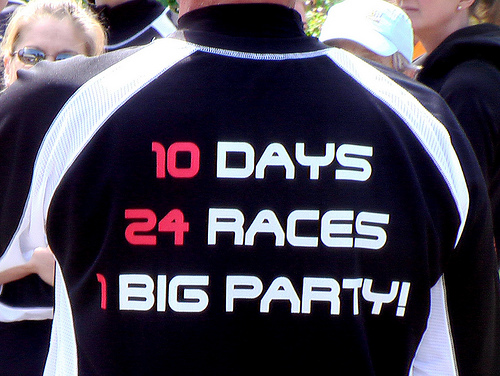
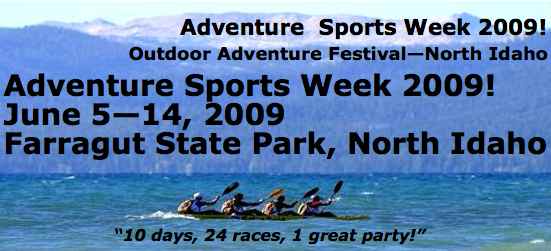
Dave Adlard, master organizer of big events, is boldly planning June 5-14th in North Idaho one of the biggest Adventure Racing events anywhere.
Our Adventure Racing Team — the Fast Farts — are part of his support team.
I’m editor of the official website:
North Idaho will play host to “adventure week 2009,” a series of “outdoor” races and events at Farragut State Park near Coeur d’Alene. (Of the famed Ironman competition.)
Click through if you know anyone who might be interested in coming down for the Adventure Week 2009.
I’m recommending to Dave that he include a surprise high speed kayak challenge, like this one …
Feel badly for those poor people who don’t have clean drinking water?
I’m one of them.
The water pipes underground the Sarcee Meadows Housing Co-op are rusted and rotting. Repairs have taken weeks!
… Around 1.2 billion people live in places that are short of water, and it is running out in others such as northern China and western America. Meanwhile, the world’s population is growing and more water will be needed to feed it. Farming, which accounts for some 70% of human water consumption, offers the best opportunity for thrift. Repairing leaks and better irrigation in poor countries could help reduce wastage by up to 70%, as could switching to less thirsty crops in arid regions. …