I will not vote for Harper

@pmharper @toewsVic #TellVicEverything

Up until now, I’ve not been all that unhappy with the Harper Conservative government.

But their non-stop efforts to restrict online freedom have forced me to look for another Party.

The latest BAD LEGISLATION (Bill 30) is called Protecting Children from Internet Predators Act

WTF !?

Vic Toews Canadian Conservative Public Safety Minister said on February 13, 2012:

“.. either stand with us or with the child pornographers” in response to questions from Quebec MP Francis Scarpaleggia (Lac-Saint-Louis) regarding extensive Privacy Commission concerns about ‘warrant-less access’ to all Canadian Internet and Cell phone accounts under C-30

Does that sound familiar?

… George W. Bush, in an address to a joint session of Congress on September 20, 2001 said,

“Either you are with us, or you are with the terrorists.”
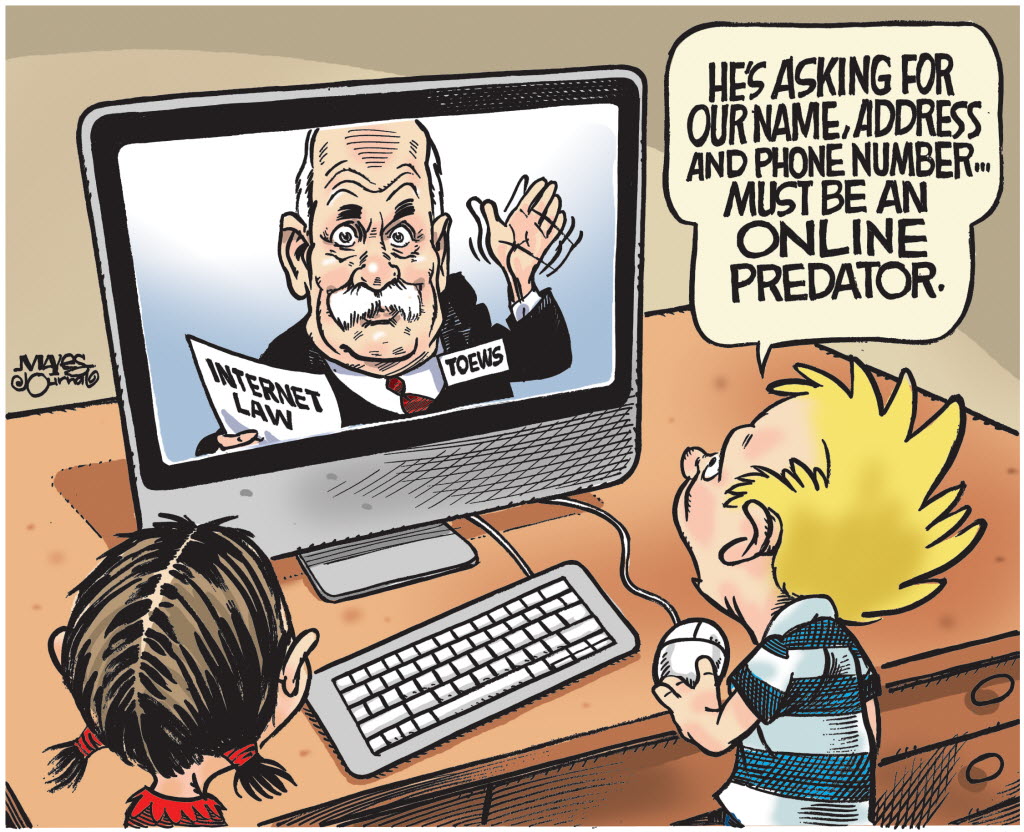
Toews has been mocked and attacked for that polarizing, disingenuous statement.

Next time you hear the statement:

You’re either with us, or against us

… somebody is trying to hide something.

If you want to know the many, many reasons why Bill 30 is lousy legislation, follow Dr. Michael Geist.


why we share online …

Jeff Jarvis, author of Public Parts:

We are sharing for good reason—not because we are insane, exhibitionistic, or drunk. We are sharing because, at last, we can, and we find benefit in it. Sharing is a social and generous act: it connects us, it establishes and improves relationships, it builds trust, it disarms strangers and stigmas, it fosters the wisdom of the crowd, it enables collaboration, and it empowers us to find, form and act as publics of our own making.

For individuals, sharing is a choice; that is the essence of privacy.

Facebook’s founder, Mark Zuckerberg, told me that before the net, we had “privacy through obscurity”. We had little chance to be public because we had little access to the tools of publicness: the press, the stage, the broadcast tower (their proprietors were last century’s 1%). Today, we have the opportunity to create, share and connect, and 845m people choose to do so on Facebook alone. Mr Zuckerberg says he is not changing their nature; he is enabling it. …

read more on Buzz Machine

Jeff Jarvis is defending sharing in an Economist magazine debate with Andrew Keen.

I voted for Jeff.

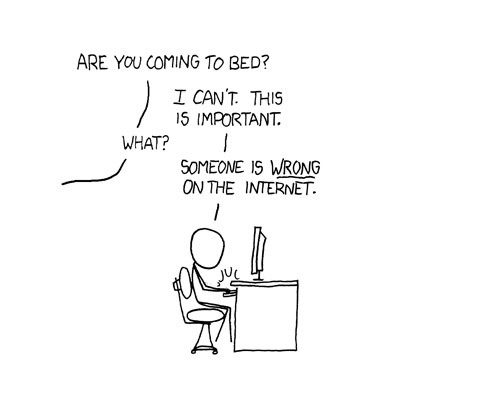
Online sharing is one of the best things that’s happened in my lifetime. But I’m surprised bloggers have not changed the world MORE.

If you are against empowering idiots to spew hate and misinformation online, your best argument is a blog called “LITERALLY UNBELIEVABLE“:

… examples from Facebook of people who think stories from The Onion are real.

You’d successfully argue that many people shouldn’t be allowed to share online. 🙂

(via Kottke)

on Google Privacy

You may have been contacted by Google:

We’re getting rid of over 60 different privacy policies across Google and replacing them with one that’s a lot shorter and easier to read. …

These changes will take effect on March 1, 2012.

details

Some are freaking out.

That’s dopey. Not much is changing. Here’s a much more measured assessment:

Read Write Web – Tech World Overreacts to Google’s New Privacy Policy – How Does It Affect You?

… You know what you can do? Stop sharing things you don’t want tracked. …

Before and after March 1st best advice is not to do anything online you’ll regret in future. Somebody, somewhere could be tracking it. And it probably won’t be Google. They’re one of the least evil players.

If you want to dig into this deeper, the best authority is Jeff Jarvis. He’s the author of:

• What Would Google Do?
Public Parts

blogging and online comments

I listened to an excellent audiocast:

Hosts: Leo Laporte and Tom Merritt

Best known as a prominent blogger, and Vice President and Chief Evangelist of Expert Labs, Anil Dash is this week’s guest.

Triangulation

Three of the smartest internet gurus, together.

Of greatest interest to me was Anil’s opine on why true blogging (better) was eclipsed by microblogs like Twitter & Facebook (inferior). The true blogging platforms (e.g. WordPress & Blogger) are still too much work. Tumblr is better.

Next … the pros and cons of online comments.

Gurus MG Siegler and Anil, amongst others, recently turned comments off on their sites.

Matt Gemmell did too. Then posted the most detailed commentary I’ve seen on online comments – Comments Still Off

Personally, I have few enough hateful and ignorant comments on my blogs not to feel compelled to turn them off. The value — especially comments correcting my many errors — outweigh the negative Karma.

Issues regarding comments come up about once a week or so on my Gymnastics blog. I try not to delete or edit, but am forced to occasionally.

My advice, as always — DON’T READ COMMENTS.

Rick Perry is finished

He should resign from the campaign right after he fires the guy who recommended he post the most hated video in the history of YouTube.

Check the numbers … 9,576 likes, 403,251 dislikes (as I post).

Click PLAY or watch it on YouTube.

Pandering to his Christian, Family Values base, he underestimated the power of a viral meme gone wrong.

Amber Mac has a good write-up on the issue – Should Rick Perry’s YouTube ad be banned as hate speech?

… perhaps not “hate speech”. But he’s certainly got some of his ‘facts’ wrong.

I’m not happy with the job Obama’s done as President. But when the alternative is a nob like this cowboy, or — worse — the Newt — ‘merica is in trouble.

Judge Kent J. Dawson is an idiot

Kent J. Dawson … granted court orders for the seizure and transfer of hundreds of domain names belonging to websites alleged by luxury goods company Chanel to be selling counterfeit merchandise. He also required that “all social media websites” and “all Internet search engines” (specifically listing Google, Bing, Facebook, Twitter, Google+, Yahoo) remove these domain names from any search results.

arstechnica explains why Judge Kent J. Dawson is an idiot.

… Did I mention that Judge Kent J. Dawson is an idiot?

SOPA sucks … American legislators are criminals

Proponents of the latest disastrous IP bill , the “Stop Online Piracy Act” (SOPA) insist it only targets the “worst of the worst”: so-called “rogue” foreign websites that profit from pirating U.S. intellectual property. But the broad definitions and vague language in the bill could place dangerous tools into the hands of IP rightsholders, with little opportunity for judicial oversight. One very possible outcome: many of the lawful sites you know and love will face new legal threats. …

Etsy
Flickr
Vimeo

Electronic Frontier Foundation

Anybody who thinks about SOPA for more than 15sec will realize it’s an idiotic idea.

… It’s a power play from big corporate media companies — the sort of legislation that nearly everyone strenuously opposes but which might pass because the money is on the wrong side. …

Daring Fireball by John Gruber

American legislators are mostly bought off by old media. How does that happen. Here’s one painfully obvious example just brought to light by 60 Minutes, a show that aired Nov. 13, 2011:

… The next national election is now less than a year away and congressmen and senators are expending much of their time and their energy raising the millions of dollars in campaign funds they’ll need just to hold onto a job that pays $174,000 a year.

… Most former congressmen and senators manage to leave Washington – if they ever leave Washington – with more money in their pockets than they had when they arrived …

(Peter) Schweizer says he wanted to know why some congressmen and senators managed to accumulate significant wealth beyond their salaries, and proved particularly adept at buying and selling stocks.

Schweizer: There are all sorts of forms of honest grafts that congressmen engage in that allow them to become very, very wealthy. So it’s not illegal, but I think it’s highly unethical, I think it’s highly offensive, and wrong.

Steve Kroft: What do you mean honest graft?

Schweizer: For example insider trading on the stock market. If you are a member of Congress, those laws are deemed not to apply.

Congress: Trading stock on inside information?

Implicated are Nancy Pelosi, John Boehner and many other heavy hitters. If they were anyone other than the group of people writing the laws, they’d be in prison.

There is some hope this criminal behaviour can be slowed – Measure to ban Congressional insider trading gains steam

in praise of internet sharing

Despite fear mongering and pragmatic cautioning, people are sharing online like there’s no tomorrow.

I’m a big fan of journalism professor / internet pundit Jeff Jarvis, author of What Would Google Do?

His newest publication is Public Parts, the book. It touts the societal benefits of sharing:

… A visionary and optimistic thinker examines the tension between privacy and publicness that is transforming how we form communities, create identities, do business, and live our lives.

Thanks to the internet, we now live—more and more—in public. More than 750 million people (and half of all Americans) use Facebook, where we share a billion times a day. The collective voice of Twitter echoes instantly 100 million times daily, from Tahrir Square to the Mall of America, on subjects that range from democratic reform to unfolding natural disasters to celebrity gossip. New tools let us share our photos, videos, purchases, knowledge, friendships, locations, and lives. …

Click PLAY or watch an introduction on YouTube.

via my Gymnastics Coaching site

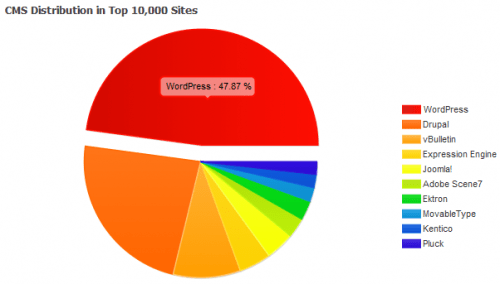
WordPress rules the internet

I’m often recommending WordPress as the best platform for hosting websites. It’s far and away the most popular platform in 2011.

WordPress Powering Practically Half Of The Top 10,000 Websites

It’s free. Get started here.

Google’s competitor — Blogger — has always sucked, in comparison. But now Blogger sucks less than before.

_____

related …

Android and Apple together now account for nearly 70 percent of smartphone subscribers in the U.S. … (they) keep taking share from RIM’s Blackberry, Microsoft, and Symbian.

What Does a Gigabyte Cost?

In expensive Canada, about $0.07 / GB.

What does your ISP or Phone company charge YOU / GB?

In Canada, folks are charged as much as $10 per gigabyte. (Companies try to convince that there is a shortage of electrons traveling over wires or fibre. That’s a lie.)

Once the wires are in place, the cost for extra electrons is almost zero.

related – CNet – Are you overpaying for smartphone data?