… the lives of two perceptive and intelligent girls, Elena (sometimes called “Lenù”) Greco and Raffaella (“Lila”) Cerullo, from childhood to adulthood as they try to create lives for themselves amidst the violent and stultifying culture of their home– a poor neighborhood on the outskirts of Naples, Italy. The novels are narrated by Elena Greco. …
I should start my review by saying that this book is a fine example of its type — the breezy travelogue — but if you prefer something meatier and more substantial, you’re likely to be disappointed. …
Like many of Murakami’s novels, not much happens. The plot is secondary to characters and their emotions.
Still, I enjoyed it as I’ve enjoyed all his books.
Norwegian Wood is a 1987 novel by Japanese author Haruki Murakami. The novel is a nostalgic story of loss and burgeoning sexuality. It is told from the first-person perspective of Toru Watanabe, who looks back on his days as a college student living in Tokyo. …
… set in Tokyo during the late 1960s, at a time when Japanese students, like those of many other nations, were protesting against the established order. …
Norwegian Wood was hugely popular with Japanese youth and made Murakami something of a superstar in his native country (apparently much to his dismay at the time). …
Murakami said it was set during the time of his own University education in Tokyo. But that an account of his personal love live in College would have only taken 15 pages. 🙂
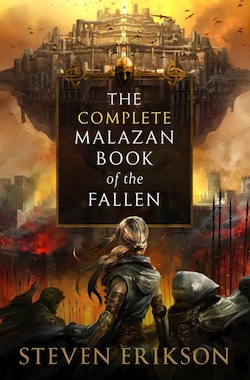
… written by Canadian author Steven Erikson, published in ten volumes beginning with the novel Gardens of the Moon, published in 1999. The series was completed with the publication of The Crippled Godin February 2011. …
The series is not told in a linear fashion. Instead, several storylines progress simultaneously, with the individual novels moving backwards and forwards between them. As the series progresses, links between these storylines become more readily apparent. …
Reviewing for SF Site, Dominic Cilli wrote, “Steven Erikson’s The Malazan Book of the Fallen has single-handedly raised the bar for fantasy literature,” praising Erikson’s ambition and humor …
So what’s not to like?
I got a couple of hundred pages into book 1 – Gardens of the Moon. It’s extremely well written. But too complex. Too confusing. There are too many characters. And far too much magic for me. Magic in a plot structure = Deus ex machina. Any dilemma can be solved by another burst of magic.
Gardens is demanding work. For the casual reader it may prove inaccessibly so …
Suffice it to say that this is a book to be read attentively, and that there is much you will appreciate and much you’ll find bewildering. …
Chile is 2600 miles long and never more than 110 miles wide. From the main north/south highway it’s easy access to fantastic wilderness.
how could Rick not LOVE Chile?
Chile should be a tourist destination as good as New Zealand.
But it’s not. 😦
I’ve spent about 2 months total in Chile traveling most of the 2600 miles. Costs are similar to Canada … but quality of goods and services are poor by comparison.
If you find something of quality – Casa Azul hostel, for example – chances are it’s run by a foreigner. Probably German.
People on the trail are good. But I’m not much impressed with the interactions I have with Chileans in the towns and cities.
A currency exchange guy tried to give me only half my money one time. (I’ve seen scummy practice like this in Italy recently, too.)
The World Health Organisation (2013) says over 40% of Chileans smoke, compared with 27% of Argentines and 17% of people in Brazil, where curbs on smoking began in the late 1990s. Chile’s health minister, Jaime Mañalich, says that treating tobacco victims takes a quarter of the $10 billion public health-care budget.
Chile’s smokers are getting younger. According to the Tobacco Atlas, a study of the industry, nearly 40% of girls aged 13-15 in Santiago, Chile’s capital, smoke cigarettes. That is up from just 20% in 2003, and is the highest rate in the world. …
The population looks unhealthy. Walking the streets reminds me of walking in Mexico. A very high percentage of people are conspicuously overweight. This is new to these nations.
For some odd reason I just finished listening to the first 4 books.
You could say they are poorly written. Or written for 13yr-old boys. (No sex, no profanity, much ultra-violence.)
The plot is somewhat interesting. Better than Hunger Games, for example.
Still, I’d never have even heard of this YA series if it weren’t for the films. The films are slightly better.
The Maze Runner, was released on September 19, 2014 and became a commercial success grossing over $348 million worldwide. The second film, Maze Runner: The Scorch Trials was released on September 18, 2015, and was also a success, grossing over $312 million worldwide. The film series is set to continue with the third film, Maze Runner: The Death Cure which is set to be released on February 17, 2017.
I found his previous book – 14 – quite juvenile. But this one I can recommend for any fan of Science Fiction.
… far out in the California desert, a team of DARPA scientists has invented a device they affectionately call the Albuquerque Door. Using a cryptic computer equation and magnetic fields to “fold” dimensions, it shrinks distances so that a traveler can travel hundreds of feet with a single step.
The invention promises to make mankind’s dreams of teleportation a reality. And, the scientists insist, traveling through the Door is completely safe.
Yet evidence is mounting that this miraculous machine isn’t quite what it seems—and that its creators are harboring a dangerous secret. …
The hero of the book, Leland “Mike” Erikson, has an eidetic memory … which means that he forgets nothing. Mike’s memory and reasoning ability was the highlight for me.


 … written by



 Rick McCharles