Though the family was very poor, the killer’s father — Wallace — had given his daughter a Ruger 10/22 semi-automatic .22 caliber rifle with a telescopic sight and 500 rounds of ammunition for Christmas 1978.
She later said, “I asked for a radio and he bought me a gun.” When asked why he might have done that, she answered, “I felt like he wanted me to kill myself.”
The killer will die in prison.
The father, I assume, is free. If it were up to me, I’d put him in prison too.
How Social Infrastructure Can Help Fight Inequality, Polarization, and the Decline of Civic Life
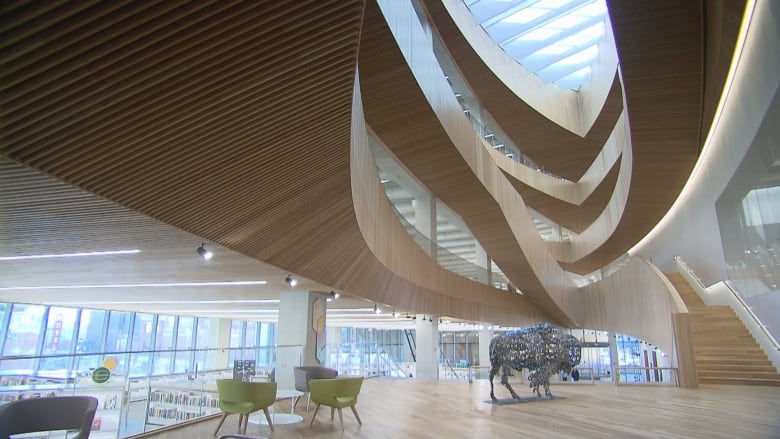
Social infrastructure is the glue that binds communities together, and it is just as real as the infrastructure for water, power, or communications, although it’s often harder to see.
But Eric Klinenberg says that when we invest in social infrastructures such as libraries, parks, or schools, we reap all kinds of benefits. We become more likely to interact with people around us, and connected to the broader public. If we neglect social infrastructure, we tend to grow more isolated, which can have serious consequences.
Calgary Public Library
I heard Klinenberg interviewed on the 99% Invisible podcast. His argument was compelling.
I’d love to see libraries expand their programs. Increase the hours they are open.
Libraries are unofficial sanctuaries for street people, at least during daylight. That should be formalized.
John Grisham is an activist and board member for the Innocence Project, an organization that fights to exonerate prisoners it deems wrongfully convicted.
This 2010 book looks at the issues of the death penalty through the wrongful conviction of 17-year-old Donté Drumm. He is a star on the high school football team and loved by the girls.
Donté’s is accused of murdering Nicole Yarber, a cheerleader.
It’s set in football mad Slone, Texas.
It’s a very good book. Well told. Some might find it a bit preachy. Repetitive in places.
Travis Boyette is the real killer. The most memorable of the characters, for me. Seems Grisham is skilled at writing complex, weird and evil bad guys.
I agree with Grisham on the death penalty. I’m against it. And still recall the day I made that decision. It was in a High School class in the 1970s where we were discussing the topic.
I’ll consider the USA a backwards nation until they ban it.
The USA will be backwards until the Republican Party finally starts to evolve their platform in the area of human rights.
United States, Japan, Singapore, Saudi Arabia, United Arab Emirates, Kuwait, Bahrain, Belarus, Oman, and Taiwan are some of the most prosperous nations that still have it.
Much of the fictional case presented in the novel is taken from some real-life cases involving defendants on death row.
I’m definitely going to eat less beef in future. Cows are TERRIBLE for the environment.
Ranchers on BLM (Bureau of Land Management) property have 94 percent of their grazing costs covered by taxpayers. …
Ranchers leasing BLM land cost taxpayers an estimated $500 million a year (and probably much more—some say a billion dollars).
According to Stephen Nash’s Grand Canyon for Sale, about 15,000 ranchers receive a $33,000 from the federal government annually.
This windfall of this bill comes in the form of radically reduced leasing fees (that some ranchers, such as Cliven Bundy, refuse to pay altogether). The cost of grazing cattle on privately owned land in the West is $21.60. BLM ranchers pay $1.41 per animal unit month (AUM), the amount of monthly forage eaten by a cow and her calf. In essence, ranchers on BLM land have 94 percent of their grazing costs covered by taxpayers. …
These subsidies apply to only 2.7 percent of livestock producers in the United States. Six percent of beneficiaries get 66 percent of the proceeds. So, rather than these subsidies leading to cheaper meat (which might, depending on one’s economic philosophy, justify them), the program tends to benefit corporate ranchers with names such as Koch, Walmart, and Hilton. …
In fact, the production of livestock is incompatible with the ecological health of much of the lands in the West.
Aridity is chief among the factors limiting compatible uses of western landscapes. Over decades, the placement of exotic, water-hogging, ill-adapted livestock on western lands has changed diverse native plant communities …
… That all said, I’m not sure I can continue with season 3. It’s too violent. Too sad. Too believable in an age where a potential leader of the Gilead theocracy is VP. ☹️
Patagonia National Park — announced January 2018 — combined the Jeinimeni National Reserve (400,000 acres), the Tamango National Reserve (20,660 acres), and the privately-owned Patagonia Park (200,000 acres).
The part donated by Americans had been a sheep ranch.
Conservacion Patagonica, the organization founded by Kristine and the late Doug Tompkins of The North Face bought the the huge property in 2004 and had been returning it to natural state.
The sheep were sold but Gauchos offered work in the new Park.
Fences and invasive species were removed. Cows are long gone.
They donated it to the Chilean government.
I visited as part of a 6 hour tour out of Cochrane. Watching large numbers of guanacos running free was the highlight.
The Park Headquarters built by the Tompkins is first class, even better than Pumalin.
It includes a wonderful museum and library of essential conservation information.
I learned a lot.
Patagonia National Park should evolve to be the second best hiking destination on the Carretera Austral after Cerro Castillo.
Right now you still need private transportation to get to trailheads. No convenient hiker shuttle yet exists. IF only I still had a bike. 🙄
Queulat is another of Chile’s newly announced Route of Parks (Ruta de los Parques) – a chain of 17 stretching 1500 miles.
Since I’d had a rest day in pretty Puyuhuapi town I felt I had to push on … despite the rain.
My bigger problem than H2O was my detached pannier rack. I’d fixed 🙄 it with a metal spacer, but didn’t have much confidence it would last the 218km to the next bike shop in Coyhaique.
Also, I had to attach my ugly load far to the left in order to keep it stable. Not good.
Though I got muddy, I actually like gravel road in the rain better than dry. The tires roll more smoothly. And there’s less dust.
Each year more of the Carretera Austral is getting paved.
I’d really been looking forward to getting to Quelat. And it is great. They are very used to rain here.
Next the very popular, short Alerce trail. This park protects the Alerce trees, the largest in South America. They grow to more than 70m with up to 5m trunk diameter. Charles Darwin reported finding a specimen 12.6 m in diameter.
They had been heavily logged before conservationists weighed in.
One is 3622 years old, the second oldest fully verified (by counting growth rings) age for any living tree species, after the bristlecone pine.
Weather was now excellent for riding. The only annoyance pesky horseflies.
My third hike of the day was Cascadas Escondidas trail. I’d actually planned to camp there as well, but it was too crowded.
Late in the day I pushed on to Lago Blanco campground.
I love sites which keep my tent under roof. If it does rain, no worries.
Fantastic as they are, these sites are not inexpensive. This one is C$32 / night. The Park guys didn’t collect this night, however. Perhaps I arrived later than they had made the rounds.
A beautiful, calm night. Superb morning.
Next morning I stopped at Volcano campground for the bathroom. Gorgeous. The best of about a dozen camps in this part of Pumalín, I’d say.
It’s alongside the Park airstrip.
I walked their excellent interpretive trail.
My only major hike of the day was Chaitén Volcano trail. Fantastic. And very popular.
I arrived back to the hostel in Chaitén about 3:30pm. Rene from Germany and Victoria from the States were just heading off to Amarillo Hotsprings about 30km away. I hopped aboard the shuttle van with them. A long soak is the best way to remove dust from nails and pores.